










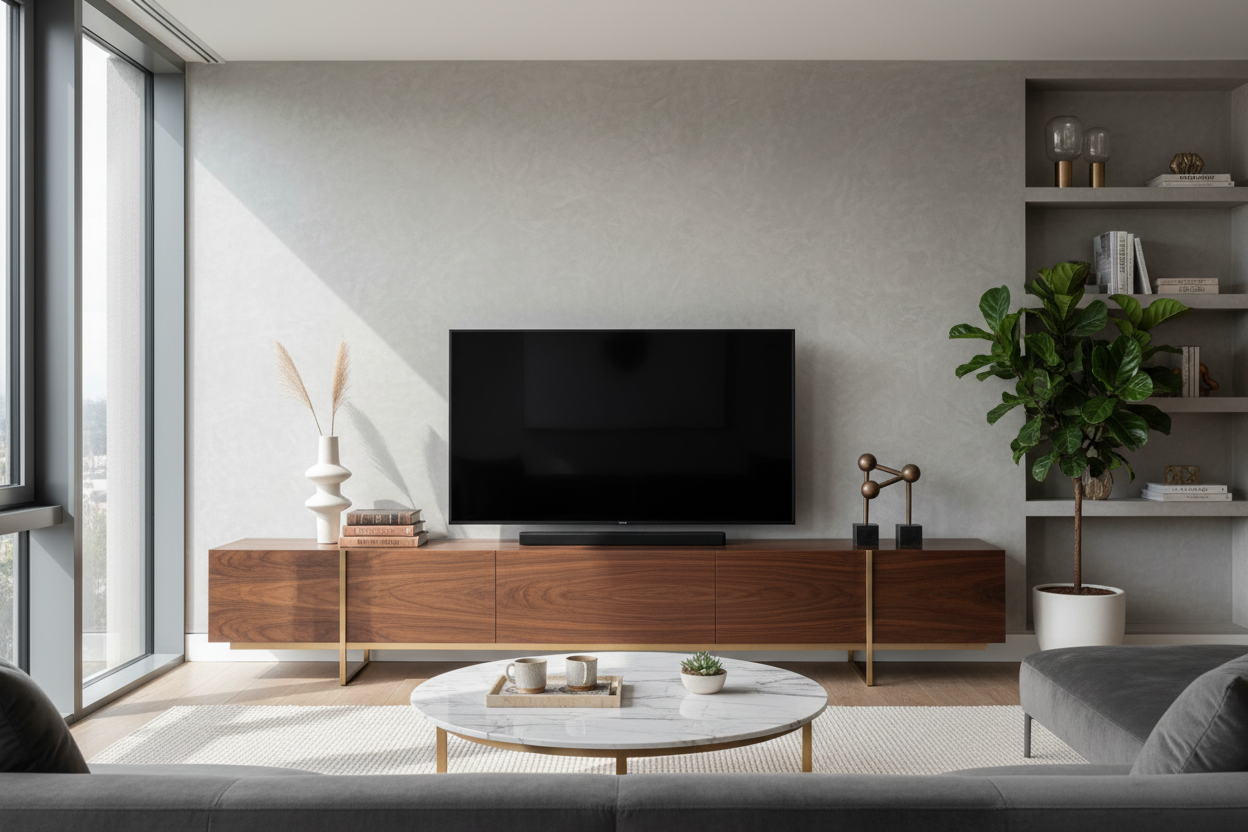
Most living rooms suffer from the same design flaw: the media wall feels like an afterthought. You buy a beautiful sofa, layer in textured rugs, and then park your expensive television on a flimsy, undersized console that barely hides the router. If you want a living room that feels intentional and grounded, swapping that basic console for a sideboard tv stand is one of the most effective upgrades you can make.
Unlike shallow media units, sideboards offer substantial visual weight and massive hidden storage. In this guide, I will walk you through exactly how to size, style, and select a piece that handles your practical needs without looking like a dorm room leftover.
Quick Decision Guide
- Width rule: Your sideboard should be at least 20 to 25 percent wider than your television to maintain visual balance and avoid a top-heavy look.
- Viewing height: Aim for a piece that is 24 to 30 inches tall so the center of your screen sits at eye level when you are seated on the sofa.
- Ventilation: Closed cabinetry requires breathable backing or slotted doors to prevent media components from overheating.
- Cable management: True media sideboards have pre-drilled holes; standard dining sideboards will require you to drill your own routing paths.
Getting the Proportions Right
The Width Equation
When sourcing sideboards for under tv setups, the most common mistake I see is matching the width of the furniture to the width of the screen. This creates a top-heavy, "lollipop" silhouette that feels unstable. Instead, you want the furniture to anchor the wall. If you have a 65-inch TV (which is roughly 57 inches wide), look for tv sideboards that are at least 70 to 80 inches wide. The negative space on either side gives you room for a structural table lamp or a trailing plant to soften the hard edges of the screen.
Height and Ergonomics
Standard dining buffets are often 34 to 36 inches tall, which is generally too high for comfortable viewing from a standard 18-inch sofa seat. Straining your neck to binge-watch a series ruins the experience. Look for a dedicated sideboard tv cabinet that sits closer to 24 to 30 inches high, ensuring the screen is positioned in your natural line of sight.
Material Quality and Daily Function
Solid Wood vs. Veneer
When shopping for a tv cabinet and sideboard combination, material dictates both longevity and maintenance. Solid oak or walnut offers incredible durability and can be sanded down if scratched by a rogue gaming controller. High-quality wood veneers over an MDF core are also highly stable and less prone to warping from the heat of electronics. Avoid paper-thin laminates, which tend to peel quickly at the edges under heavy daily use.
The Ventilation Factor
A heavy, solid wood sideboard entertainment center looks beautiful, but modern electronics generate significant heat. If you are storing gaming consoles or receivers, you need airflow. Rattan, cane, or slatted wood doors are fantastic for letting heat escape and allowing infrared remote signals to pass through without forcing you to keep the doors open.
Lessons from My Own Projects
Early in my career, I found a stunning vintage mid-century credenza and convinced my clients to use it as a sideboard and tv unit. It had gorgeous sliding teak doors and massive storage capacity. We excitedly set up the room, drilled a small hole in the back for the power strip, and loaded in the cable box and receiver.
Within three days, I got a call. The receiver had completely overheated and shut down because the airtight vintage craftsmanship allowed zero airflow. Furthermore, the clients had to leave the beautiful teak doors wide open just to use their remote controls. I learned the hard way that retrofitting a dining piece requires serious modifications. We ended up having a custom carpenter replace the back panel with a vented mesh and installing an IR repeater. It was an expensive lesson: if you buy a standard piece instead of a dedicated sideboard tv unit, be prepared to do some structural problem-solving.
Frequently Asked Questions
Can any sideboard be used as a TV stand?
Technically yes, but it requires work. A standard dining buffet will not have wire routing holes or ventilation. If you want a plug-and-play solution, buy a piece specifically manufactured as a sideboard cabinet tv stand. If you use a vintage piece, you must drill your own holes and manage internal temperatures.
How do I style a sideboard with tv unit setups?
Keep it asymmetrical. If your TV is mounted or sitting dead center, place a tall element (like a ceramic lamp or a vase with tall branches) on one side, and a low, heavy element (like a stack of design books or a low bowl) on the other. This balances the stark visual weight of the black screen.
Do tv stands and sideboards work in small apartments?
Absolutely. In a tight space, multi-functional furniture is critical. A deep sideboard provides a massive amount of hidden storage for things completely unrelated to your TV, like winter coats, extra dishware, or board games, making it far more practical than a shallow, open-shelf media console.


Leave a comment
This site is protected by hCaptcha and the hCaptcha Privacy Policy and Terms of Service apply.