










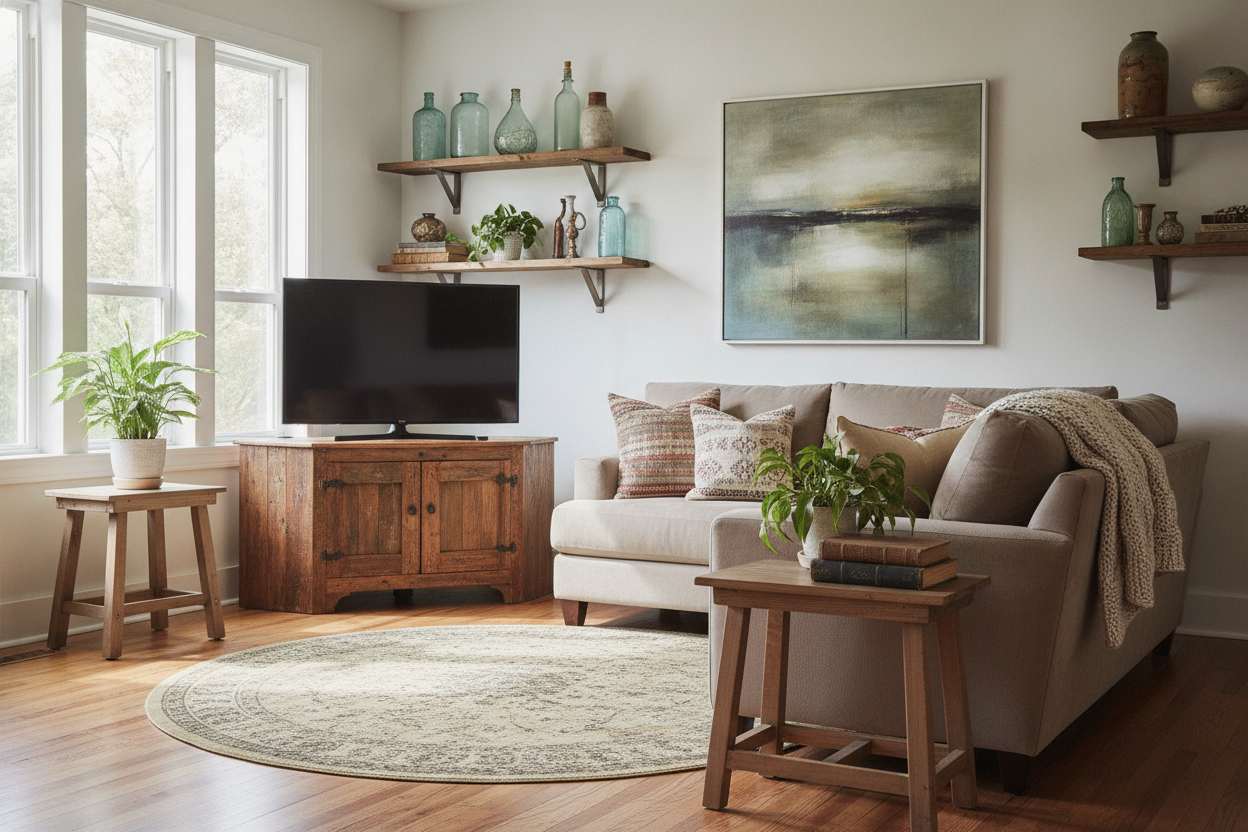
I’ve spent too many Sunday afternoons surrounded by Allen keys and sawdust, only to realize the $200 'oak' console I just built is actually compressed paper. It looks fine for about six months until the weight of a 65-inch screen starts to make the top shelf bow like a tired bridge. If you're tired of furniture that feels like it’s one move away from a landfill, it's time to start looking for a corner tv stand used.
We've all been there: staring at 47 browser tabs at 1 AM, trying to figure out if a 'wood-effect' finish is going to look cheap next to your actual rug. Spoiler: it always does. The solution isn't spending a month's rent on a designer piece; it's hunting down the solid wood gems people are practically giving away because they’re 'outdated.'
- Solid wood beats particle board every single time for durability.
- You can save 70-90% off the original retail price by going pre-owned.
- Older units are often deeper, providing better stability for large screens.
- Used furniture is already 'off-gassed' and better for your indoor air quality.
- Customizing a thrifted piece is easier and more rewarding than assembling a flat-pack.
Why I Finally Gave Up on Flat-Pack Furniture
There is a specific kind of heartbreak that comes from moving a flat-pack media console. You lift one end, hear a sickening 'crunch,' and realize the cam-lock has ripped right through the MDF. I’ve owned three of those 'modern' stands in five years, and none of them survived a U-Haul trip. They are designed to be disposable, and quite frankly, your tech deserves better.
When you look at the cost of buying brand new tv stands made of actual hardwood, the prices are eye-watering. You’re often choosing between a $150 box of sawdust or a $1,200 heirloom. There is no middle ground in the big-box stores anymore. The particle board stuff sags under the weight of a modern receiver, and the 'veneer' peels if you so much as spill a drop of water. I’m done with it. I want furniture that can handle a move, a spill, and a heavy TV without flinching.
The Undeniable Perks of Buying a Corner TV Stand Used
The biggest win when you buy a corner tv stand used is the material quality. Twenty years ago, even 'mid-range' furniture was often built with solid pine, oak, or maple. These pieces are heavy, sturdy, and built to last decades, not semesters. You’re getting a $800 build quality for the price of a takeout dinner.
Then there’s the environmental factor. The furniture industry is a massive contributor to deforestation and landfill waste. By rescueing a second hand corner tv stand, you’re keeping high-quality lumber out of the dump. Plus, these older pieces have already done their off-gassing. You won't have that chemical 'new furniture' smell lingering in your living room for weeks.
Finally, let’s talk about the 'wedge.' Corner units are inherently awkward to ship, which is why modern versions are often so flimsy—they have to be light to keep shipping costs down. Older units were built to be furniture first and 'shippable items' second. They have the depth and weight-bearing capacity that modern slim-profile units lack.
Mastering the Search for a Second Hand Corner TV Stand
Finding a second hand corner tv stand requires a bit of 'search term' karate. Sellers on Facebook Marketplace often don't know what they have. They might list a high-end Ethan Allen piece as 'brown cabinet' or 'corner table.' I always search for 'media cabinet,' 'corner hutch,' or even 'entertainment center' to find the hidden gems.
If you're looking for something specific, like mid century corner tv stand layouts, try searching for 'record cabinet' or 'stereo console.' Often, these vintage pieces have the perfect wedge shape to tuck into a corner, but they aren't labeled as TV stands because they pre-date the flat-screen era. Don't be afraid to look for 'ugly' finishes; a weekend with some 120-grit sandpaper and a fresh coat of paint can turn a dated oak eyesore into a custom focal point.
Spotting Good Bones vs. A Total Lost Cause
When you show up to a stranger’s driveway to inspect a piece, don't be shy. Open the drawers. If they glide on wooden tracks or have dovetail joints, you’ve found gold. If the drawers are stapled together and stick when you pull them, keep walking. You want to see real wood grain on the edges, not the tell-tale 'seam' of a laminate sticker.
Check the back panel. Most modern units use a piece of cardboard held on by tiny nails. A quality older piece will have a plywood or solid wood back. However, don't worry if the back is solid—you can easily modify it. Check the hinges on any doors; if they’re loose, see if the wood is stripped. Stripped wood is fixable with some toothpicks and wood glue, but a cracked frame is a dealbreaker.
Stability is king. Give the unit a literal 'shove test.' If it wobbles or leans, the joints are failing. If it feels like a rock, it’s worth the effort of hauling it home. Remember, you can replace hardware like knobs and pulls in five minutes, so focus on the structure, not the shiny bits.
Making an Older Piece Work for Modern Tech
The biggest hurdle with older corner units is cable management. They were built for VCRs and heavy tube TVs, not slim OLEDs and mesh routers. I always keep a 2-inch hole saw attachment for my drill handy. Drilling a clean hole in the back of a solid wood cabinet is satisfying and allows you to hide all those ugly black cords.
If the piece feels too 'heavy' for your room, consider styling an antique corner tv stand with modern elements. Swap out the brass hardware for matte black pulls, or paint the interior of the shelves a contrasting color. This blends the 'old world' durability with your 'new world' tech. I’ve found that a dark, moody charcoal paint can make a 1990s oak cabinet look like a high-end custom build from a boutique showroom.
My Biggest Thrifting Fail
I once bought a massive, solid oak corner unit for $20. I was so excited about the price that I didn't measure my car. I spent two hours in a Home Depot parking lot trying to Tetris a 100-pound cabinet into a Honda Civic. I eventually had to call a friend with a truck and pay them $40 in gas and beer. The 'cheap' stand ended up costing me more in time and favors than if I’d just been prepared. Measure your space, then measure your car. Twice.
FAQ
Will a new 65-inch TV fit on an old corner stand?
Usually, yes, but watch the 'feet.' Modern TVs have wide-set legs. Measure the distance between the TV's legs and compare it to the widest part of the stand's top surface. If the TV has a center pedestal stand, you're almost always safe.
Is it hard to paint an old TV stand?
Not if it's real wood. Scuff it with sandpaper, use a good primer, and use a cabinet-grade paint. If it's laminate, it's a nightmare—which is why I tell people to stick to solid wood.
How do I get the 'old furniture' smell out?
Wipe it down with a 50/50 mix of white vinegar and water. If the smell persists, leave a bowl of baking soda or coffee grounds inside the cabinets for 48 hours. It works wonders.

Leave a comment
This site is protected by hCaptcha and the hCaptcha Privacy Policy and Terms of Service apply.