










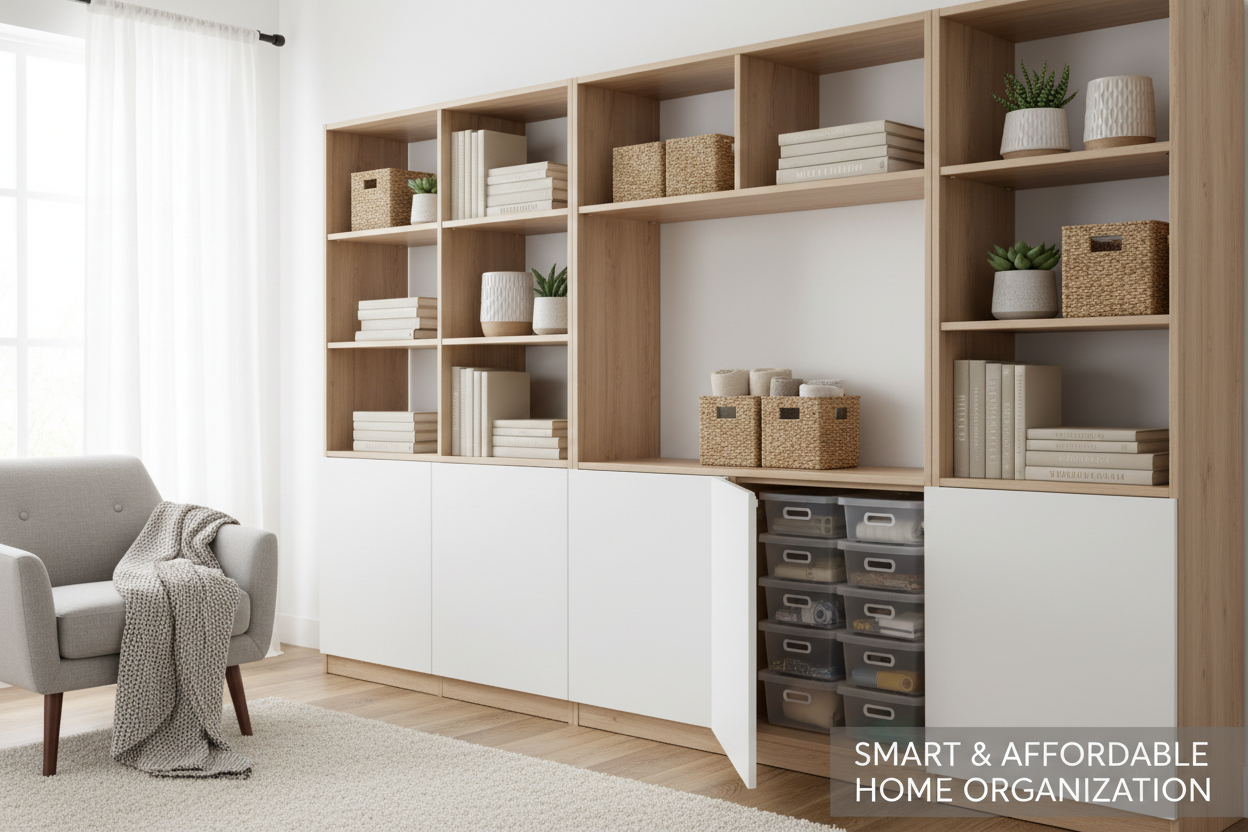
Clutter has a way of expanding until it consumes every horizontal surface in a home, and the standard solution—buying new furniture—often feels like trading one headache for a financial one. You shouldn't have to drain your savings account just to find a place to put your linens, pantry overflow, or tools. Finding affordable storage cabinets that don't collapse under the weight of a few towels is entirely possible, but it requires looking past the price tag and understanding construction methods. The goal is to identify pieces that balance cost with structural integrity.
I learned this lesson the hard way a few years ago when organizing my laundry room. I bought the absolute lowest-priced unit I could find online without checking the material specifications. It was a shaky, particle-board disaster that started bowing the moment I placed detergent bottles on the shelf. I eventually replaced it with a slightly more robust, yet still cheap storage cabinet from a scratch-and-dent outlet. The difference wasn't the price—it was knowing that I needed reinforced shelving and adjustable feet for an uneven floor. That experience taught me that "budget-friendly" doesn't have to mean "disposable" if you know what to look for.
Material Matters: What to Expect at Lower Price Points
When you are hunting for inexpensive storage cabinets, you are generally choosing between three main materials: particle board, MDF (Medium Density Fiberboard), and light-gauge metal. Understanding the limitations of each is the key to longevity. Particle board is the most common material for low price storage cabinets. It consists of wood chips glued together. It is perfectly functional for dry environments like a bedroom or hallway, but it is the enemy of moisture. If you place a standard particle board unit in a damp basement or right next to a shower, it will swell and crumble within a year.
MDF offers a smoother finish and is denser than particle board, making it a step up for painting and durability. However, for heavy-duty needs, like a garage or workshop, metal is superior. Even thin metal cabinets can hold significant weight and are impervious to humidity. If you spot storage cabinets deals on metal lockers or utility units, grab them for your non-climate-controlled spaces. They might dent, but they won't disintegrate.
Expanding Your Pantry with Closed Units
The kitchen is often the most critical zone for organization, yet custom cabinetry costs a fortune. A smart workaround is using standalone, closed cabinets for kitchen use. These are freestanding units that mimic the look of built-ins but cost a fraction of the price. If your kitchen lacks a pantry, a tall, two-door cabinet can swallow an immense amount of cereal boxes, canned goods, and small appliances.
When selecting cabinet cheap storage for kitchen areas, pay close attention to the depth. Standard kitchen counters are 24 inches deep, while many budget cabinets are only 12 to 15 inches deep. This shallower depth is actually an advantage for food storage because things don't get lost in the back. Look for units with adjustable shelving so you can accommodate tall cereal boxes and short soup cans in the same vertical space. White or faux-wood finishes can blend seamless with existing joinery, making the unit look like an intentional part of the kitchen design rather than an afterthought.
Where to Find the Best Bargains
Big-box furniture stores are the obvious first stop, but they aren't the only place to find discount storage cabinets. To get better quality for your dollar, check the "as-is" sections of major retailers. These items are often fully assembled and significantly marked down because of a minor scratch on a side panel that will likely be hidden against a wall anyway. This is a prime strategy for getting a mid-range cabinet at a budget price.
Another often-overlooked source is office liquidation sales. Businesses often offload heavy-duty filing cabinets and storage lockers for pennies on the dollar when they move or renovate. These units are built for commercial use, meaning they are far more durable than the cheap cabinets for storage you might find in a residential catalog. A coat of spray paint can easily transform a drab beige office cabinet into a chic industrial piece for your living room.
The Assembly Secret: Glue and Brackets
If you buy a flat-pack unit, the way you assemble it dictates its lifespan. Most affordable storage cabinets rely on cam locks and wooden dowels. These are sufficient for holding the piece together, but they don't provide much rigidity. Here is the trick to making a thirty-dollar cabinet feel like a three-hundred-dollar one: wood glue.
During assembly, apply a bead of wood glue to every dowel and along the raw edges where panels meet before tightening the screws. This bonds the frame into a solid unit rather than a collection of loose parts. Additionally, tossing out the flimsy cardboard back panel and replacing it with a thin sheet of plywood (even 1/4 inch thick) will stop the cabinet from racking or wobbling. These small modifications turn a flimsy purchase into a sturdy fixture.
Aesthetic Upgrades for Basic Cabinets
The hardware that comes with budget furniture is usually plastic or lightweight alloy. Swapping these out is the fastest way to elevate the look of inexpensive storage cabinets. Buying heavy, matte black handles or brushed brass knobs can instantly change the character of the piece. It draws the eye to the hardware rather than the laminate finish.
You can also use peel-and-stick wallpaper on the back panel or the shelves themselves. If you have a cabinet with glass doors, lining the back with a patterned paper creates a custom look. For solid doors, applying architectural molding or trim before painting can mimic the shaker style found in high-end kitchens. With a little creativity, no one needs to know you scored a massive discount on the furniture.
Safety and Anchoring
Lightweight materials mean that budget cabinets are more prone to tipping over, especially when the doors are open or if they are loaded with heavy items on top. Regardless of where you buy your low price storage cabinets, securing them to the wall is non-negotiable. Most units come with a basic strap, but buying a metal L-bracket and anchoring it into a wall stud provides much better security. This is especially vital in homes with children or pets, or if you live in an earthquake-prone area. A stable cabinet is a functional cabinet.
Frequently Asked Questions
How much weight can a typical budget storage cabinet hold?
Most standard particle board shelves are rated for 25 to 50 pounds each. However, this weight needs to be distributed limits evenly. If you plan to store heavy items like canned goods or tools, look for metal units or cabinets with reinforced shelves, as overloading particle board will cause it to sag permanently over time.
Can I paint laminate storage cabinets?
Yes, but you cannot use standard wall paint directly on laminate because it will peel off. You must first lightly sand the surface to create a "key" or rough texture, then apply a high-quality bonding primer specifically designed for glossy surfaces. Once primed, you can use acrylic or enamel paint for a durable finish.
What is the difference between freestanding and wall-mounted storage cabinets?
Freestanding cabinets rest on the floor and are easier to install and move, making them ideal for renters or heavy items. Wall-mounted cabinets free up floor space and offer a cleaner look but require secure installation into wall studs to handle the weight of the cabinet plus its contents.


Leave a comment
This site is protected by hCaptcha and the hCaptcha Privacy Policy and Terms of Service apply.