










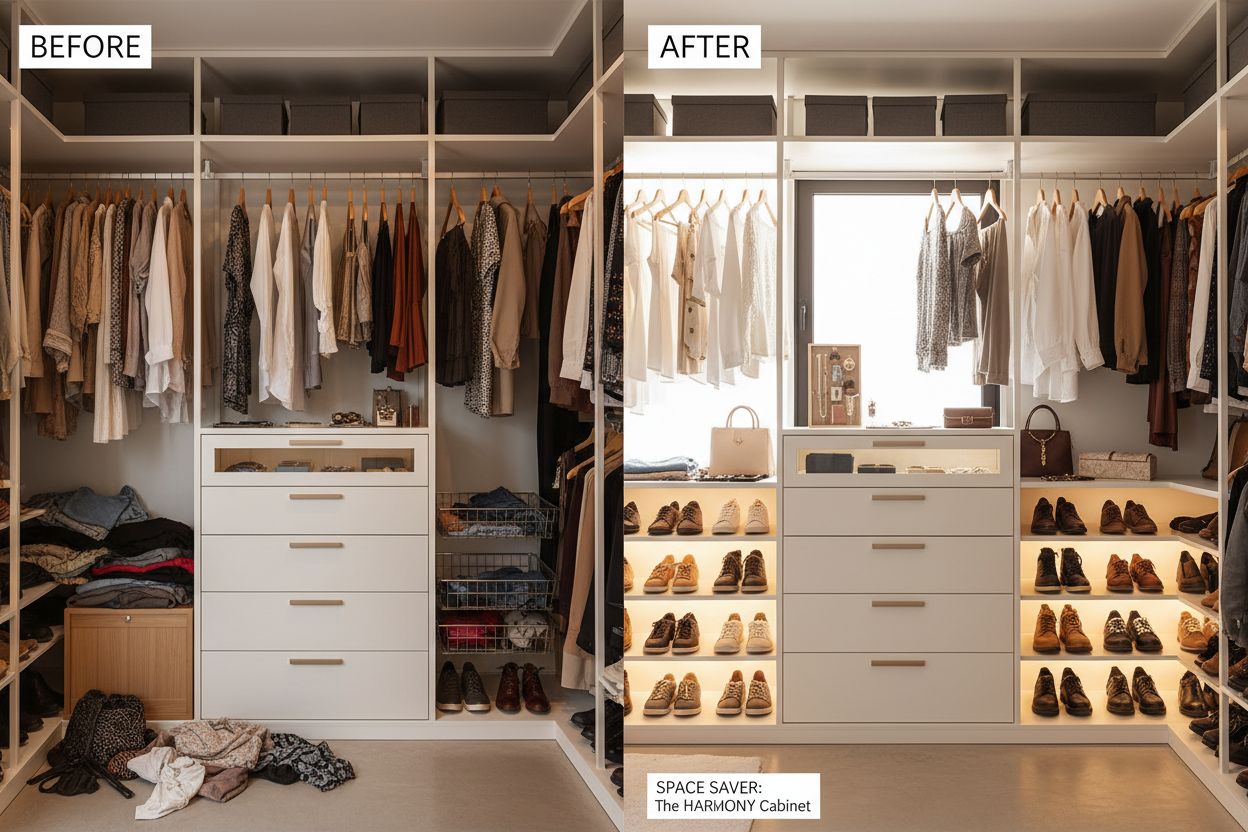
Most people look at their closet and see the hanging clothes, but they completely ignore the most valuable real estate available: the floor. Specifically, the empty void beneath your shorter hanging items like shirts, jackets, and folded trousers. This area usually becomes a graveyard for mismatched shoes, gym bags, or dust bunnies. The most effective way to reclaim this area isn't another hanging organizer or a flimsy shoe rack—it is adding a dedicated small cabinet for closet interiors.
Integrating a piece of furniture inside another space might seem counterintuitive if you are trying to save room, but it actually creates defined boundaries for your clutter. A freestanding unit provides a solid surface for stacking and distinct zones for loose items that otherwise get lost in the abyss of a large wardrobe. Whether you have a walk-in or a standard reach-in, placing a sturdy unit on the floor instantly upgrades the look from "storage locker" to "custom dressing room."
Identifying Your Closet's "Dead Zone"
Before you buy anything, you need to look at the vertical gap. Grab a tape measure and determine the distance from the floor to the bottom of your hanging clothes. In a standard setup, you usually have between 30 to 40 inches of clearance under a single rod holding shirts or blazers. This is the sweet spot. You want a unit that fits comfortably underneath the hems of your clothes without the fabric bunching up on the countertop.
Width and depth are equally critical. A common mistake is buying a unit that is too deep, preventing the closet doors from sliding or swinging shut. Standard closet depth is 24 inches, but the usable depth is often less due to door tracks or hinges. Ideally, you should look for a small storage cabinet for closet use that is no deeper than 18 to 20 inches. This ensures you have room to stand in front of it (if it's a walk-in) or that the doors close flush (if it's a reach-in).
Drawers vs. Open Shelving
Once you know your dimensions, the next decision is configuration. Open shelving is excellent for bulky items like sweaters or denim, where you need to see what you have at a glance. However, open shelves require constant maintenance to keep them looking tidy. If you are not a master folder, open shelves can quickly look chaotic.
For most people, a small cabinet with drawers for closet organization is the superior choice. Drawers hide a multitude of sins. They are perfect for the "unfoldables"—socks, underwear, swimwear, and accessories like belts or scarves. A drawer unit essentially adds a dresser to your closet, freeing up bedroom floor space. If you have a small bedroom, moving your primary storage for intimates into the closet can make your actual sleeping area feel twice as big.
My Experience with "Temporary" Solutions
I learned the value of a proper cabinet the hard way. For years, I relied on those cheap, three-tier plastic rolling carts to hold my workout gear inside my closet. I thought I was being frugal and practical. Within six months, the plastic drawers warped from the weight, the wheels gathered so much hair they stopped rolling, and the whole unit leaned precariously to the left. It looked terrible and made me hate opening my closet door.
I eventually replaced it with a white, wood-composite cabinet with three deep drawers. The difference was night and day. The solid top gave me a place to set out my jewelry for the next day, and the sturdy drawers meant I could actually fill them without the bottom falling out. It wasn't an expensive custom build, just a decent piece of furniture, but it made the closet feel finished. That mental shift from "storage bin" to "furniture" changed how I treated my clothes.
Material Selection and Aesthetics
Since this piece will live inside a closet, you might be tempted to go with the cheapest material available. While you don't need solid mahogany, you should avoid raw particle board or flimsy fabric bins if you want longevity. Melamine or laminated wood is usually the best middle ground. It is easy to wipe down, resists moisture (which can be an issue in closets near bathrooms), and mimics the look of built-in cabinetry.
If your closet is dark, opt for a white or light wood finish to reflect light. Closets rarely have adequate lighting, and a dark cabinet can turn the bottom half of your wardrobe into a black hole. If you are going for a boutique look, consider swapping out the standard knobs that come with the cabinet for decorative hardware. A five-dollar investment in gold or matte black handles can make a fifty-dollar cabinet look like a permanent installation.
Maximizing the Top Surface
The top of your small storage cabinet for closet setups is a functional space in its own right. It serves as a staging area. You can place a valet tray there for your watch and keys, a small mirror for last-minute checks, or organization trays for jewelry. If you have enough clearance between the cabinet top and your hanging clothes, you can even place a row of handbags or hats there.
This surface also helps with laundry day. Having a waist-high surface inside the closet allows you to fold items and place them directly into drawers without walking back and forth to the bed. It creates a self-contained ecosystem where you can get fully ready in one spot.
Installation and Assembly Tips
Most small cabinets will arrive flat-packed. When assembling a unit meant for a tight space, try to build the frame outside the closet but insert the drawers after moving the frame inside. Some closets have narrow doorways, and maneuvering a fully built cabinet with heavy drawers sliding out can be a nightmare / recipe for damaged drywall.
If you have baseboards inside your closet, the cabinet won't sit flush against the wall. This creates a gap where socks love to fall and disappear. You can solve this by either removing the section of baseboard where the cabinet sits (for a built-in look) or adding a small spacer block behind the cabinet to keep it stable and prevent it from rocking when you open a drawer.
Final Thoughts on Decluttering
Adding furniture to a closet forces a necessary purge. To fit the cabinet, you have to clear the floor. This is the perfect excuse to finally toss those shoes that hurt your feet or the backpack with the broken zipper. By introducing a rigid structure like a small cabinet for closet storage, you are setting physical limits on how much stuff you can keep. It stops the sprawl. Everything has a home—either on a hanger, in a drawer, or on a shelf—and if it doesn't fit, it might be time to let it go.
Frequently Asked Questions
Can I stack two small cabinets on top of each other?
Yes, but stability is a major concern. If you stack units, you must secure them together using mending plates and anchor the top unit to the wall to prevent tipping. Ensure the bottom unit is sturdy enough to support the weight of the top one plus its contents.
How do I prevent mold behind a closet cabinet?
Air circulation is key. Leave a small gap (about an inch) between the back of the cabinet and the wall, especially if the closet is on an exterior wall. Using moisture absorbers like silica gel packets or a small dehumidifier inside the closet can also help regulate humidity levels.
What is the standard width for a small closet cabinet?
There isn't a single standard, but most compact drawer units range between 16 and 24 inches wide. This width is generally narrow enough to fit into one side of a sliding door closet or sit between hanging sections in a walk-in without blocking traffic.


Leave a comment
This site is protected by hCaptcha and the hCaptcha Privacy Policy and Terms of Service apply.