











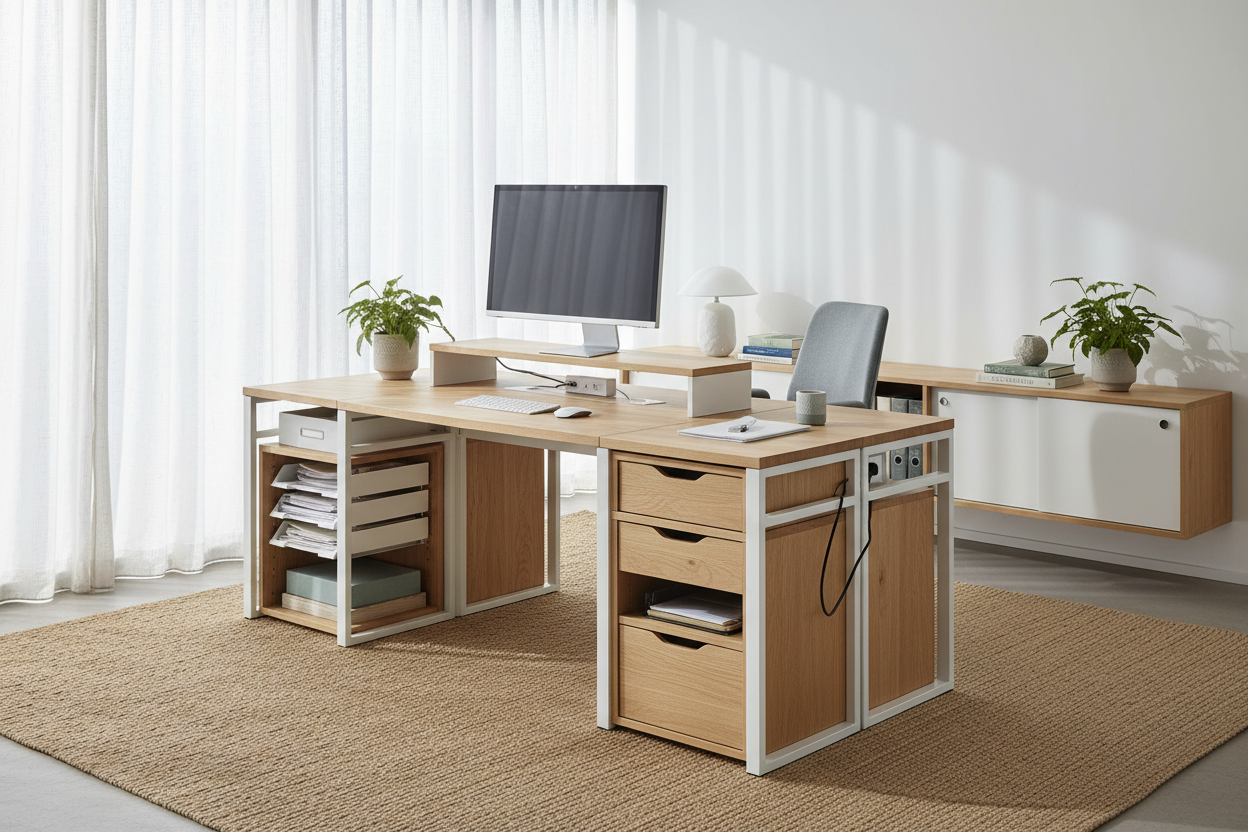
We've all been there: sitting down to tackle a Monday morning inbox, only to be entirely distracted by the chaotic pile of papers, chargers, and coffee mugs scattered across your workspace. When your desk feels overwhelmed, the entire room feels heavy. Adding a dedicated storage table for office use is often the missing puzzle piece that bridges the gap between a sterile corporate cubicle and a functional residential workspace. By the end of this guide, you will know exactly how to select a piece that hides the clutter without swallowing your square footage.
Quick Decision Guide
- Check the clearance: Always leave at least 36 inches between your primary desk and the storage table so your office chair can roll freely.
- Prioritize drawer hardware: Look for full-extension, soft-close metal glides. Cheap wood-on-wood tracks will stick and frustrate you daily.
- Match the visual weight: If you have a chunky, heavy executive desk, pair it with a lighter, leggy storage table to keep the room balanced.
- Consider wire management: If you plan to put a printer or charging station on top, ensure the table has pre-drilled grommets for cord control.
Space Planning & Layout Rules
Finding the Right Clearances
Most North American home offices are carved out of secondary bedrooms, meaning square footage is at a premium. When introducing a secondary surface, traffic flow is critical. If you are placing the storage table directly behind your desk as a credenza, you need a minimum of 36 inches—ideally 42 inches—of clearance. This allows you to push your chair back comfortably without dinging the furniture.
If the table is going against a side wall, pay attention to the depth. A standard storage table runs between 18 to 22 inches deep. Anything deeper than 24 inches starts to act like a secondary desk and will quickly crowd a standard 10x10 room.
Material Matters for Daily Use
Solid Wood vs. Engineered Solutions
The finish you choose dictates how the piece will age. Solid wood, particularly hard species like oak or walnut, offers incredible longevity and can be refinished down the line. However, it reacts to humidity changes typical in climates with forced-air heating.
High-quality engineered wood with a thick wood veneer is often a smarter choice for office environments. It resists warping and provides a smooth, consistent surface. Just beware of paper-thin veneers or melamine finishes if you plan to slide heavy printers or metal filing trays across the top—they will scratch, and you cannot sand them out.
Keeping It Professional Yet Personal
Managing Visual Weight
Your office should feel cohesive, but everything does not need to come from the same matching furniture set. In fact, mixing finishes creates a much more collected, high-end look. If your primary desk is a dark, heavy mahogany, balance the room by choosing a storage table with a lighter silhouette, perhaps one with slender metal legs or a painted finish.
Pay attention to negative space. A storage table that sits flush to the floor provides maximum drawer capacity but feels much heavier in the room. A piece raised on legs allows light to pass underneath, making a small home office feel significantly larger.
Designer's Honest Take
Over the last 15 years, I have designed dozens of home offices, and I have definitely made my share of mistakes. A few years ago, I specified a stunning, matte black oak storage table for my own workspace. It looked incredible in photos.
But here is the unpolished truth: the sharp, 90-degree edge profile was brutal on my wrists whenever I leaned over to sort documents. Worse, the matte finish was a magnet for fingerprints and dust. Every time I set down a slightly damp water glass, it left a temporary ring that gave me a minor heart attack. I also learned that shallow drawers are practically useless for modern office needs; if a drawer cannot comfortably fit a standard charging block or a stack of legal pads, it is just wasted space. Always measure the interior drawer height before buying.
Frequently Asked Questions
What is the ideal height for a storage table?
For optimal ergonomics and visual flow, a storage table or credenza should typically match the height of your main desk, which is usually around 29 to 30 inches. If you are using it purely as a display and standing-storage surface, a taller buffet height of 34 to 36 inches works beautifully.
Is a storage table good for small spaces?
Yes, provided you choose the right proportions. Look for narrow profiles (around 15 to 18 inches deep) and sliding doors instead of swinging doors. Sliding doors do not require extra clearance to open, making them perfect for tight walkways.
How do I organize the inside of the table?
Do not let the inside become a junk drawer. Use acrylic or bamboo drawer dividers for small supplies like pens and paperclips. For deeper cabinets, incorporate stackable letter trays and dedicated baskets for tech accessories to maximize vertical space.

Leave a comment
This site is protected by hCaptcha and the hCaptcha Privacy Policy and Terms of Service apply.