










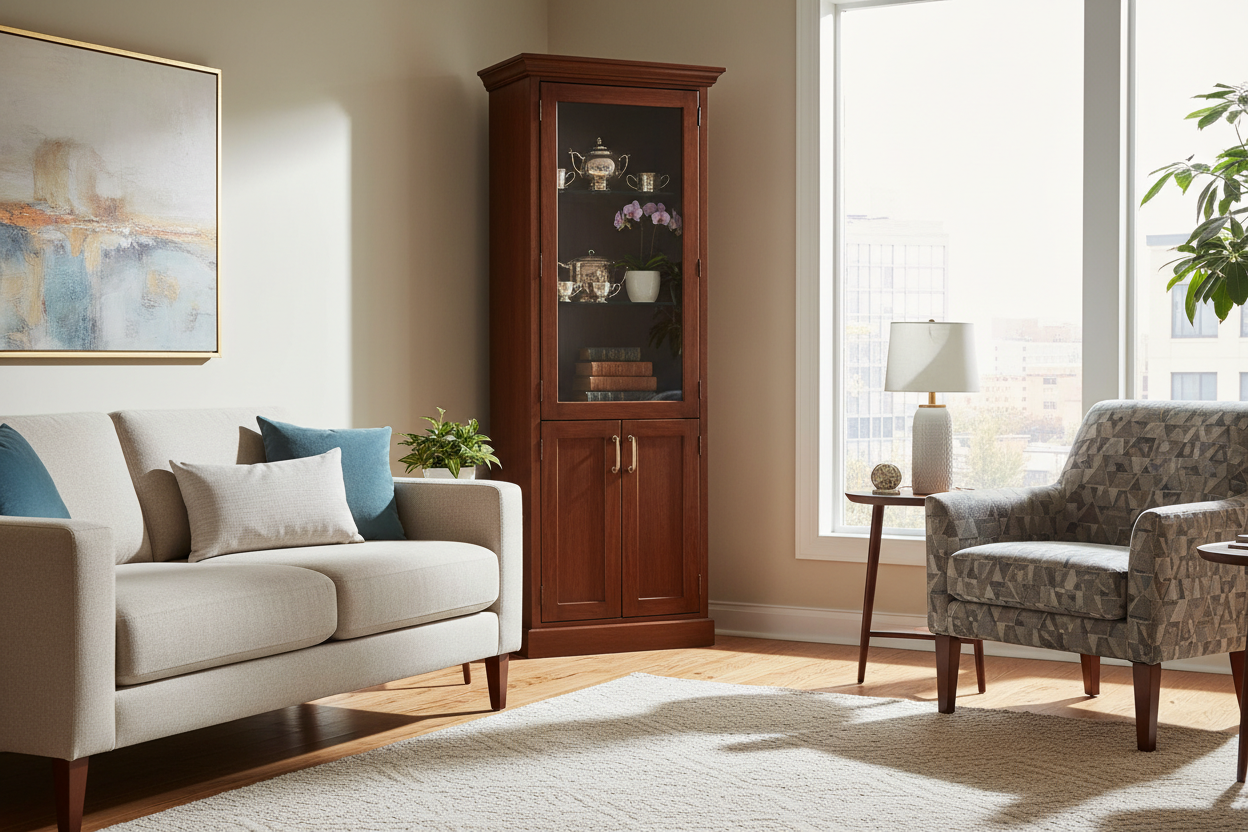
Every home has one: that awkward twelve-inch gap between the bathroom vanity and the wall, or the empty sliver of hallway that feels entirely wasted. You want storage, but standard furniture simply will not fit. That is exactly where a tall narrow cabinet canada becomes a lifesaver. Rather than letting those awkward alcoves gather dust, you can use verticality to your advantage. By the end of this read, you will know exactly how to choose, scale, and style a slim cabinet that actually works for your home.
Quick Decision Guide
- Measure baseboards first: Always account for the depth of your baseboards, as slim cabinets need to sit flush against the wall to prevent tipping.
- Anchor everything: Any cabinet taller than 36 inches with a narrow footprint must be secured to a wall stud.
- Mix open and closed storage: A solid tower of doors can feel heavy; opt for glass uppers or open middle shelves to break up the visual mass.
- Check door swing clearance: Ensure you have at least 15 inches of clearance in front of the cabinet so doors can open fully in tight hallways.
Mastering Vertical Space Planning
When dealing with North American floor plans, particularly in urban condos or older suburban homes, floor space is a premium commodity. A tall, slim cabinet draws the eye upward, making low ceilings feel slightly higher while utilizing square footage that usually goes ignored.
Understanding Clearances
The biggest mistake I see clients make is forgetting the operational footprint. It is not just about whether the cabinet fits into the gap. If you are placing a unit in a narrow hallway, you need to account for the door swing. A good rule of thumb is to measure the depth of the cabinet door and add a minimum of 18 inches for comfortable human clearance while accessing the shelves.
Material Choices and Security Needs
Slim profile furniture is inherently top-heavy. If you are shopping for a tall narrow cabinet in Canada, the material dictates both the stability and the lifespan of the piece. Solid wood offers excellent anchoring weight at the base, while metal units bring an industrial edge and extreme durability.
Adding Secure Storage
Sometimes these cabinets serve a highly specific, functional purpose. If you are storing medications in a bathroom or sensitive documents in a home office, you might actually be looking for a locking cabinet canada. Many modern slim cabinets now come with discreet, built-in locks that blend seamlessly into the hardware, providing peace of mind without looking like a sterile office filing system.
Styling Your Slim Cabinet
Because these pieces are so tall and thin, they can easily look like awkward pillars if not styled correctly. The goal is to integrate the cabinet into the room's architecture.
Balancing Visual Weight
If your cabinet is entirely closed off with solid wood doors, it will carry a lot of visual weight. To soften this, place a textured runner on the floor leading up to it, or hang a piece of art on the adjacent wall to widen the focal point. If the cabinet has glass doors, keep the internal styling intentional: stack neutral towels, display a few ceramic pieces, and leave at least thirty percent of the shelf space empty to let the piece breathe.
Designer's Honest Take
I will be the first to admit that narrow cabinets can be incredibly frustrating if you buy cheap materials. A few years ago, I sourced a stunning, matte black engineered-wood tall cabinet for a client's tiny Toronto townhouse. It looked fantastic on installation day.
However, I learned a hard lesson about high-traffic narrow spaces. Because the hallway was tight, coats and bags constantly brushed against the bottom edge of the cabinet. Within six months, the veneer started peeling at the corners. Furthermore, because it was lightweight engineered wood, the cabinet wobbled every time the heavy top door was pulled open, even with the wall anchor installed. I ended up swapping it out for a solid oak piece with a wider base and a slightly tapered top. It cost twice as much, but the stability and wear-resistance were non-negotiable. If you are buying a tall, skinny piece of furniture, do not skimp on the build quality.
Frequently Asked Questions
How wide is considered a narrow cabinet?
In the furniture industry, a narrow cabinet typically ranges from 12 to 18 inches in width. Anything wider than 18 inches starts to fall into standard shelving or linen closet territory.
Do I really need to anchor a tall narrow cabinet?
Absolutely. Due to their high center of gravity and small footprint, these cabinets are highly prone to tipping. Always use the provided anti-tip hardware and secure it directly into a wall stud, not just drywall.
Can I use a narrow cabinet in a bathroom?
Yes, but material matters. Bathrooms experience wild humidity fluctuations. Avoid cheap particleboard, which will swell and warp. Look for solid wood treated with a water-resistant sealant, or powder-coated metal options.


Leave a comment
This site is protected by hCaptcha and the hCaptcha Privacy Policy and Terms of Service apply.