










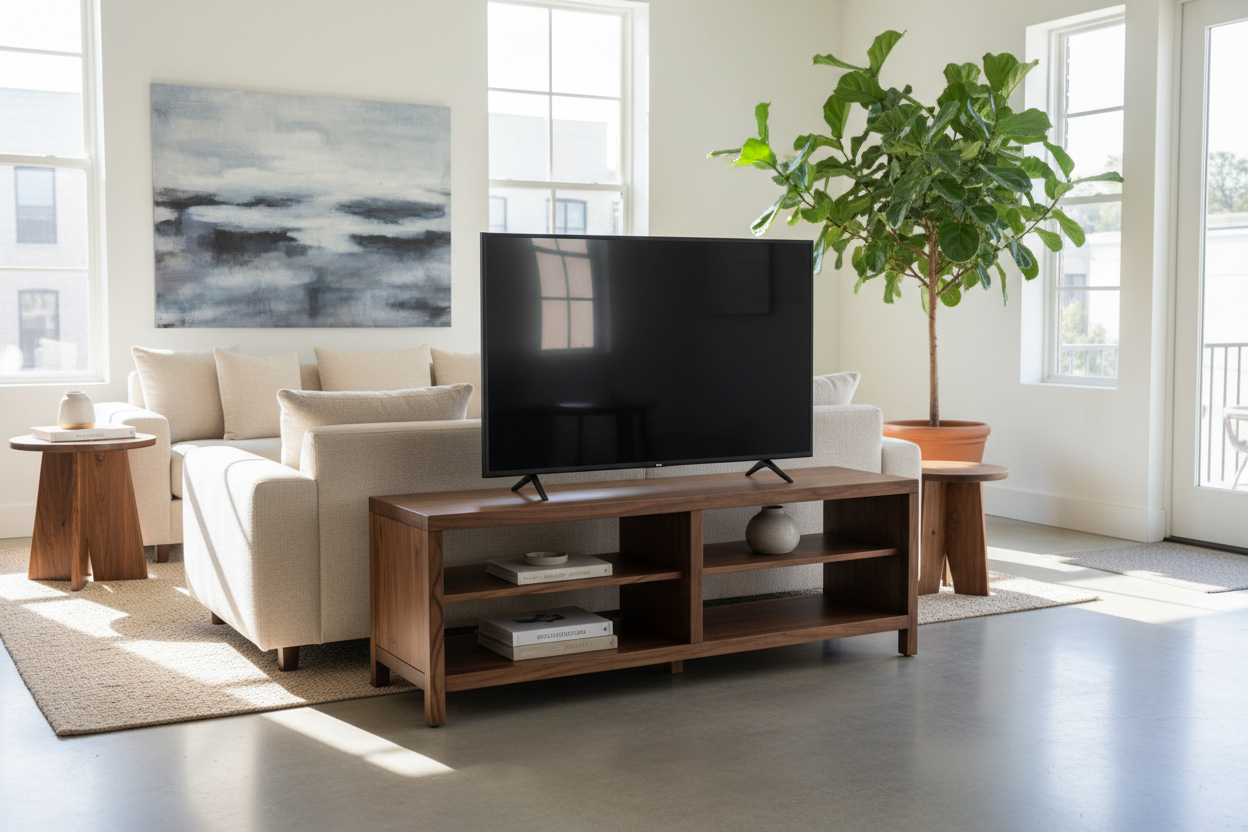
I recently watched a friend drop two grand on a stunning 75-inch OLED, only to perch it on a flimsy particle-board unit he had owned since his first apartment. It looked like a bodybuilder standing on a toothpick. Choosing a wood tv stand isn't just about finding a finish that matches your coffee table; it is about physics, visual weight, and saving your neck from a lifetime of strain.
Quick Takeaways
- Your stand should be at least 25% wider than the actual width of your TV.
- The center of the screen must stay at eye level (usually 42 inches from the floor).
- Solid wood is non-negotiable for heavy tech to prevent the 'sagging shelf' look.
- Small rooms need vertical decor to balance out narrower consoles.
The 'Lollipop Effect' Is Ruining Your Living Room
We have all seen it: a massive 65-inch screen overhanging a tiny, 50-inch console. Designers call this the 'Lollipop Effect.' It makes the entire room feel top-heavy and unstable, as if the slightest breeze might send your expensive tech tumbling. A television should never be the widest thing on its wall segment.
The goal is to ground the screen. You want wood tv stands that act as an anchor, providing a visual base that feels sturdy enough to support the weight. Before you browse through wood tv stands, grab a tape measure. Don't look at the diagonal screen size advertised on the box—measure the actual physical width of the frame from left to right. That number is your starting point, not your ending point.
Rule 1: The 'Plus 25 Percent' Width Formula
If your TV is 50 inches wide, do not buy a 50-inch stand. You need breathing room. I follow the 'Plus 25 Percent' rule: your console should be at least 25% wider than the TV itself. For a 60-inch wide screen, you are looking for a 75-inch console. This extra space on the ends prevents the TV from looking like it is suffocating the furniture.
Finding a proper long tv stand wood design allows you to place a small lamp or a couple of books on the ends. This creates a 'ledge' that eases the transition from the wall to the screen. If the TV is flush with the edges of the stand, the whole setup looks accidental and cramped. A long, low profile is almost always more sophisticated than a boxy, short one.
Rule 2: What If You Only Have Room for a Small Wood TV Cabinet?
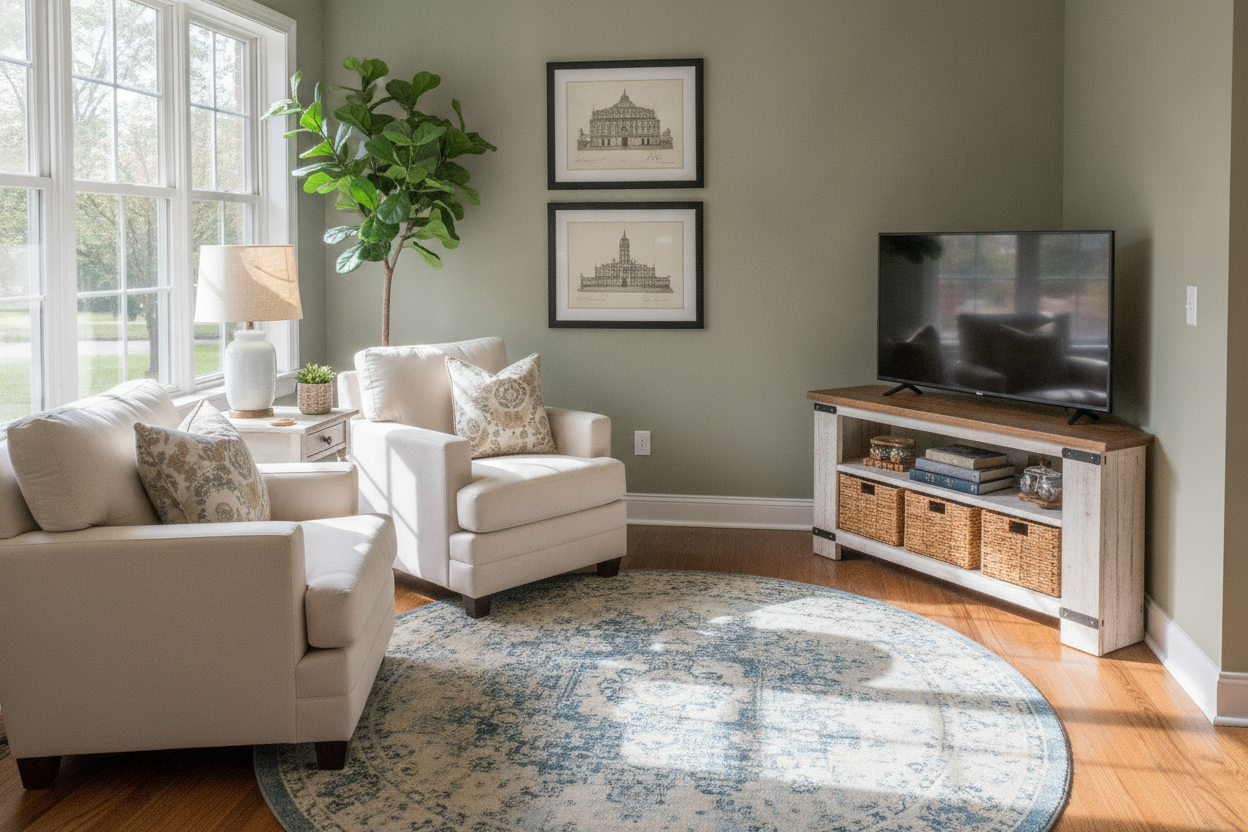
I get it—not everyone has an eight-foot wall to play with. If you are in a tight apartment and a small wood tv cabinet is your only option, you have to trick the eye. You can't change the width of the furniture, but you can change the width of the 'moment.' Use an asymmetrical gallery wall or a tall floor plant on one side to extend the visual footprint of the stand.
When space is tight, quality matters more than ever. I'm a firm believer in investing in solid wood furniture for small pieces. Cheap, hollow-core cabinets look like toys when a heavy TV is placed on top. A dense, heavy wood like oak or walnut has the visual 'heft' to hold its own against a large black screen, even if the cabinet itself is compact.
Rule 3: Height Matters Just as Much as Width
The biggest mistake people make is buying a stand that is too tall. If you are sitting on a standard sofa (where your seat height is 18-20 inches), the center of your TV should be about 42 inches from the floor. Most people buy dining-height sideboards and wonder why they have a headache after two episodes of a Netflix binge. A simple tv stand wood unit should usually sit between 18 and 24 inches high.
Don't repurpose a tall dresser unless you have a very high bed. If you choose a low-profile unit, you can style a simple wood tv stand with a few intentional items—think a low ceramic bowl or a tray—without cluttering the screen's field of view. Keep it clean, keep it low, and keep your chiropractor out of the equation.
When a Basic Console Isn't Enough to Anchor the Room
In a massive open-concept living room, a lone wood tv table can look like a postage stamp on a billboard. If your wall is over 15 feet long, a standard wood entertainment stand might not have enough presence to ground the space. This is the one scenario where you should scale up significantly.
A full wood tv entertainment center can turn a vast, empty wall into a focal point. I have seen this modern wood tv entertainment center work perfectly in lofts because it uses vertical and horizontal space to frame the TV. It stops being a 'TV on a stand' and starts being a built-in architectural feature. If the room feels cold and cavernous, go for the multi-piece unit.
Personal Experience: The Bowing Shelf Lesson
Years ago, I bought a 'mid-century' style stand made of thin MDF. It looked great for exactly two months. Then, the weight of my 55-inch TV and a heavy vintage receiver caused the top shelf to bow. It developed a 1-inch dip in the middle that made everything look crooked. I tried to fix it with a center support leg, but the damage was done. Now, I only buy kiln-dried hardwood. It’s heavier to move, sure, but it doesn't surrender to gravity. My current walnut stand has held the same TV for five years without moving a millimeter.
FAQ
How much wider should a TV stand be than the TV?
Aim for at least 3 to 6 inches of space on either side of the TV frame. This usually means the stand is 10 to 12 inches wider than the TV's physical width.
Can I use a dresser as a TV stand?
Only if it's low. Most dressers are 30-36 inches tall, which is too high for comfortable viewing from a sofa. It works for a bedroom where you are viewing from a higher mattress, though.
What wood is best for a TV stand?
Hardwoods like oak, walnut, and maple are best. They handle the heat from electronics well and won't sag under the weight of a large screen and soundbar.


Leave a comment
This site is protected by hCaptcha and the hCaptcha Privacy Policy and Terms of Service apply.