










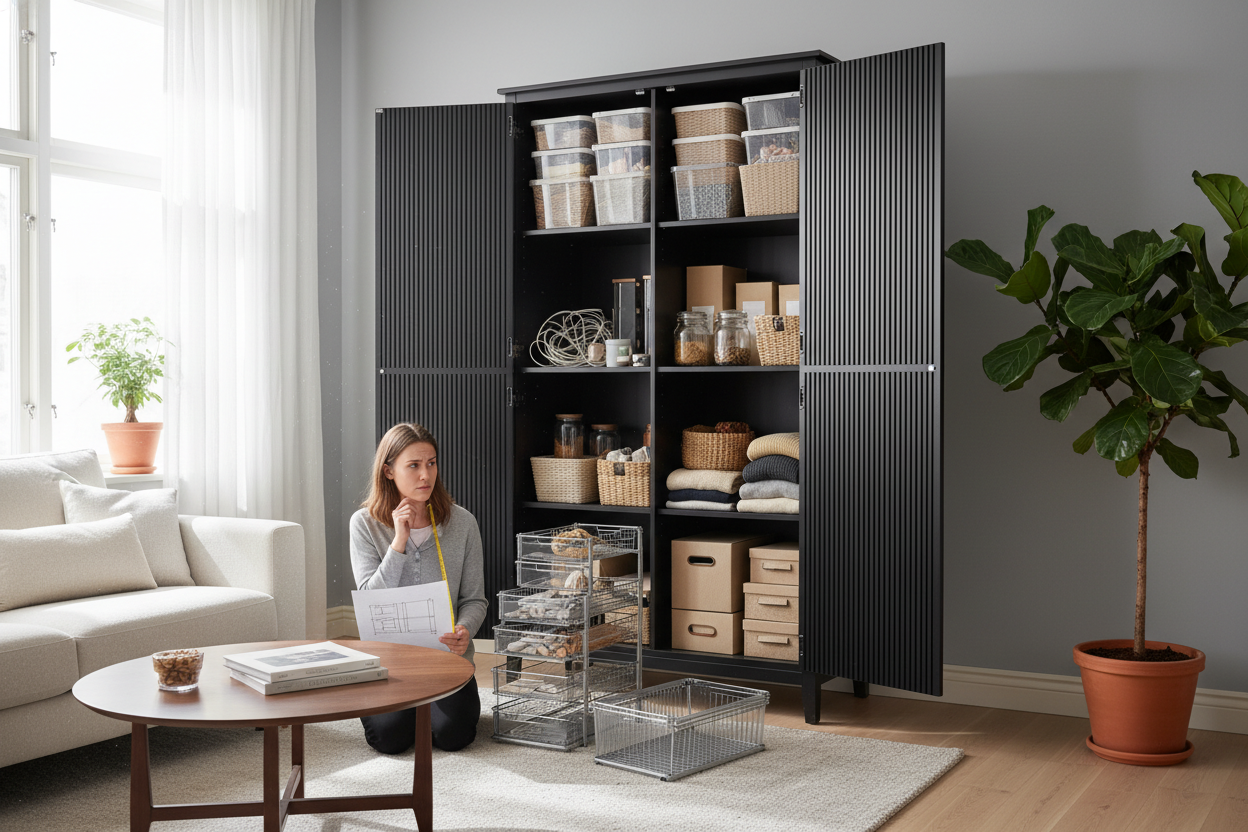
I was staring at my kitchen counter at 2 AM, and it looked like an appliance graveyard. Between the air fryer, the stand mixer I use twice a year, and a mountain of mismatched Tupperware, I was drowning. My solution felt obvious: buy the biggest, most massive deep storage cabinet I could find to hide the mess. I wanted something with enough volume to swallow my clutter whole.
I ended up with a beast of an extra deep storage cabinet. It was 24 inches deep—the same depth as a standard kitchen base cabinet. On paper, it was the perfect fix. In reality, I quickly realized that sheer volume is a double-edged sword. Within a week, my new extra deep cabinet became a dark abyss. I was losing things in the back, double-buying spices I couldn't find, and literally bruising my shoulder trying to reach a bag of flour that had migrated to the rear panel.
- Depth is useless if you can't see what is at the back.
- Standard shelves in a deep cabinet require a 'container system' to be functional.
- Tall items must live in the back, but only if they are taller than what is in front.
- If you are storing small items, a deep shelf cabinet is actually your enemy.
The 'Black Hole' Effect of Deep Furniture
The excitement of a tall deep storage cabinet wears off the moment you realize you've created a graveyard. Most large deep storage cabinets are sold on the promise of 'more space,' but they don't tell you that 24 inches of depth is actually quite hard to manage. In a standard cabinet, you can see everything. In a deep cabinet with doors, the back 10 inches might as well be in another zip code.
I found that deep storage cabinets with doors and shelves often become the place where 'seasonal' items go to be forgotten forever. I once found a waffle maker I thought I'd lost in a move tucked behind a stack of dinner plates. The problem isn't the cabinet itself; it's the physics of it. When you have 24 inches of shelf space, you naturally start double-stacking. Once you have a 'front row' and a 'back row,' the back row is effectively dead to you. You won't move the blender to get to the food processor; you'll just order takeout instead.
How to Stop Losing Stuff in an Extra Deep Cabinet
After a month of frustration, I realized I had to treat my deep kitchen storage cabinet like a series of drawers. The 'container inside a container' strategy is the only way to survive a deep tall storage cabinet. You need long, narrow bins that utilize the full 22 or 24 inches of depth. I prefer clear acrylic bins because you can see the contents from the side, but wooden crates work too if you label them clearly.
The goal is to be able to pull the entire 'row' forward at once. If I need the baking powder at the back, I pull the whole bin out. This is especially crucial when you are using a large kitchen storage cabinet with doors and shelves to hide bulky items like stand mixers or slow cookers. Put the heavy stuff on the bottom shelf and use heavy-duty felt sliders under them so you can glide them forward without scratching the finish. If you don't use bins, you are just playing a high-stakes game of Tetris every time you want to make toast.
The Front-to-Back Strategy for Tall Items
Visual hierarchy is your best friend when dealing with a tall and deep storage cabinet. The rule is simple: the back of the shelf is for the giants, and the front is for the shorties. If you put a tall box of cereal in front of a short jar of peanut butter, that peanut butter is gone. I spent a Saturday morning rearranging my deep shelf cabinet so that my tallest canisters were flush against the back wall, with descending heights as I moved toward the doors.
This works well for utility, but if you are using your furniture for aesthetics, you might find this depth frustrating. In those cases, you might want to display cabinet storage shelf 3 glass doors 4 drawers instead. A display-oriented piece usually has shallower shelves or glass panels that force you to keep things organized. In my deep cabinet, I kept the 'ugly' bulk in the back—extra paper towels, gallon jugs of vinegar—and kept the daily-use items right at eye level in the front three inches.
Are You Sure You Don't Just Need Drawers?
Here is my hot take: most people who think they want a deep storage cabinet actually just want drawers. If you are trying to store batteries, craft supplies, or mail, a 24-inch deep shelf is a nightmare. You will spend your life digging. Deep shelves are designed for big things—think sleeping bags, stock pots, and printers. If your clutter is small, you should probably try a short cabinet with drawers instead.
Before you click 'buy' on that massive wardrobe or pantry, measure your largest item. If your biggest pot is only 12 inches wide, why are you buying a 24-inch deep cabinet? You're just paying for air and future headaches. But, if you truly need the volume for those awkward, oversized items, just remember my golden rule: if you can't reach it with one hand without moving three other things, your system is broken.
FAQ
How deep is too deep for a storage cabinet?
Anything over 18 inches starts to become a 'reach-in' struggle. If you go for a 24-inch depth, you absolutely must use bins or pull-out hardware, or you will lose items in the back indefinitely.
What should I store in the back of a deep cabinet?
Store items you only use once or twice a year, like holiday platters, large stock pots, or backstock paper goods. Never put daily-use items like coffee or spices in the back row.
Are deep cabinets better for small kitchens?
Not necessarily. While they offer more volume, they take up more floor space and can make a small kitchen feel cramped. Sometimes two shallow cabinets are better than one deep one because they keep everything in the 'active' sightline.


Leave a comment
This site is protected by hCaptcha and the hCaptcha Privacy Policy and Terms of Service apply.