










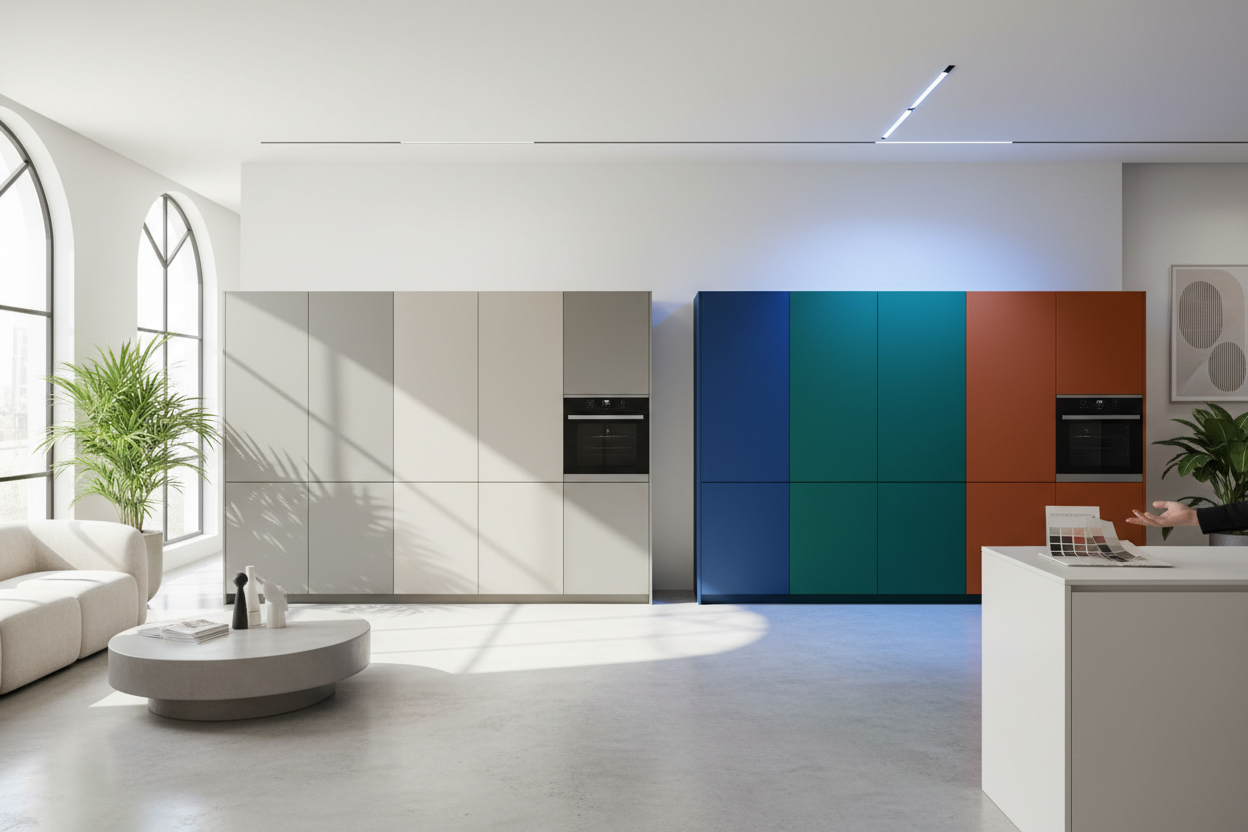
I remember standing in a high-end SoHo showroom three years ago, staring at a navy kitchen cabinet model that looked like pure velvet under the spotlights. It was sophisticated, moody, and exactly what I wanted for my own renovation. I skipped the home-testing phase because I was 'certain' of the vibe. Six months later, those same cabinets were installed in my dim, North-facing kitchen, and they didn't look navy at all—they looked like an endless black hole that sucked the life out of the room.
That is the danger of showroom seduction. You are looking at a curated environment designed by professionals to hide flaws and exaggerate beauty. When you bring that same finish into a real house with 8-foot ceilings and mismatched lightbulbs, the reality check hits hard. Here is how to stop being fooled by the display and start seeing what your kitchen will actually look like.
- Showroom lighting is usually 4000K-5000K (cool and bright), while most homes are 2700K (warm and yellow).
- Massive showroom ceilings make dark cabinets feel lighter than they do in a standard kitchen.
- A 3x3 inch swatch is a lie; it cannot show you how shadows fall into the recessed panels of a door.
- Always test your samples vertically at 9 AM, 2 PM, and 8 PM before signing a contract.
The Big Lighting Lie (Why Stores Trick Your Eyes)
Walk into any big-box store or designer studio and look up. You will see a grid of high-intensity track lights or industrial LEDs. These bulbs are usually rated at 4000K or higher on the Kelvin scale, mimicking bright midday sun. This makes every model kitchen cupboard look crisp and vibrant. Most of us, however, live in a world of 2700K 'Soft White' bulbs that turn those crisp blues into muddy greens and those clean whites into dingy yellows.
Then there is the shadow problem. Showrooms use 'wash' lighting that hits the cabinets from every angle, effectively erasing the shadows that naturally occur under your soffits or upper cabinets. In your actual kitchen, you have a single source of light or a few cans in the ceiling. Those shadows will pool in the corners of your cabinet doors, making the paint color look two shades darker than it did in the store. If you do not account for the 'shadow tax,' you are going to end up with a kitchen that feels cramped and heavy.
Why Dark Colors Look So Much Heavier at Home
Scale is the hardest thing to judge in a warehouse. When you are standing in a 10,000-square-foot showroom with 20-foot ceilings, a massive island of charcoal cabinets feels like a chic accent. In a standard 12x14 kitchen, that same dark finish can feel like it is closing in on you. The sheer volume of the store dilutes the visual weight of the furniture.
I have seen people fall in love with a black cabinet with glass doors in a showroom and assume it will feel 'airy' because of the glass. But in a galley layout, that dark frame still acts as a visual anchor that stops the eye. Dark finishes absorb light rather than reflecting it. In a massive store, there is plenty of light to spare. In your home, you are fighting for every lumen. If your heart is set on a dark model of kitchen cabinets, you need to ensure you have the square footage and the window light to support it, or it will swallow your room whole.
Stop Trying to Judge Scale From a Tiny Swatch
If a designer hands you a 3x3 inch square of painted wood and asks you to make a $20,000 decision, walk away. Those tiny swatches are useless for anything other than checking a basic color family. They don't show you the grain of the wood, the texture of the paint, or most importantly, how the trim profiles create depth.
You need a full-sized door sample. Period. A real model of kitchen cabinets involves complex routing—those little ridges and valleys in a Shaker or raised-panel door. Those details create 'micro-shadows.' A flat swatch has no shadows. A full door will show you how the paint catches the light on the edges and how it pools in the crevices. This is the difference between a kitchen that looks like it was custom-built and one that looks like it was wrapped in plastic contact paper. If the store won't let you borrow or buy a full door, find a different store.
How to Actually Test Cabinet Samples in Your House
Once you get that full-sized door home, do not lay it flat on your dining table or kitchen island. Light hits a horizontal surface differently than a vertical one. Prop the sample up vertically against your existing lower cabinets. This is the exact angle the light will hit it for the next twenty years. It is also a good time to think about choosing the perfect sideboard or freestanding pantry to match; bring that sample over to your other furniture to see if the undertones clash.
Now, do the 'Time of Day' test. Check that door at 9 AM when the light is blue and cool. Check it at 2 PM when the sun is at its harshest. Finally, check it at 8 PM with only your overhead kitchen lights on. I once had a 'perfect' greige sample turn a sickly, bruised purple under my 8 PM kitchen lights. If I hadn't tested it, I would have been stuck with a kitchen that looked like a grape popsicle every night after dinner.
Bypassing the Showroom Altogether
The secret that showroom designers don't want you to know? You are paying for their rent, their electricity, and those fancy track lights that are currently lying to you. Once you have done the hard work of testing physical samples in your own lighting and you know exactly what material and finish you want, the 'experience' of the showroom is over. You have the data you need.
You can often find quality without the designer markup by ordering your cabinets from reputable online suppliers or direct-to-consumer manufacturers. They don't have the overhead of a glitzy storefront, which means you get the same kiln-dried hardwoods and high-density finishes for a fraction of the price. Just make sure you've held that physical sample in your own kitchen first. Trust your eyes in your house, not your eyes in the store.
FAQ
Why does my white cabinet look yellow at home?
It is likely your lightbulbs. Standard 'Soft White' bulbs have a yellow tint. Switch to 'Cool White' or 'Daylight' bulbs (3000K to 3500K) to neutralize the yellow and make the whites look crisp again.
Can I trust a 3D render of my kitchen?
No. Renders are great for layout, but they are terrible for color. Software cannot perfectly replicate the way light bounces off your specific flooring or reflects your wall paint. Use renders for 'where things go,' not 'what color they are.'
Is it worth paying for a sample door?
Yes. Spending $50 on a sample door is the cheapest insurance policy you will ever buy. It is much better to lose fifty bucks on a sample you hate than twenty grand on a kitchen you can't stand to look at.


Leave a comment
This site is protected by hCaptcha and the hCaptcha Privacy Policy and Terms of Service apply.