










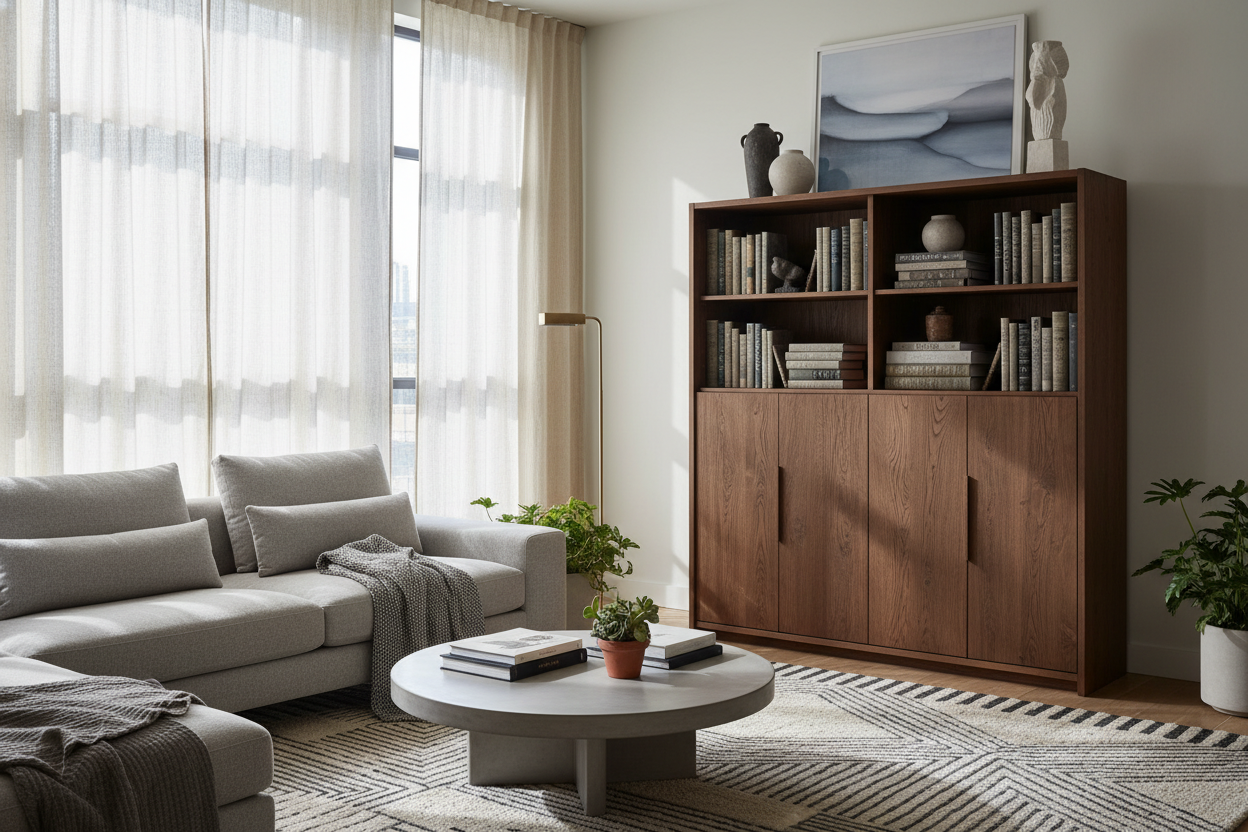
I woke up at 3 AM to a sound like a gunshot echoing through my hallway. It wasn't an intruder; it was my $89 flat-pack bookshelf finally surrendering to the laws of gravity. My entire collection of oversized hardcovers and a heavy ceramic vase had performed a slow-motion kamikaze dive because the particleboard shelves had developed that tell-tale 'sad smile'—a permanent, structural bow that eventually snapped.
If you've ever tried to store a 26-pound KitchenAid mixer or a stack of heavy board games on a vertical shelf made of sawdust and glue, you know the anxiety. This is exactly why I finally stopped buying 'placeholder' furniture and invested in a solid wood tall cabinet. When you go vertical, you aren't just fighting for floor space; you're fighting physics, and real timber is the only thing that wins that battle consistently.
Quick Takeaways
- MDF and particleboard have a 'creep' factor, meaning they will permanently deform under heavy weight over time.
- Solid wood offers superior screw-holding power, which is vital for the hinges on tall, heavy doors.
- A tall piece has a higher center of gravity; solid wood provides the base weight needed for better stability.
- Real wood cabinets can be sanded and refinished if they get dinged during a move, unlike laminate which just peels.
The Night My Fake Wood Bookshelf Finally Gave Up
The failure of cheap furniture is never a surprise, yet it always feels like a betrayal. I spent years thinking I was being 'frugal' by buying those honeycomb-core units from big-box retailers. I figured as long as I didn't exceed the '30 lbs per shelf' warning on the instruction manual, I was safe. I was wrong. Those weight limits are for static weight—perfectly distributed loads that never move.
In reality, we shove things in, we stack heavy boxes on one side, and we live in humid environments that soften the glue in engineered wood. My old shelf didn't just break; it disintegrated. The cam locks pulled right out of the side panels because the 'wood' was basically compressed paper. Cleaning up a mountain of shattered ceramics and splintered laminate at 3 in the morning is a special kind of hell I wouldn't wish on anyone. It was the last time I trusted my heavy gear to anything that wasn't grown in the ground.
Why Going Vertical Changes the Physics of Your Furniture
When you buy a low coffee table, the material matters less because the weight is close to the floor. But when you move to a solid wood tall storage cabinet, the stakes get higher—literally. A six-foot-tall piece of furniture acts like a lever. If the frame is flimsy, the whole unit will rack and sway every time you open the door. I’ve owned tall MDF cabinets that felt like they were made of Jell-O the moment I tried to level them on an uneven floor.
Solid wood has natural rigidity that engineered boards lack. It doesn't just hold weight; it resists twisting. This structural integrity is why professionals consider a sturdy vertical unit the designer secret to hidden storage for heavy, bulky items. You can stack cast iron pans or heavy linens all the way to the ceiling without worrying that the sides will bulge or the top will lean three inches to the left.
Hiding the Chaos: The Magic of Real Doors
Open shelving is a trap designed by people who don't actually own stuff. Unless you live in a museum, your vertical storage is likely holding things that are functional but ugly—think vacuum attachments, bulk toilet paper, or that bread maker you use twice a year. A solid wood tall cabinet with doors is the ultimate living room cheat code because it provides a massive amount of 'visual silence.'
However, doors on a tall cabinet are a major failure point for cheap furniture. Heavy doors need massive hinges, and those hinges need to be anchored into something substantial. I’ve seen countless particleboard cabinets where the hinge screws simply stripped out because the material was too soft to hold the thread. If you're looking for something to handle the weight of winter coats and heavy boxes, a heavy-duty wardrobe armoire built from solid timber ensures those doors stay aligned and swinging smoothly for decades, not months.
How to Tell if It Is Actually Solid Wood (Before You Buy)
Marketing departments are clever. They love terms like 'wood solids' or 'veneer over engineered core.' Don't fall for it. To find the real stuff, you have to look at the weight and the joinery. A real 72-inch tall cabinet made of solid pine or oak is going to weigh significantly more than its MDF counterpart. If the shipping weight says 60 lbs for a massive cabinet, it’s not solid wood.
Check the back panel and the drawer bottoms too. Even 'solid wood' pieces sometimes use thin plywood for the back—which is actually fine for breathability—but the load-bearing shelves must be thick. Look for grain that wraps around the edges of the boards. If you want to know what designers actually think, they’ll tell you that the 'knock test' never lies. Tap the side; if it sounds hollow and high-pitched, keep walking. Real wood has a dull, thudding resonance that feels expensive because it is.
Is the Price Jump for Real Wood Actually Justified?
Let's do the 'bad furniture math.' You buy a $250 flat-pack cabinet. It survives one move, but by the second move, the joints are wobbly. By year four, the shelves are sagging, and the laminate is peeling at the corners. You throw it away and buy another. Over 12 years, you've spent $750 and owned three pieces of junk that ended up in a landfill. Or, you buy one solid wood piece for $900 today.
That solid wood piece will survive five moves, three different apartments, and can be handed down to your kids. If you aren't ready for the height, you might start with a solid wood modern sideboard to test the quality, but for vertical storage, the investment is non-negotiable. It’s the difference between buying furniture and buying a headache.
Frequently Asked Questions
Will a solid wood cabinet warp in a humid house?
Real wood does breathe, but high-quality furniture is kiln-dried to prevent major warping. Unlike particleboard, which swells and disintegrates when wet, solid wood just needs a stable environment and maybe a little wax once a year to stay perfect.
How do I stop a tall cabinet from tipping?
Regardless of the material, you must anchor any tall piece to a wall stud. However, solid wood is much safer because the anti-tip hardware actually has 'meat' to bite into, whereas screws can easily pull out of thin MDF backings.
Why is solid wood so much heavier?
It’s the density of the fibers. Engineered wood is full of air pockets and resin. Real timber is a dense network of cellulose and lignin. That weight is exactly what keeps your cabinet from wobbling when you're grabbing a heavy mixer off the top shelf.


Leave a comment
This site is protected by hCaptcha and the hCaptcha Privacy Policy and Terms of Service apply.