










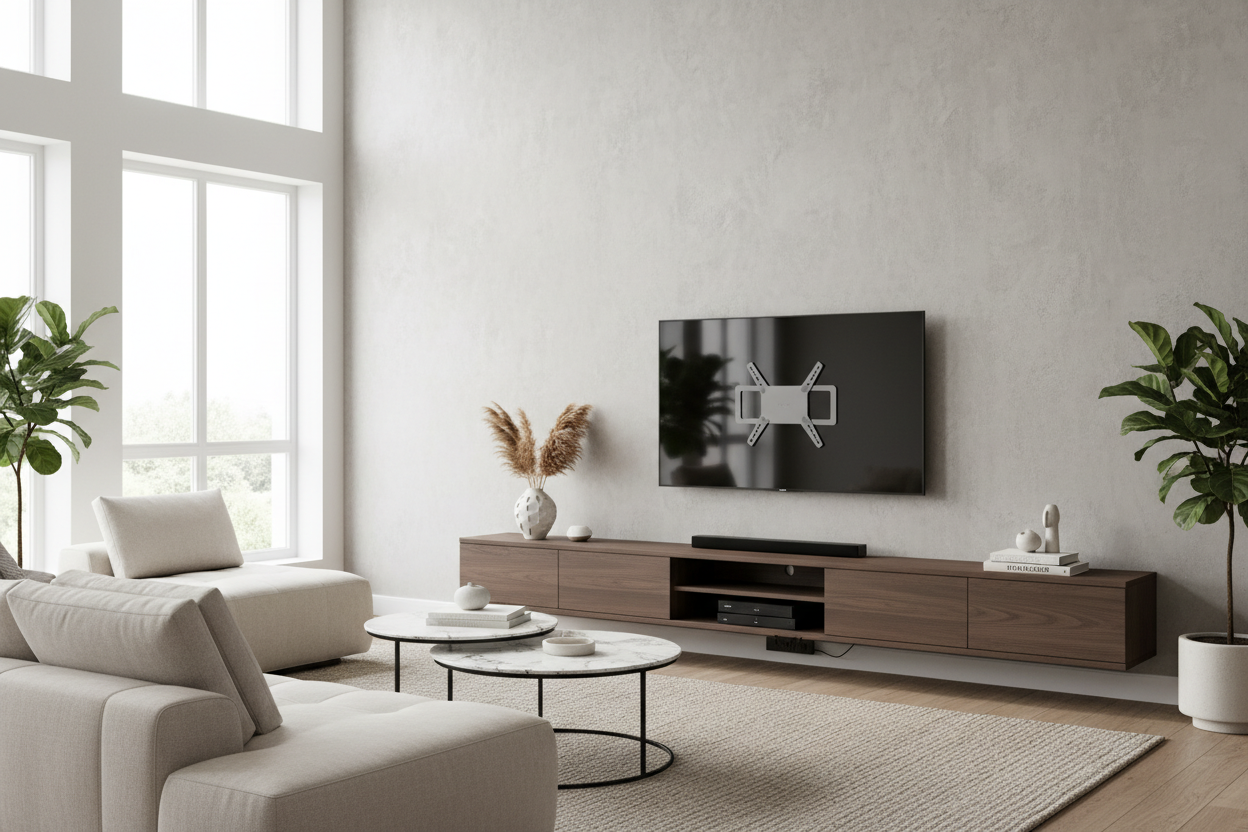
I remember staring at my first 'adult' apartment wall for three hours, trying to decide if I should drill holes for a bracket or just plunk the TV on a dresser. It is a classic paralyzing moment. You want the sleek look of a gallery, but you also need a place to put your PlayStation and that weirdly heavy soundbar. The truth is, the whole tv wall mount and stand debate is a false choice. You do not need one or the other; you need both.
Quick Takeaways
- Mounting provides the perfect ergonomic viewing height to save your neck.
- A stand anchors the room visually so the TV does not look like a floating black hole.
- Consoles are the only way to truly hide the 'cable waterfall' of gaming systems.
- Aim for a 4 to 8-inch gap between the screen and the furniture surface.
The Endless Debate: Mount TV on Wall vs Stand
People treat the choice between a tv stand vs wall mount like they are picking a political party. If you mount it, you are 'modern' and 'minimalist.' If you use a stand, you are 'traditional.' But choosing just one usually leaves the room feeling unfinished. A TV sitting on a stand is often too low for comfortable viewing, especially if you have a deep sofa. Conversely, a lone TV on a wall looks like a floating black mirror in a haunted house—cold, lonely, and unfinished.
Why I Refuse to Choose (And Why You Should Too)
I stopped choosing years ago. When you use both, you get the ergonomic benefits of a mount and the storage capacity of a console. It is the easiest way to go about faking a custom media wall without spending five grand on a contractor. You get that high-end, built-in look by simply layering the two elements. The mount handles the heavy lifting, while the furniture handles the style.
The 'Floating Screen, Grounded Room' Effect
There is a specific visual weight problem when you mount a TV on a bare wall. It looks untethered. By placing one of many low-profile TV stands underneath, you ground the technology. It turns the TV into a 'moment' rather than just an appliance. I prefer a stand that is at least 10 inches wider than the TV itself. If the stand is narrower than the screen, the whole setup looks top-heavy and accidental.
Hiding the Mess: The Practical Argument
Let us talk about the 'cable waterfall.' Even 'hidden' cable management systems inside walls can be a nightmare if you ever want to add a new HDMI cord or a Nintendo Switch. Using a wall mounted media console allows you to tuck the surge protector and the messy excess wire right out of sight while keeping the floor clear for the vacuum. It is the ultimate hack for people who hate visual clutter but own more than one electronic device. The stand acts as the 'brain' for all your peripherals while the screen stays clean.
How to Nail the Gap Between Your Screen and Furniture
The biggest mistake I see is the 'dead zone'—that awkward two-foot gap between the TV and the stand. You want it to look like they are in a relationship. I usually aim for 4 to 8 inches of space. Any higher and the TV feels like it is trying to escape the room; any lower and you might as well have just used the plastic legs that came in the box. Measure twice, drill once, and keep that gap tight for a professional finish.
What If You Absolutely Can't Drill into the Wall?
Sometimes you cannot drill. Maybe you have a landlord who treats drywall like sacred parchment, or perhaps your wall studs betrayed me (and you) by not being where the stud finder promised. In those cases, I look for 'hybrid' stands. These have an integrated mounting pole that mimics the floating look without a single hole in the wall. You still get the storage and the height, minus the security deposit deduction.
My Personal Take
I once spent four hours trying to fish cables behind a drywall-mounted TV in a rental, only to realize I had accidentally dropped the power cord into a fire block I could not reach. I ended up having to cut a massive hole in the wall and lost my deposit. Now? I mount the TV, run a simple white cord cover straight down, and hide the 'brain' of the operation in a solid wood cabinet below. It is foolproof and looks ten times better than the DIY disaster I tried before.
FAQ
Can I put a TV stand under a mounted TV?
Yes, and you should. It provides a place for your soundbar and décor while hiding the cables that run down from the screen.
How high should a mounted TV be?
The center of the screen should be at eye level when you are sitting on your sofa. For most people, that is about 42 inches from the floor.
Does the TV stand have to be wider than the TV?
Visually, yes. A stand that is wider than the TV creates a sense of balance. If the TV is wider, the room will feel cramped and 'off.'



Leave a comment
This site is protected by hCaptcha and the hCaptcha Privacy Policy and Terms of Service apply.