










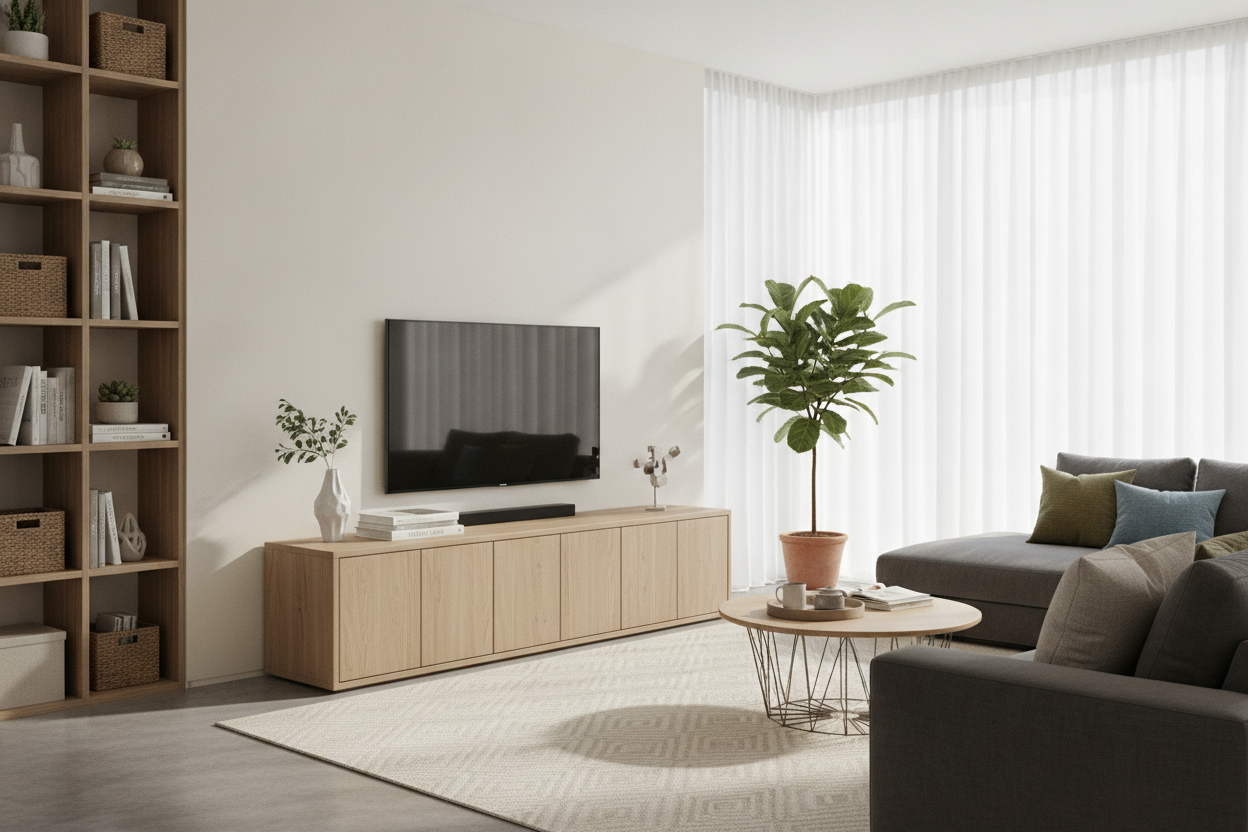
I spent three months staring at a pile of Switch controllers, a dusty router that looked like a cyber-spider, and a Wii U that hasn't been touched since the Obama administration. My old console was a standard two-door 'black hole' where things went to die. I was browsing standard TV stands at 2 AM, realizing my current setup was basically a trash can with a hinge.
Switching to a 3-door tv stand changed the math of my living room. It stopped the 'everything drawer' phenomenon by forcing me to actually categorize my life. It turns out, that extra door is the difference between a cluttered mess and a room that actually looks like an adult lives in it.
Quick Takeaways
- The Odd Number Rule: Three doors look more like a curated piece of furniture and less like a generic storage locker.
- Cable Management: One door for the 'ugly' stuff, two for the 'fun' stuff.
- Visual Balance: It fills a long wall without feeling bulky.
- Zoning: Dedicated spots for gaming, tech, and actual living.
The Problem With Two Doors (and Four Doors)
Most people default to a two-door console because it’s what they see in every big-box flyer. But here is the reality: two doors usually mean one massive, unorganized internal shelf. It becomes a dumping ground where your copy of Catan gets crushed by a heavy power brick. You can never find anything, so you just keep the doors shut and pray your guests don't open them.
On the flip side, four-door units often feel like a locker room. They are visually busy, with too many vertical lines breaking up the design. Plus, the individual compartments are often too small to fit a standard board game box or a larger receiver. The three-door layout is the 'Goldilocks' zone—enough storage to be useful, but simple enough to look clean.
Enter the 'Rule of Three' for Media Storage
In interior design, we talk about the 'Rule of Three' constantly. Items grouped in odd numbers are more appealing, memorable, and effective than even-numbered groupings. When choosing the perfect TV stand, this principle helps break up the heavy visual weight of a 60-inch or 70-inch piece of wood.
A three-door console creates a natural rhythm. It doesn't look like a monolithic block of wood sitting against your wall. Instead, it offers a sense of intentionality. You aren't just hiding your stuff; you're organizing it into functional zones that actually make sense for your daily routine.
Zone 1: The Ugly Tech Box
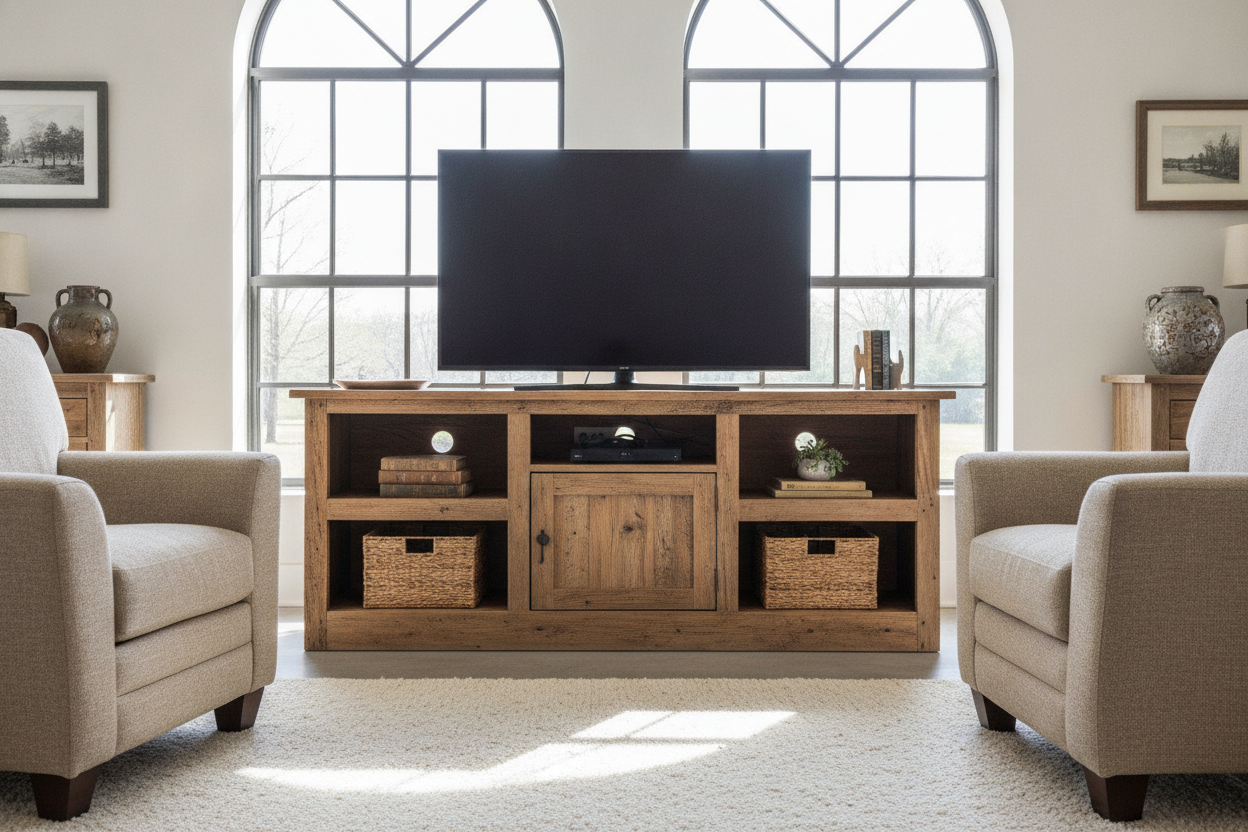
The first door is where I hide the sins of modern living. This is the home for the router, the messy power strips, and the three miles of tangled HDMI cables that I refuse to sort. If you pick a TV stand with slatted doors, this is the perfect spot for it. Slats allow the heat from your electronics to escape and let your remote signals pass through without you having to leave the door hanging open like a broken jaw.
Zone 2: The Entertainment Hub
The middle section is the prime real estate. This is where the PlayStation, the Xbox, and the controllers live. By putting these in the center, you have the shortest cable run to the TV above. I’ve found that keeping the 'active' tech here makes it easy to swap discs or sync controllers without digging through the 'junk' door on the end. When the gaming session is over, you shut the door and the neon plastic disappears.
Zone 3: The 'Life' Storage
The third door is my favorite because it has nothing to do with a screen. This is where I keep the 'living room' items that usually clutter up the coffee table. Extra throw blankets for movie night, a few favorite board games, or even those kids' toys that usually migrate across the floor like an invasive species. Having a dedicated 'non-tech' zone keeps the console from feeling like a server rack.
How to Style a Longer Console Without Adding Clutter
Since a three-door unit is naturally wider—usually between 60 and 80 inches—you have a lot of surface area to work with. Don't fall into the 'landing zone' trap where you just toss your keys and mail on it. I like to mirror the 'rule of three' on top. Group your decor in three clusters.
Anchor one end with something tall, like a table lamp or a large vase. In the middle, keep it low so you don't block the screen—think a stack of coffee table books. On the other end, use a medium-sized object like a candle or a small plant. This creates a visual 'wave' that keeps the eye moving across the piece rather than getting stuck on the giant black rectangle of the TV.
FAQ
Will my remote work through solid wood doors?
Usually, no. If you want to keep the doors closed while using your devices, look for slatted designs or glass fronts. Otherwise, you'll need an IR repeater, which is just another wire to hide.
Is a three-door stand too big for a small apartment?
Actually, a longer, lower console can make a small room feel wider. It’s the depth you have to worry about. Look for something around 15-18 inches deep to save floor space while still getting that 70-inch length.
What material should I look for?
Avoid the cheap 1/2-inch particle board if you have a heavy TV. It will bow in the middle. Look for kiln-dried hardwood or high-grade MDF with a real wood veneer if you want it to last more than one move.

Leave a comment
This site is protected by hCaptcha and the hCaptcha Privacy Policy and Terms of Service apply.