










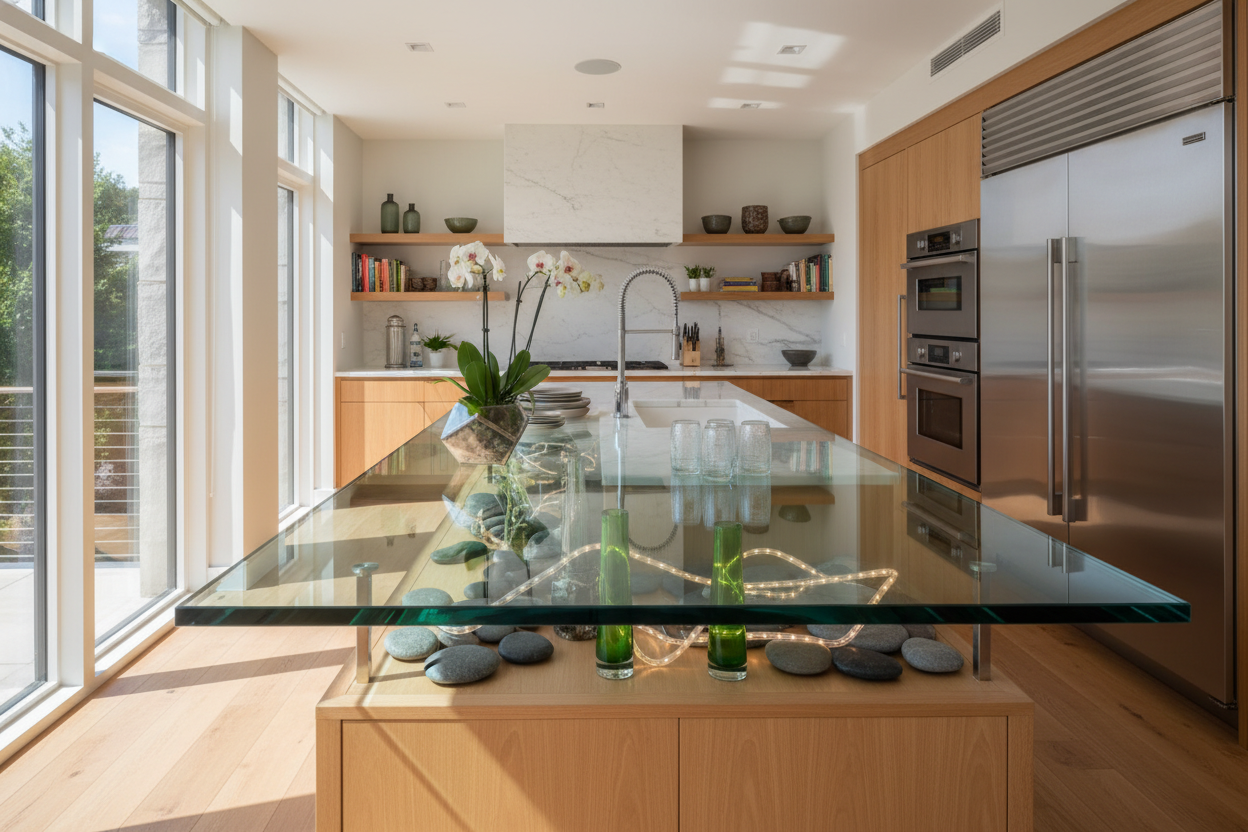
I was three weeks deep into a kitchen remodel, staring at 47 browser tabs of white quartz that all looked like the same slab of plastic-infused stone. I wanted something that didn't feel like every other Pinterest board from the last decade. That is when I saw a 1.5-inch thick slab of translucent, aqua-tinted glass countertop, and I knew I was about to make a very unconventional choice.
- Glass is non-porous, meaning it is more hygienic than almost any stone.
- It handles heat better than quartz, which can scorch if you set a hot pan down.
- Maintenance is basically just Windex and a microfiber cloth.
- Texture on the bottom side hides the 'science lab' look people fear.
The Day I Decided Against Boring Stone
Renovation fatigue is real. By the time I got to choosing the perfect kitchen counter table and surrounding surfaces, I was over the 'safe' options. Granite felt too busy, and quartz felt too manufactured. I wanted a glass kitchen worktop because it felt alive. It catches the light from the windows and glows in a way that stone simply cannot.
Most people think of glass countertops as fragile art pieces. I saw them as a way to make my small, dark kitchen feel significantly larger. Because you can see 'into' the surface rather than just 'at' it, the visual weight of the counters disappeared. I traded the heavy, grounded feeling of stone for something that felt like it was floating.
The 'Will It Break?' Panic (And Other Glass Myths)
The first question everyone asks is: 'What if I drop a wine bottle?' Here is the reality: this isn't window pane glass. We are talking about thick, tempered architectural kitchen counter glass. It is incredibly dense. I have banged heavy Le Creuset pots against the edge more times than I care to admit, and I haven't seen a single chip.
When you look at glass countertops for kitchen use, you are usually looking at material that is at least 1 inch thick. It is heat-resistant, so unlike my old laminate or even some engineered stones, I don't panic if a hot baking sheet touches the surface. It is tough, but it has a different 'give' than stone. It sounds different when you set a glass down—more of a solid thud than a sharp clink.
The Honest Truth About Smudges and Scratches
Let's talk about the glass on countertop reality: fingerprints happen. If you are the kind of person who can't stand a single smudge, you might want to stick to a matte granite. However, I found a workaround. By choosing a 'crushed' or textured finish on the underside of the glass, the fingerprints on the top are almost invisible unless the light hits them at a specific 45-degree angle.
Daily maintenance of glass on counter surfaces is actually easier than sealing granite. I keep a spray bottle of vinegar and water under the sink. A quick wipe-down and it looks brand new. I did notice one tiny scratch after six months—likely from a ceramic bowl with a rough bottom—but because of the translucent nature of the material, you really have to hunt for it to find it.
How to Keep Your Kitchen From Looking Like a Science Lab
The biggest risk with glass kitchen countertops is that they can feel cold or clinical. To combat this, I paired my custom glass countertops with warm walnut cabinetry and unlacquered brass hardware. The organic wood grain balances the icy, smooth surface of the glass perfectly. It is all about contrast.
One of my favorite features is the lighting. If you install a kitchen island with glass top and light, you can actually run LED strips along the back edge. At night, the entire slab glows. It turns the kitchen into a lounge. It is a specific look, sure, but it is one that makes guests stop and stare every single time they walk in.
The Final Verdict: Would I Do It Again?
After a year of heavy use—including a toddler who treats every surface like a drum set—I would choose a glass countertop kitchen setup again in a heartbeat. It is the most complimented feature of my home. It hasn't stained, it hasn't cracked, and it makes my morning coffee feel like I'm sitting in a high-end cafe.
If you aren't ready to commit the whole room to it, consider a glass kitchen countertop for just the island or a secondary prep area. You could even look into a kitchen hutch with countertop space in glass to test the waters. It is a bold move, but for those of us tired of the sea of gray marble, it is a breath of fresh air.
Is glass more expensive than quartz?
Generally, yes. You are paying for the custom tempering and the weight of the material. Expect to pay about 20-30% more than mid-range quartz, but the durability and 'wow factor' are significantly higher.
Does it scratch easily?
It is about as scratch-resistant as high-end stone. While you shouldn't use it as a cutting board (it will dull your knives anyway), normal kitchen activity won't leave marks. Just watch out for rough-bottomed ceramics.
Can you see the cabinets through the glass?
Only if you choose perfectly clear glass. Most people opt for a frosted, colored, or textured underside which completely hides the tops of the cabinets and the adhesive used to secure the slab.


Leave a comment
This site is protected by hCaptcha and the hCaptcha Privacy Policy and Terms of Service apply.