










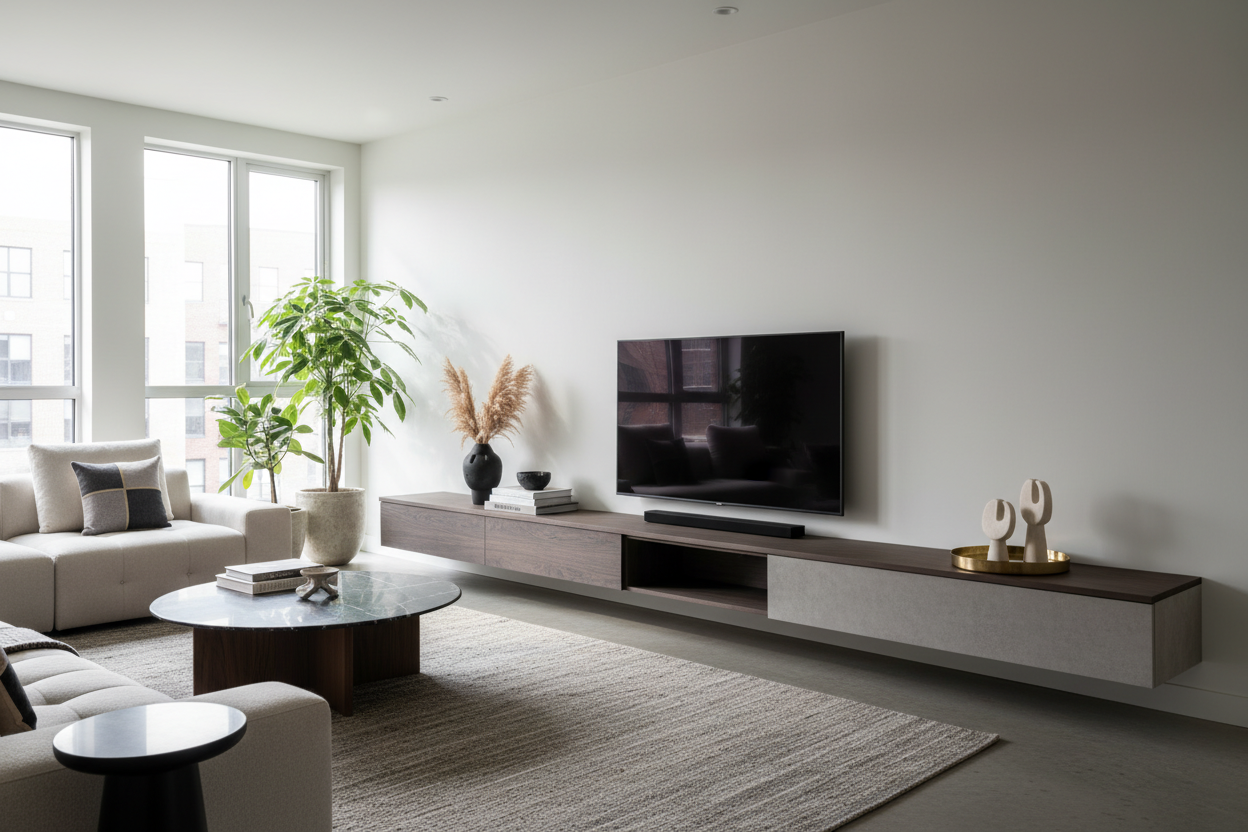
I spent three hours drilling into a stud that wasn't actually there, only to realize my 65-inch TV was slightly crooked and a waterfall of black cables was mocking my minimalist dreams. Wall mounting sounds like a sleek, high-end solution until you're staring at a 'floating' screen that looks more like a hospital monitor. That is when I finally caved and bought a living room modern tv stand.
- Cords disappear behind the unit without cutting into your drywall.
- Low-profile consoles anchor the room and provide a much-needed focal point.
- Slatted doors are the secret to hiding ugly routers and gaming consoles.
- No more neck strain from the dreaded 'TV too high' syndrome.
The Wall-Mounting Delusion (Why I Finally Gave Up)
It starts with a Pinterest board and ends with you covered in white dust, holding a level, and questioning your life choices. The biggest lie we are told is that mounting a TV cleans up the room. Unless you are prepared to snake wires through the wall—which is a total nightmare in a rental or a brick-walled loft—you end up with those plastic cord hiders that look like industrial plumbing. They never stay flat, and they never quite match your paint color.
Then there is the height issue. Most people mount their screens way too high, forcing guests to crane their necks like they are in the front row of a movie theater. After six months of squinting at a screen that felt disconnected from the rest of my furniture, I realized the 'floating' look was just making my living room feel cold and unfinished. My wall looked like a tech showroom, not a home.
Enter the Living Room Modern TV Stand
I traded the drill for a sleek black TV stand entertainment center and the vibe shift was instant. Instead of a screen hanging in the void, the furniture grounded the entire wall. This unit sits about 18 to 22 inches off the ground, which is the ergonomic sweet spot for eye-level viewing. When I sit on my sofa, the center of the screen is exactly where it should be.
Assembling a modern tv stand wall setup is actually easier than measuring for heavy-duty anchors. I spent about 45 minutes with an Allen wrench, and suddenly I had a place to put my soundbar that didn't involve more wall brackets. A solid console gives the room a sense of permanence and purpose that a mounting bracket simply cannot provide. It is the difference between a temporary setup and a curated space.
How to Style a Modern TV Stand Wall
Once the TV is resting on the stand, people often worry the surrounding wall looks naked. Do not just leave it as a blank expanse of drywall. I layered a few oversized art prints to the left of the screen and added a tall, architectural floor lamp on the right. This creates a visual 'frame' that makes the tech feel like part of the decor rather than an intrusion.
If you have a massive collection of books or vinyl records that need a home, you might even consider adding a modern wall cabinet for living room storage to flank the console. It fills the vertical space without making the room look like a cluttered office. The key is to keep the heights varied; you want the eye to move around the room, not just stare at the big black rectangle in the middle.
Hiding the Tech Clutter (The Slatted Door Secret)
My biggest beef with open shelving is the dust and the constant blinking lights of the PlayStation and the router. I found that a TV stand with slatted doors is the ultimate design hack. The slats allow the remote’s infrared signal to pass through effortlessly, and more importantly, your consoles will not overheat because air can still circulate. It hides the mess but keeps everything fully functional.
I have three different HDMI cables, a power strip, and a mess of charging docks tucked behind my modern living room tv unit. To the casual observer, it looks like a clean, mid-century inspired piece of furniture. To me, it is a fortress that guards against the 'cable spaghetti' that used to haunt my dreams. When you are shopping, look for units with pre-drilled cable management holes in the back panel—it saves you from having to DIY your own exits.
Do Modern TV Units in Living Room Spaces Look Too Bulky?
People often fear a 70-inch console will eat their small apartment. However, contemporary designs use tapered legs and thin profiles to create negative space underneath the unit. This actually makes the floor look bigger because you can see the baseboard and the rug extending underneath the furniture. It is a classic interior design trick: if you can see the floor, the room feels larger.
When browsing through a curated living room collection, look for pieces that sit on legs rather than a solid plinth base. Avoid those chunky, 90s-style oversized media centers that take up an entire wall. A low, wide modern tv units in living room layouts should be at least a few inches wider than the TV itself to keep the proportions balanced. It is about creating a stable base, not a bulky obstacle.
FAQ
How wide should my TV stand be?
Your stand should be at least 3 to 6 inches wider than your TV on both sides. This prevents the 'top-heavy' look and keeps the screen from looking like it is about to fall off the edge.
Is eye-level viewing really that important?
Yes. If you are looking up at your TV, you are straining your neck and shoulders. The center of the screen should ideally be at eye level when you are sitting on your primary sofa.
Can I still use a soundbar with a stand?
Absolutely. Most modern stands are designed with a flat top surface or a specific open shelf just for soundbars. Just measure the height of your soundbar to make sure it doesn't block the bottom of your TV screen.


Leave a comment
This site is protected by hCaptcha and the hCaptcha Privacy Policy and Terms of Service apply.