










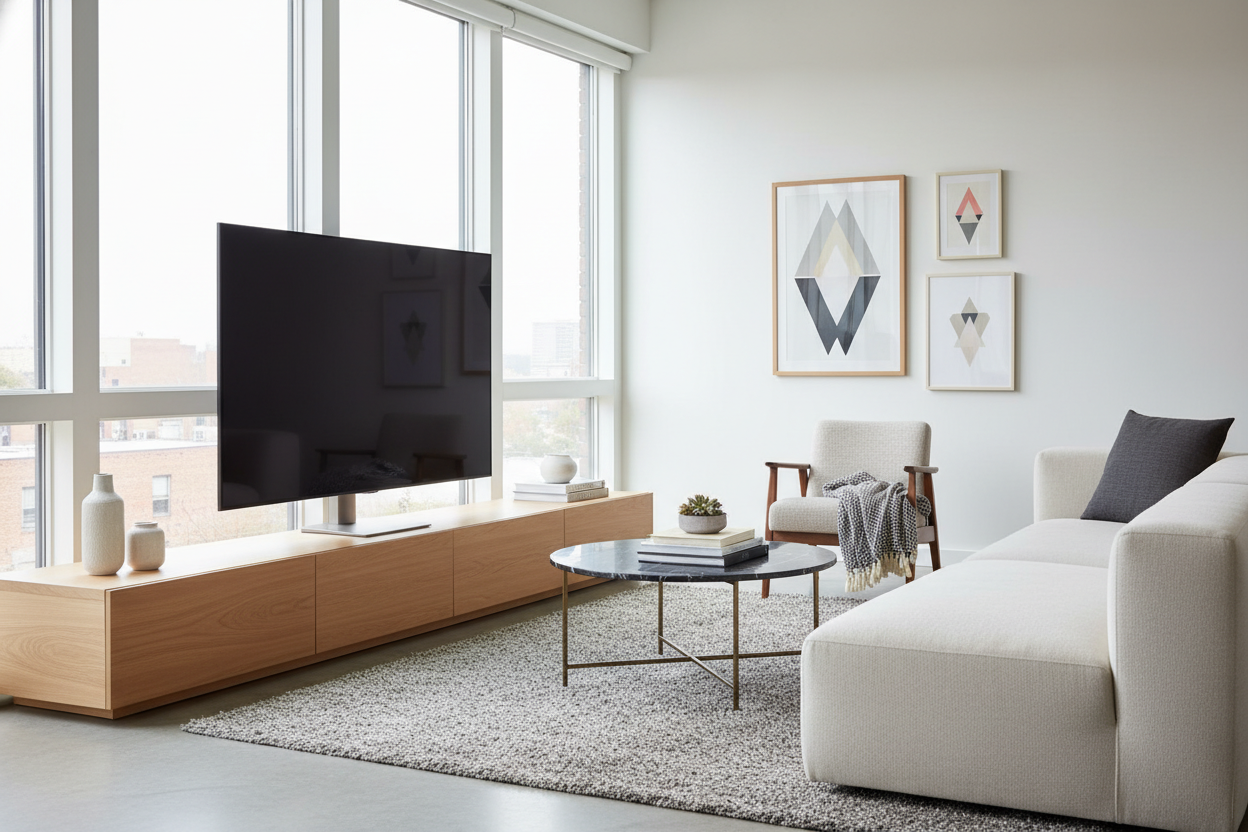
I remember the Black Friday of 2022 like it was yesterday. I had finally pulled the trigger on a 65-inch beast of a screen that promised the inky blacks and vibrant colors I'd been dreaming of. I cleared off my prized 1960s teak sideboard, unboxed the monster, and realized with a sinking heart that the two spindly legs were spaced exactly 58 inches apart. My sideboard was 56 inches wide.
I sat on my living room floor staring at a tv with single base model I should have bought, while my new purchase sat precariously on the rug, its 'feet' hanging over the abyss of my furniture edges. It was a design disaster that nearly cost me a vintage heirloom and a brand-new panel.
- Center pedestals allow large screens to sit on narrow, vintage, or compact furniture.
- Wide-set 'chicken legs' are a cost-cutting measure that forces consumers to buy larger furniture.
- A center stand often provides a swivel feature that wide legs lack.
- Universal VESA mounts can fix the problem if you already bought a wide-leg TV.
The Day I Brought Home a 65-Inch Mistake
There is a specific kind of panic that sets in when you realize your expensive new tech is physically incompatible with your home. I had measured the wall space. I had measured the height. But I completely ignored the footprint of the stand. Those two plastic feet, located at the extreme outer edges of the screen, are the bane of any interior lover's existence.
I ended up propping the TV on a stack of heavy coffee table books for three days while I searched for a solution. It looked hideous. My living room felt like a dorm room. It was the moment I realized that the industry had moved toward a 'one size fits all' approach to stands that actually fits almost nobody's existing decor.
The Annoying Rise of the 'Chicken Leg' Screen
Why did manufacturers abandon the heavy, reliable center pedestal? It’s simple: weight and cost. Shipping a heavy metal base is expensive. Two hollow plastic 'chicken legs' weigh next to nothing and cost pennies to manufacture. But this shift has created a secondary problem for us. It forces people to go out and buy massive TV stands that take up way too much floor space just to support the width of the legs.
I've seen people buy 75-inch consoles for 65-inch TVs just because the legs were too wide for a standard 60-inch unit. It’s a waste of square footage. Unless you are wall-mounting, these wide-set legs dictate your entire room layout, often pushing your furniture into walkways or blocking vents.
Why a TV With One Stand Changes Everything
The beauty of a tv with one stand is the physics of it. By concentrating the weight in the center, the actual footprint of the TV might only be 12 to 18 inches wide. This means you can finally put a modern, high-tech screen on a beautiful storage credenza with sliding glass doors without the legs hanging off the sides like a bad suit.
Visually, it creates a 'floating' effect. It allows the furniture underneath to breathe. Most center pedestals also offer a swivel function, which is a lifesaver if your living room is open-concept. I can turn my screen 20 degrees to face the kitchen while I'm cooking, then swivel it back to the sofa for movie night. You can't do that with static wide legs.
How to Find a Good Smart TV With Single Base Now
You have to look a little harder these days, but they exist. Most premium OLED and QLED lines from brands like Samsung, LG, and Sony still utilize a center pedestal for their mid-to-high-end models. When you are hunting for a smart tv with single base, check the 'Product Gallery' photos specifically for the stand design. Don't just trust the main marketing image.
Expect to pay a small premium. The manufacturers know that the center base is a 'pro' feature. But when you factor in the cost of not having to buy a new $800 console just to hold up your TV, that extra $100 on the sticker price starts to look like a massive bargain.
The Backup Plan If You Already Bought the Wrong TV
If you’re currently staring at a wide-leg TV that doesn't fit your furniture, don't return the TV yet. You can buy a universal VESA pedestal stand. These bolt into the mounting holes on the back of your TV and provide a heavy, stable center base. I’ve used these for years to 'fix' budget TVs that came with ugly plastic feet.
Once you swap out those wide legs for a sleek center mount, you can finally use that mid-century modern TV stand you’ve had your eye on. It opens up a world of furniture possibilities that aren't limited by the manufacturer's cheap plastic components.
Is a single base TV as stable as wide legs?
Yes, provided it is a high-quality metal base. They are weighted heavily to prevent tipping. However, if you have rowdy pets or toddlers, always use an anti-tip strap regardless of the stand style.
Can I buy a center stand for a TV that came with two legs?
Absolutely. Look for a 'Universal VESA TV Stand.' They usually cost between $30 and $60 and work just like a computer monitor stand, bolting directly into the back of the set.
Do all OLED TVs have a single base?
Many do, but not all. LG’s C-series usually features a wide center pedestal, while some of their entry-level or 'Gallery' series might use different configurations. Always check the specific model number.

Leave a comment
This site is protected by hCaptcha and the hCaptcha Privacy Policy and Terms of Service apply.