










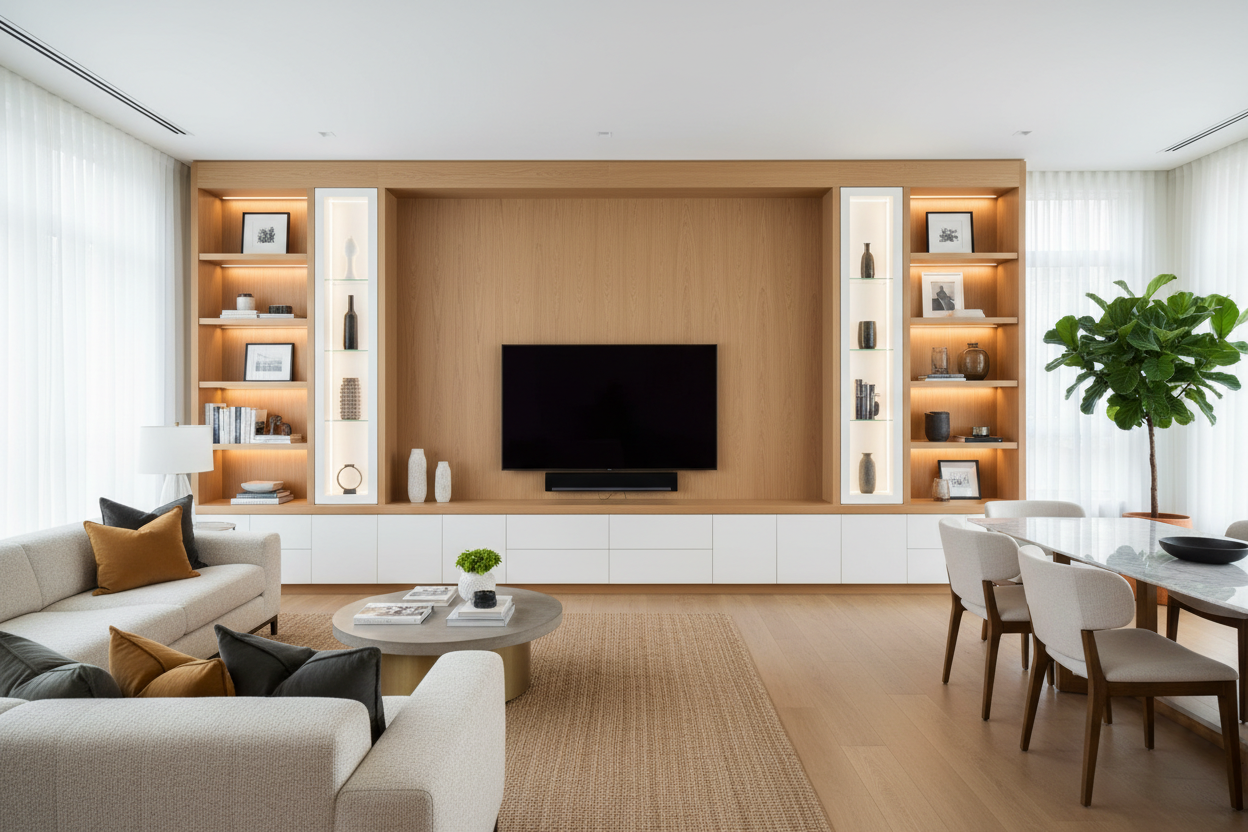
I spent three weeks staring at a 22-foot expanse of drywall in my new 'open-concept' living room, feeling like I was living in a luxury hallway. I had a beautiful sofa, a vintage rug, and a television that looked like a postage stamp stuck to a billboard. No matter where I moved the furniture, nothing felt grounded. My home didn't have a living room; it had a thoroughfare.
That is the curse of the modern floor plan. We tear down all the walls and then wonder why our homes feel like cold, echoing gymnasiums. After a month of 'floating' my furniture in the middle of the floor like a stranded island, I realized the solution wasn't a bigger rug or more floor lamps. It was a built-in media wall.
- Anchors the room by creating a clear architectural focal point.
- Solves the 'floating furniture' problem by giving the sofa something to face.
- Hides the inevitable rat's nest of HDMI cables and power strips.
- Adds permanent value to your home that a freestanding cabinet cannot.
The 'Bowling Alley' Living Room Dilemma
If you live in a house built in the last decade, you know exactly what I am talking about. The builder gave you a massive, rectangular 'great room' that is great for exactly nothing. Without walls to define the space, your eyes just slide right past the furniture and out the window. It is the 'bowling alley' effect, and it makes even the most expensive furniture look temporary and cheap.
I tried the 'floating' sofa trick. You know, the one where you pull the couch six feet away from the wall to create a walkway? In theory, it creates an intimate seating area. In reality, I just felt like I was sitting in the middle of a corridor. My 84-inch sofa was visually swallowed by the sheer scale of the room. It lacked gravity. The room needed something heavy—something structural—to stop the eye and say, 'This is where the living happens.'
A media wall built in does exactly that. By framing out a portion of that endless wall, you create a destination. You aren't just putting a TV on a wall; you are building a room within a room. It changes the psychology of the space from a transit zone to a lounge.
Why a Standard TV Stand Looks So Sad in a Big Room
I see it all the time: a massive 75-inch OLED TV perched precariously on a 60-inch retail console. It looks top-heavy and unfinished. In a room with 10-foot ceilings, a standard 24-inch high media cabinet leaves a vast, awkward ocean of empty white space above it. It makes your expensive tech look like an afterthought rather than a design choice.
Retail furniture is designed for average rooms, but open-concept spaces are rarely average. When you have a 20-foot wall, a freestanding piece of furniture—no matter how beautiful—will always look like it’s just visiting. It doesn't have the visual 'heft' to compete with the square footage. You end up with 'wall acne'—a bunch of small frames and floating shelves trying to fill the void.
Instead of adding more 'stuff' to the wall, you should be subtracting the clutter by recessing a media cabinet in the wall. This integrated approach reclaims your floor space while providing the vertical height necessary to balance those tall ceilings. It turns a piece of furniture into a piece of architecture.
Balancing Scale with Media Wall Built-Ins
Interior design is 90% about proportion. If your furniture is too small for the room, the room feels cavernous. If it’s too big, the room feels cramped. In an open floor plan, you almost always have a scale problem. This is where media wall built-ins become your best friend. They allow you to manipulate the perceived dimensions of the room.
By building a structure that reaches toward the ceiling, you are drawing the eye upward and filling the vertical volume of the space. I recommend framing the unit at least 12 to 18 inches deep. That physical depth creates shadows and highlights that a flat wall lacks. It gives the room 'shoulders.' When I was designing the perfect living room hub, I realized that symmetry was my secret weapon. A centered TV flanked by deep, substantial cabinetry makes the entire room feel intentional and balanced.
Don't be afraid to go big. A media wall built in that spans 12 feet of a 20-foot wall will actually make the room feel more organized and spacious than a small stand would. It provides a 'boundary' that the brain uses to categorize the space as a cozy den, even if the kitchen is only ten feet away.
Designing for Life, Not Just for the Screen
The biggest mistake people make with a media wall built-in is making it look like a Best Buy showroom. If it’s just a giant black rectangle surrounded by drywall, it’s going to feel cold. You want this structure to feel like a library that happens to have a TV in it. I always suggest a mix of open and closed storage.
Use the lower cabinets to hide the 'ugly' stuff—the PlayStation, the router, and the tangled mess of cords. Use the upper open shelving to store books and media, family photos, or curated ceramics. This layering of textures and colors softens the hard edges of the electronics. I personally love using 2.0 lb/ft³ HR foam for any integrated bench seating in these units—it holds its shape for a decade, unlike the cheap stuff that sags after one season of binge-watching.
Think about lighting, too. Small LED puck lights or integrated strip lighting in the shelving can turn the wall into a soft light source at night. It prevents the 'cave' feeling where the only light in the room is the glow of the screen. You want a space that feels just as good when the TV is off as it does during movie night.
Is a Custom Media Wall Built In Actually Worth the Framing Costs?
Let's talk numbers. A high-end, solid wood entertainment center from a place like Arhaus or RH can easily run you $4,000 to $7,000. And at the end of the day, it's still just a piece of furniture you have to dust behind. For that same price, you can usually hire a contractor to frame, drywall, and finish a custom media wall built in that is literally part of the house.
The ROI on built-ins is significantly higher than on freestanding furniture. When you sell your home, that media wall is an architectural feature; your old TV stand is just something you're taking with you. If you are on a tighter budget, you can get creative with the 'semi-custom' look. I’ve seen incredible results where people incorporate a floating TV stand and media console into a recessed drywall niche. You get the high-end look of custom carpentry without the $10,000 cabinet maker's bill.
My personal experience? I spent about $3,200 on framing, electrical, and finish work for my media wall. It was messy, and I lived with drywall dust for a week, but the second the paint dried, the room finally felt 'finished.' No more bowling alley. No more floating sofa. Just a space that actually feels like a home.
Frequently Asked Questions
Will a built-in media wall make my room look smaller?
Actually, it usually does the opposite. By giving the room a clear focal point and drawing the eye upward, it makes the space feel more organized and expansive. It eliminates the visual clutter of small, mismatched furniture pieces.
How do I handle the heat from my electronics?
Ventilation is key. If you are enclosing your gear in lower cabinets, make sure to use slatted doors or install small, silent cooling fans. I learned the hard way that a closed cabinet can turn into an oven for an Xbox in about twenty minutes.
Should the TV be at eye level?
Yes, please. Stop hanging TVs near the ceiling. The center of the screen should be roughly 42 inches from the floor for the average sofa. Your neck will thank you, and the scale of the media wall built-ins will look much more natural.


Leave a comment
This site is protected by hCaptcha and the hCaptcha Privacy Policy and Terms of Service apply.