










I once lived in a rental where the only 'logical' wall for a television was actually a giant radiator topped by a drafty window. I spent three weeks trying to figure out how to mount a 55-inch OLED without blocking my only source of natural light or accidentally melting my tech. It was a disaster of measuring tapes and frustration.
Eventually, I realized that the traditional 'mount it or sit it' binary is a total trap. If your room has more angles than a geometry textbook, you need a tv unit with stand. It is the middle ground that actually works for real, messy floor plans where walls are either non-existent or made of crumbling plaster.
Quick Takeaways
- No drilling required—a massive win for renters or anyone with fragile drywall.
- Integrated swivels let you watch from the sofa, the dining table, or the kitchen.
- Built-in cable management hides the 'black spaghetti' cord mess inside a central pillar.
- The hovering screen frees up the console surface for books, plants, and actual decor.
The 'No Good Walls' Dilemma (And Why Mounting Fails)
We have been conditioned to think that mounting a TV is the pinnacle of home design. But let’s be honest: in an old house or a modern 'open concept' box, walls are often the enemy. You have got floor-to-ceiling windows, off-center fireplaces, or those weird 45-degree corner nooks that make zero sense for a flat bracket.
Forcing a wall mount in these spots usually leads to 'TV too high' syndrome or a viewing angle that gives everyone a permanent neck cramp. Plus, if you are dealing with metal studs or thin drywall, you are one heavy bracket away from a structural nightmare. I have seen enough failed patch jobs to know that sometimes, the wall just is not your friend.
What Even Is an Integrated TV Unit With Stand?
Think of this as a hybrid. It is a solid piece of furniture with a structural steel spine bolted to the back. That spine holds a VESA-compatible bracket, meaning your TV hovers a few inches above the cabinet. It looks like it is floating, but it is entirely self-supporting and stable.
I’m a big fan of using a mid-century modern TV stand for this setup. The slatted doors are great for hiding the router and the gaming consoles at the base, while the integrated tv unit stand design keeps the screen at eye level without needing a single toggle bolt in the wall. It gives you the clean lines of a gallery mount with the storage of a traditional sideboard.
The Perks of a Built-In Bracket
The best part is the swivel. Most of these units allow for 15 to 30 degrees of movement. If you are hosting a game and people are scattered across the room, you just nudge the screen. No more dragging the whole couch around just to see the score. It turns a static room into a flexible one.
You also get to choose your height. Most integrated stands have adjustable notches. I usually set mine so the bottom third of the screen is at eye level when I am sunk into the cushions. Standard consoles are often just a bit too low for my taste, and this fixes that without the commitment of drilling holes.
Hiding the Cords Without Drywall Surgery
Nothing kills a vibe faster than a waterfall of black cables dangling under a TV. With a standard mount, you are either cutting holes in the wall or using those ugly plastic cord covers. A tv unit with stand solves this by routing everything through the hollow center of the mounting column.
You plug everything into the back of the TV, zip-tie the bundle to the spine, and it disappears down into the cabinet. It is clean, it is fast, and you do not need a permit or a contractor to do it. It’s the closest you can get to a professional install on a DIY budget.
How to Style Your Console When the TV is Hovering
When your TV is sitting on its own little plastic legs, the top of your furniture is basically dead space. You cannot put a plant there because it blocks the screen. You cannot put books there because they look cluttered. But when the screen is hovering, that surface becomes prime real estate for your personality.
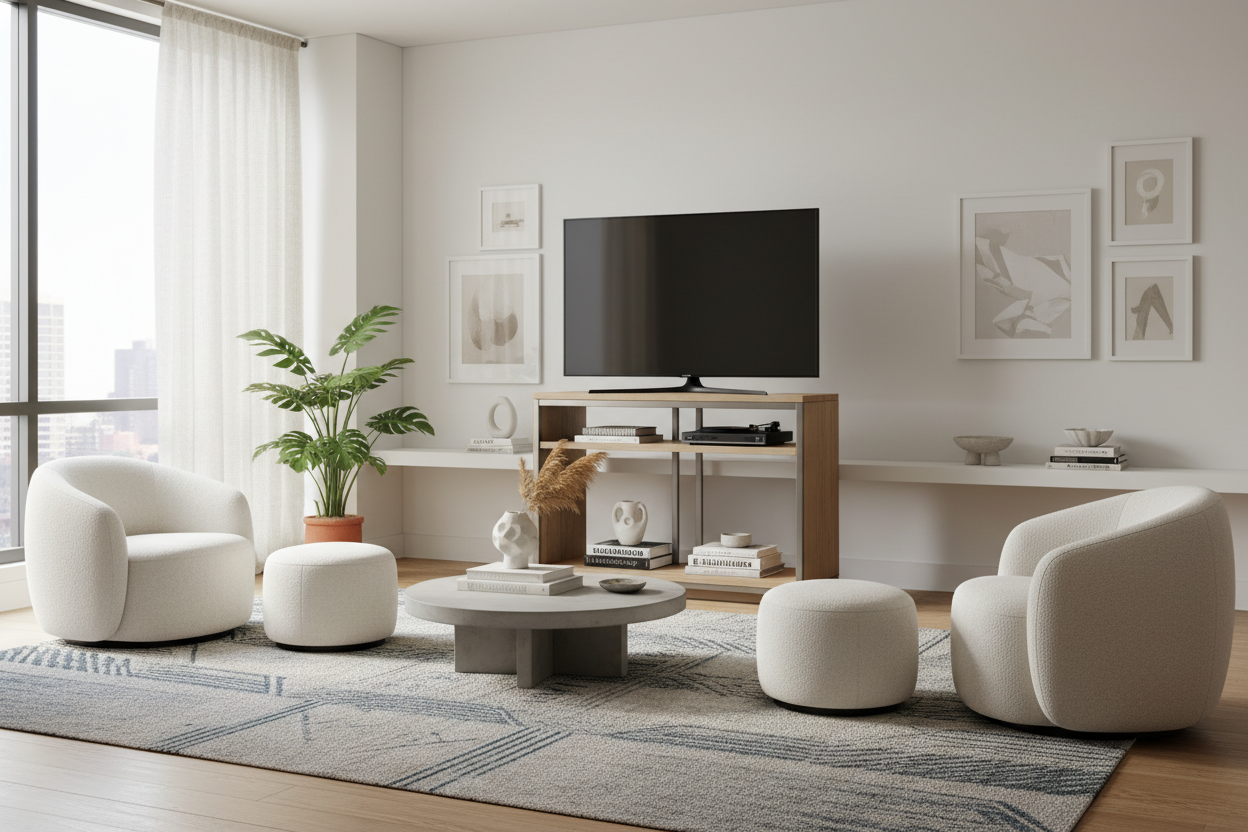
I like to ground the look with a wider piece, like a credenza with sliding glass doors. Since the TV is elevated, you can actually style the top. Put a low-profile tray for remotes on one side and maybe a stack of art books on the other. Just keep the decor below the bottom edge of the screen so you do not create a visual distraction during movie night.
Other Clever Fixes for Tricky Floor Plans
Sometimes the issue is not just the wall—it is that the room has no natural focal point. If your living room is just a giant, featureless rectangle, you have to manufacture some interest. Furniture that does double duty is the only way to win here.
If a sleek metal spine feels too industrial for your vibe, consider a perfect TV stand with fireplace. It creates an architectural anchor in a room that lacks a chimney breast, giving you a place to point the furniture that feels intentional rather than forced. It’s about creating a 'zone' where there wasn't one before.
Final Thoughts: Don't Let Your Architecture Bully You
Your furniture should work for your life, not the other way around. If your landlord will not let you drill or your walls are made of hopes and dreams, stop fighting the layout. A hybrid unit gives you the clean, high-end look of a mount with the flexibility of a floor lamp.
Take a look at a solid collection of TV stands and look specifically for the ones with integrated mounting kits. It is the easiest way to fix a 'broken' living room layout without calling a contractor or losing your security deposit.
FAQ
Will this stand hold a 75-inch TV?
Most integrated units are rated for specific weight and size limits. Always check the VESA pattern and weight capacity—many modern steel-spine units can easily handle up to 100 lbs, which covers the vast majority of 75-inch LED screens.
Is it hard to assemble?
It is about 20% more effort than a standard flat-pack console. You are essentially building a small tower on the back of the unit. If you can handle an Allen wrench and have a second person to help lift the screen onto the bracket, you will be fine.
Can I still use a soundbar?
Yes, and it actually looks better. Most people either sit the soundbar on the console surface directly under the hovering TV or use a separate 'soundbar bracket' that attaches to the main mounting spine for a fully floating look.


Leave a comment
This site is protected by hCaptcha and the hCaptcha Privacy Policy and Terms of Service apply.