










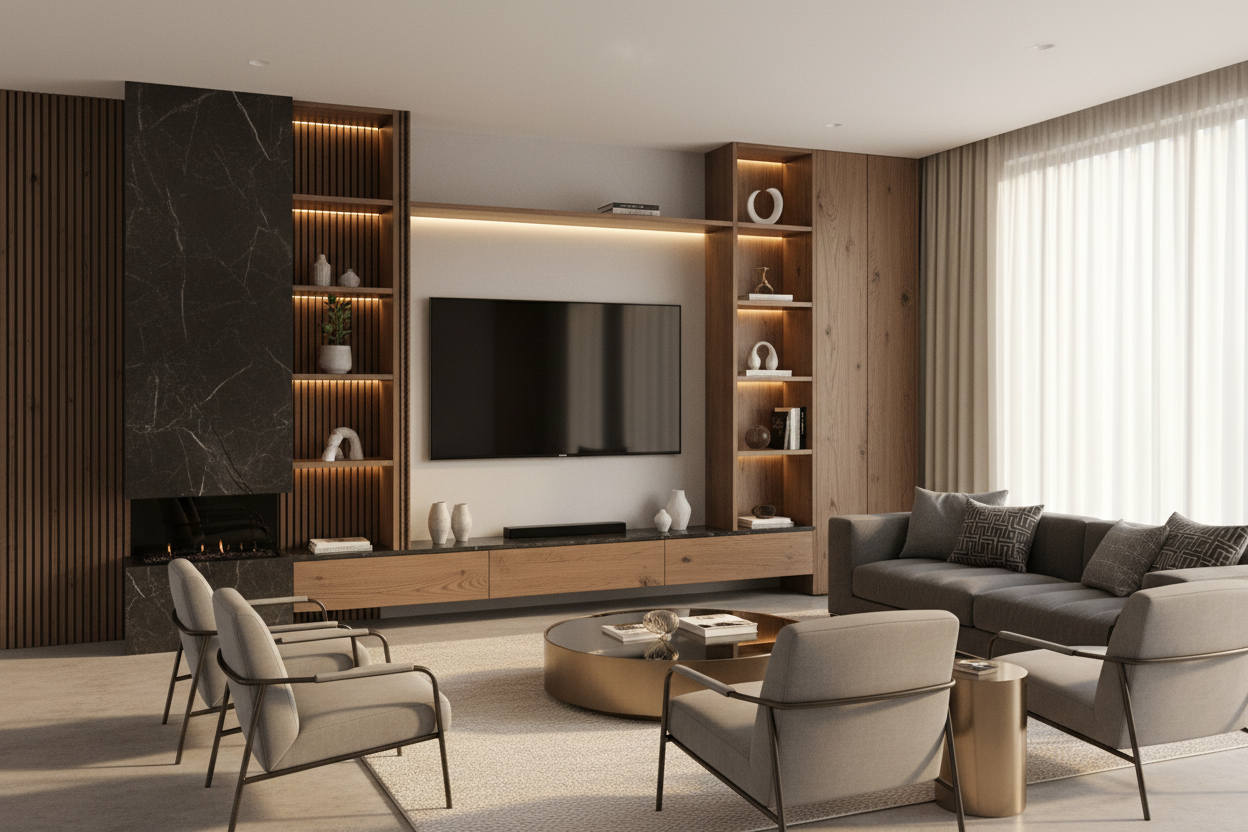
I spent three hours measuring, leveling, and sweating over my 65-inch OLED mount last year, only to step back and realize I hated it. The TV was floating like a lonely black monolith four feet above a dinky, 40-inch shelf I’d kept since college. It looked less like a curated home and more like a waiting room at a budget tire shop. That awkward vertical gap is the silent killer of good design, and honestly, a living room tv wall unit is the only way to actually fix it.
- Stop the 'hovering rectangle' look by connecting your TV to your furniture visually.
- Measure for a unit that is at least 20% wider than your screen to maintain balance.
- Integrated back panels are the only real way to hide cable clutter forever.
- Scale matters: a tall unit can make a small room feel more architectural, not just cluttered.
The 'Hovering Rectangle' Epidemic
Walk into almost any suburban home and you will see it: a massive flat screen bolted to the drywall with about two feet of empty space underneath it. Below that, a tiny console sits on the floor, looking overwhelmed and undersized. We’ve been told that mounting a TV saves space, but without a cohesive living room tv wall unit, you’re just creating a weird, disjointed dead zone on your wall.
The problem is visual weight. A large screen is heavy, dark, and demanding. When it hangs there without anything framing it or supporting it from below, it feels unstable. I’ve seen 85-inch screens paired with 50-inch stands, and it makes the whole room feel top-heavy. You need something that spans the width of the wall to ground that giant piece of glass.
Bridging the Gap With a Living Room TV Wall Unit
A wall unit isn't just a fancy word for a big shelf; it’s a way to bridge the gap between your electronics and your architecture. Instead of two separate objects—the TV and the stand—you create one singular focal point. By choosing a unit that rises up to meet or surround the screen, you eliminate that 'floating' sensation that makes a room feel unfinished.
If you aren't ready for a full floor-to-ceiling built-in, you should at least look at a wide tv stand entertainment stand. The goal is to have the furniture extend well past the edges of the TV. When the stand is wider than the screen, it creates a visual base that makes the TV look like it belongs there, rather than like it was just slapped onto the wall as an afterthought.
It Finally Kills the Plastic Cord Cover
We need to talk about those adhesive plastic cord channels. You know the ones—the 'paintable' strips that never actually match your wall color and always peel off after six months. They are an eyesore. A proper tv wall unit for living room setups solves this by providing a dedicated backplane or internal cable management system.
I’ve tried the 'behind the drywall' kits, and unless you’re handy with a saw and local building codes, they’re a nightmare. A wall unit with a back panel allows you to run every HDMI and power cable behind the furniture, keeping the look clean without needing to perform surgery on your house. It’s the easiest way to get that 'magazine look' without the contractor bill.
Proportions Matter: Getting the Scale Right
Scale is where most people trip up. I once bought a massive dark oak unit for a 10x10 room and it felt like a giant was standing over me while I watched Netflix. You want the unit to be substantial enough for anchoring your living room, but you have to watch the depth. Aim for a unit that is about 15-18 inches deep; anything more starts to eat into your walking paths.
Height is the other factor. If you have 8-foot ceilings, a unit that stops at 5 feet can look stunted. Go higher or stay low and wide. The middle ground usually looks accidental. I prefer units that offer a mix of closed cabinetry at the bottom (to hide the ugly PlayStation controllers) and open shelving at the top to keep the room feeling airy.
Why I'm Done With Basic Low-Profile Consoles
I used to be a low-profile console purist. I thought 'less is more' until I realized I had nowhere to put my books, my router looked like a robotic spider on top of the counter, and my wall looked naked. Making the jump to a modern wall cabinet for living room storage was the best move I made for my current apartment.
It’s not just about the TV; it’s about the storage. Having a place to tuck away the tech mess while creating a frame for the screen makes the entire room feel intentional. Yes, it’s a bigger investment than a $99 particle-board stand, but the difference in how the room feels is night and day. It stops being a room with a TV in it and starts being a designed living space.
FAQ
How wide should my wall unit be compared to my TV?
The golden rule is that the unit should be at least 20% wider than the TV. If your TV is 60 inches wide, your unit should be at least 72 inches. This prevents the 'overhang' look that makes a room feel cramped and cheap.
Is a wall unit too much for a small apartment?
Actually, no. One large, well-proportioned piece of furniture often makes a small room feel bigger than five small, scattered pieces. Stick to lighter wood tones or whites if you’re worried about it feeling too heavy.
Do I still need to mount the TV if I have a wall unit?
You don't have to, but I still recommend it. Mounting the TV about 6 inches above the surface of the unit gives you room for a soundbar or some decor, while the wall unit still provides the visual 'grounding' the screen needs.


Leave a comment
This site is protected by hCaptcha and the hCaptcha Privacy Policy and Terms of Service apply.