










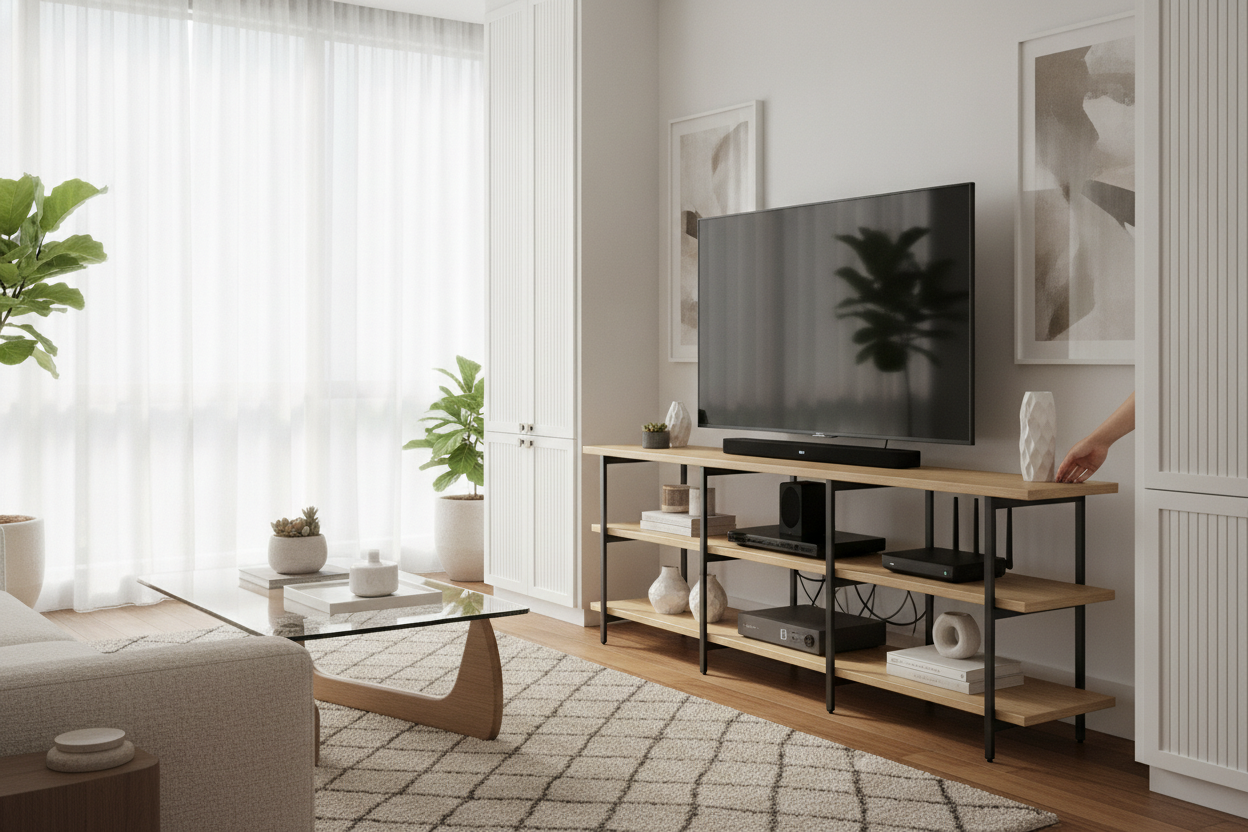
I remember unboxing my PS5 like it was Christmas morning, only to realize the 'standard' cubby in my $800 console was exactly 14 inches high. The PS5, in its vertical glory, is 15.4 inches. I ended up with a massive piece of white plastic sitting on a stack of magazines on the floor because my furniture was too stubborn to change. It was the moment I realized that buying a tv stand with adjustable shelves isn't a luxury; it is a basic requirement for anyone who actually owns electronics.
- Fixed shelves are the enemy of tech upgrades and oversized coffee table books.
- Always look for at least five peg holes per section for true flexibility.
- Metal shelf pegs are non-negotiable if you are storing heavy receivers or vinyl.
- Adjustable shelving allows for better airflow, preventing your gear from overheating.
The Day I Realized Fixed Shelves Are a Scam
I spent weeks shopping for modern TV stands, finally settling on a piece that looked like it belonged in a high-end gallery. It had these perfectly symmetrical, fixed cubbies that looked great in the professional listing photos. But those photos didn't show a real human's life. They didn't show the chunky cable box, the vintage Marantz receiver I inherited, or the vertical height of a modern gaming console.
When I tried to set everything up, I was half an inch short of a fit. Just half an inch. Because those shelves were glued and doweled into place, that half-inch might as well have been a mile. I was stuck with a 'beautiful' piece of furniture that forced my tech into awkward, overheating piles on the top surface. It looked cluttered, messy, and completely defeated the point of buying a dedicated media console.
Why a TV Stand With Adjustable Shelves Is Future-Proofing
Technology has a habit of changing shapes every few years. One year everything is a slim black box; the next, we are back to massive towers and VR hubs. If your furniture is rigid, you are essentially committing to never upgrading your gear, or worse, buying a new stand every time Sony or Microsoft releases a new console. That is a waste of money and a headache you don't need.
A stand with movable internals adapts to your life. Maybe today you need a tall gap for a subwoofer, but next year you decide to ditch the sub and want three narrow slots for a 4K player and a Nintendo Switch. Flexible shelving means your furniture grows with your hobbies instead of becoming an obstacle to them. It is the difference between a piece of furniture that lasts three years and one that lasts a decade.
3 Things I Always Check Before Buying
Not all adjustable shelves are created equal. I have bought cheap units where the 'adjustment' was just two possible positions, which is barely an improvement over fixed wood. You have to look closer at the specs and the assembly photos to know if it will actually work for your specific setup.
The 'Peg Hole' Count Matters
When you are looking at the interior of a cabinet, count the holes. If you see three lonely holes in the middle of the side panel, keep moving. You want a row of holes that spans almost the entire vertical height of the unit. This gives you the freedom to place a shelf exactly where you need it, whether that is two inches from the bottom or right at the top.
I recently looked at a mid century modern TV stand that nailed this. It used a series of increments that allowed for micro-adjustments. This is especially helpful for hiding cables; you can align the shelf height perfectly with the pre-drilled cable management holes in the back panel so your wires aren't straining at weird angles.
Don't Ignore the Weight Capacity
Adjustable shelves are usually held up by four tiny pegs. If those pegs are plastic, they will eventually shear off under the weight of a heavy amplifier or a stack of records. I have seen it happen, and the resulting crash is never pretty. Always check the weight rating per shelf—usually, you want something that can handle at least 25-30 pounds if you are a power user.
How I Style the 'Awkward' Gaps
One downside of moving shelves to accommodate a tall item is that you often end up with a very skinny, 3-inch gap on the shelf above it. Most people leave this empty, but that just looks like a mistake. I use those 'sliver' spaces for things that are naturally flat. Think of a stack of oversized coffee table books that don't fit on your regular bookshelf, or a dedicated tray for all those stray remotes and controllers.
If you have an extra long barn door TV stand, you have even more room to play. I like to keep one side of the console dedicated to the tall, ugly tech (hidden behind a door) and use the other adjustable sections for decor. By varying the shelf heights on the 'display' side, you create visual interest that makes the whole room feel more custom and less like it came out of a flat-pack box.
The Verdict: Stop Boxing Yourself In
Stop buying furniture that dictates how you live. Your living room should serve your needs, not the other way around. A rigid media console is a ticking clock—eventually, you will buy something that doesn't fit, and you will be right back on the internet looking for a replacement. Prioritize a tv stand with adjustable shelves and give yourself the breathing room to upgrade your tech whenever you want. It is the smartest move you can make for a functional, stress-free media setup.
FAQ
Can I add more holes to a stand I already own?
If it is solid wood or high-quality plywood, yes, you can use a shelf pin jig to drill new holes. If it is cheap particle board, don't touch it—you will likely cause the laminate to peel or the board to crumble.
Are metal or plastic shelf pins better?
Metal, every single time. Plastic pins get brittle over time and can snap without warning. If your stand comes with plastic ones, spend five dollars at the hardware store to replace them with steel versions.
How much clearance do I need for electronics?
Never shove a console into a space where it has less than two inches of clearance on the top and sides. Adjustable shelves are great for creating this 'breathing room' so your gear doesn't overheat and die an early death.

Leave a comment
This site is protected by hCaptcha and the hCaptcha Privacy Policy and Terms of Service apply.