










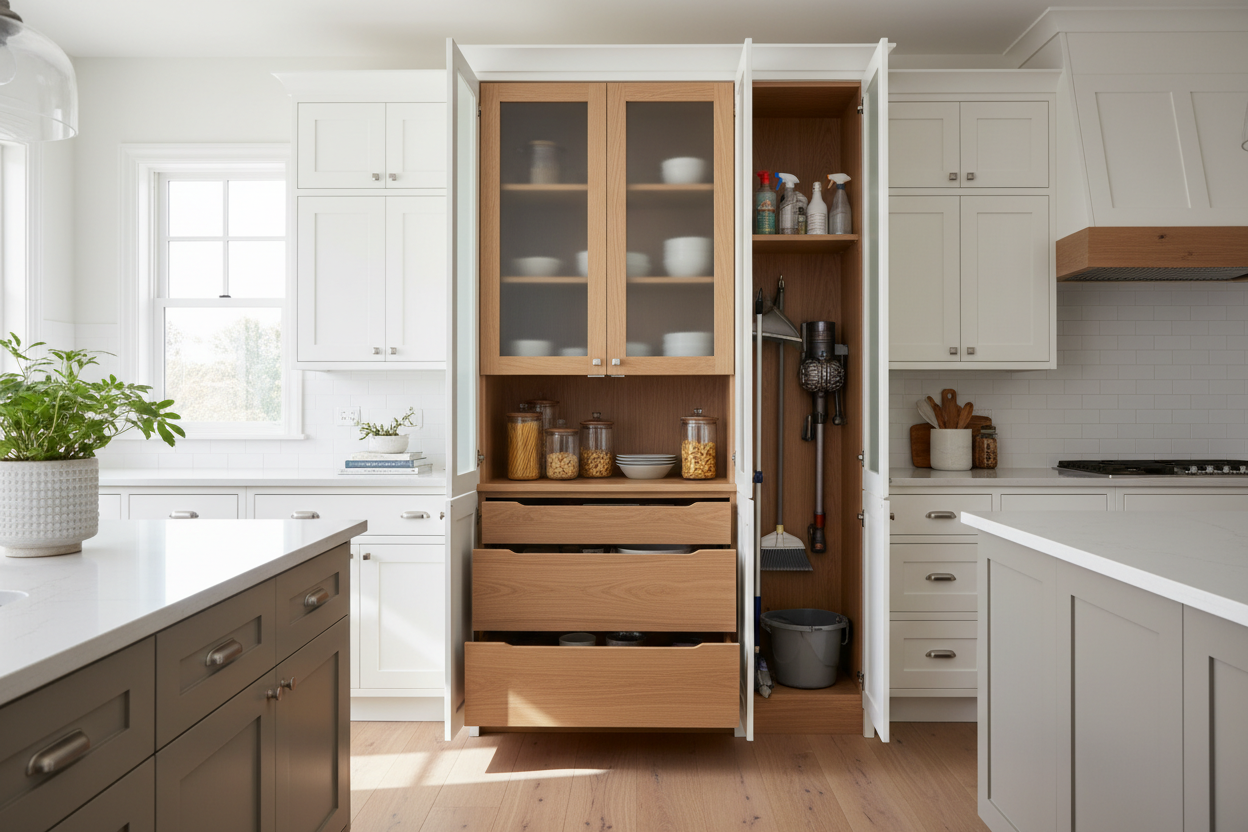
I spent three years leaning my mop against the side of my refrigerator. Every time someone walked by too fast, it would clatter to the floor like a clumsy ghost. If you live in a house built before 1960, you know the struggle: architects apparently thought we would all just stop cleaning our floors or keep our brooms in the backyard. My kitchen was a disaster of visual noise, with a vacuum cord perpetually tangled around the legs of a barstool.
I finally caved and bought a pantry utility cabinet to act as the closet I never had. It was not just about hiding the Swiffer; it was about reclaiming my kitchen's dignity. When you are staring at 47 browser tabs of storage units at 1 AM, you start to realize that most furniture is designed for either books or clothes, rarely for a gallon of bleach and a Dyson stick vacuum. But a dedicated utility pantry changes the math of a small kitchen entirely.
Quick Takeaways
- Standard broom closets need at least 15 inches of width to fit most modern vacuums comfortably.
- Adjustable shelving is a dealbreaker—you need to be able to move shelves to accommodate tall mops.
- Always check the weight rating; canned goods are heavy, and cheap particle board will bow under 40 cans of beans.
- Wall anchoring is mandatory for these tall, narrow units to prevent tipping.
The Universal House Problem: Zero Broom Closets
The lack of a proper utility closet kitchen setup is a design flaw that haunts thousands of renters and homeowners alike. We have all tried the 'behind the door' trick, only to have the door stop halfway and the broom handle poke us in the shoulder every time we enter the room. It is a small annoyance that adds up to a general feeling of chaos. When your cleaning supplies are on display, your kitchen never actually feels clean, no matter how much you scrub the counters.
I tried the decorative baskets. I tried the over-the-door hangers. Nothing worked because those solutions do not hide the bulk. You need a way to transition from messy open space to closed kitchen pantry storage solutions that actually have the vertical clearance for a full-sized broom. Without a door to shut on the mess, your kitchen remains a workspace rather than a home. A freestanding cabinet provides that missing architectural element without the cost of a full-scale renovation.
What Makes a Utility Pantry Different From a Regular One?
A standard pantry cabinet is usually just a stack of shelves spaced about 10 to 12 inches apart. That is great for boxes of cereal, but it is useless for a vacuum. A utility pantry is a different beast. It usually features a split design: one side or section has a tall, uninterrupted vertical cavity for your long-handled tools, while the other side offers the traditional shelving you need for dry goods. It is the hybrid nature of the piece that makes it valuable.
When I was shopping, I looked for units that used thick MDF or solid wood rather than the flimsy 1/2-inch plywood that sags the moment you put a jar of pickles on it. You want something like this large kitchen cupboard cabinet that handles the heavy lifting of bulkier items while still keeping your canned goods organized. The hardware matters too. In a utility unit, the doors get opened and closed constantly—look for European-style concealed hinges that can be adjusted. If the doors don't align, the whole thing looks cheap, and your vacuum will probably end up peeking through the gap.
How I Fit a Vacuum, a Mop, and 40 Cans of Beans Inside
The secret to making a pantry utility cabinet work is not just shoving everything inside; it is about the internal architecture. I started by installing a small tension rod across the top of the utility section. This allows you to hang spray bottles by their triggers, clearing up floor space for the vacuum base. I also added heavy-duty command hooks to the inside of the door for the dustpan and small hand brushes. This keeps the 'long' items from getting tangled with the 'small' items.
On the shelving side, I separate the food from the chemicals using clear acrylic bins. You do not want a leak from a bottle of floor cleaner to ruin your stash of pasta. I put the heaviest items—the 40 cans of beans and the gallon jugs of water—on the very bottom shelf. This lowers the center of gravity and makes the cabinet much more stable. Most people make the mistake of putting heavy stuff at eye level, which is a recipe for a wobbly cabinet. Use the top shelves for lightweight items like paper towels or extra sponges.
Wait, Where Are You Supposed to Put It?
The biggest hurdle is usually floor space. If your kitchen is already cramped, adding a 72-inch tall cabinet feels like inviting an elephant into the room. But you have to look for 'dead' space. I found that the transition wall between my kitchen and dining room was the perfect spot. It was a five-foot stretch of wall that did nothing but hold a single framed picture. By placing the cabinet there, I created a functional 'zone' that bridged the two rooms.
If you have a truly awkward layout, consider a corner kitchen pantry cabinet set to steal back that square footage in the corner that usually just collects dust. Corners are often the most underutilized parts of a kitchen. If the kitchen is a total no-go, these units actually look great in a hallway or even a laundry room. The key is to find a piece that matches your existing trim or cabinetry so it looks built-in. If you are still struggling with dimensions, I highly recommend this guide to finding the perfect kitchen pantry for your specific wall before you hit 'buy'.
Personal Experience: The Particle Board Disaster
I once bought a very cheap, $99 utility cabinet from a big-box store. It looked fine in the photos, but the back panel was essentially a piece of cardboard held on by tiny nails. Within two months, the weight of my vacuum caused the bottom shelf to crack, and the whole unit started to lean like the Tower of Pisa. I had to trash it. Now, I only buy units with a reinforced base and a minimum shelf thickness of 18mm. It costs a bit more upfront, but it beats having to replace your furniture every time you buy a bulk pack of soup cans.
FAQ
Will my food smell like cleaning supplies?
Only if you are messy. Keep your cleaning liquids in sealed bins on a separate side from your dry goods. If you use strong-smelling stuff like bleach, make sure the caps are tight. I have never had my crackers taste like Windex.
Can a standard upright vacuum fit?
Most 'slim' uprights and almost all stick vacuums (like Dysons or Sharks) fit easily. If you have a massive, old-school industrial vacuum, measure the 'foot' of the machine. You usually need at least 13 to 15 inches of depth and width.
Do I really need to anchor it to the wall?
Yes. 100%. Especially if you are putting heavy cans on the shelves. A tall, narrow cabinet is top-heavy by nature, and pulling a heavy vacuum out can cause it to shift. Most units come with a simple L-bracket—use it.



Dejar un comentario
Este sitio está protegido por hCaptcha y se aplican la Política de privacidad de hCaptcha y los Términos del servicio.