










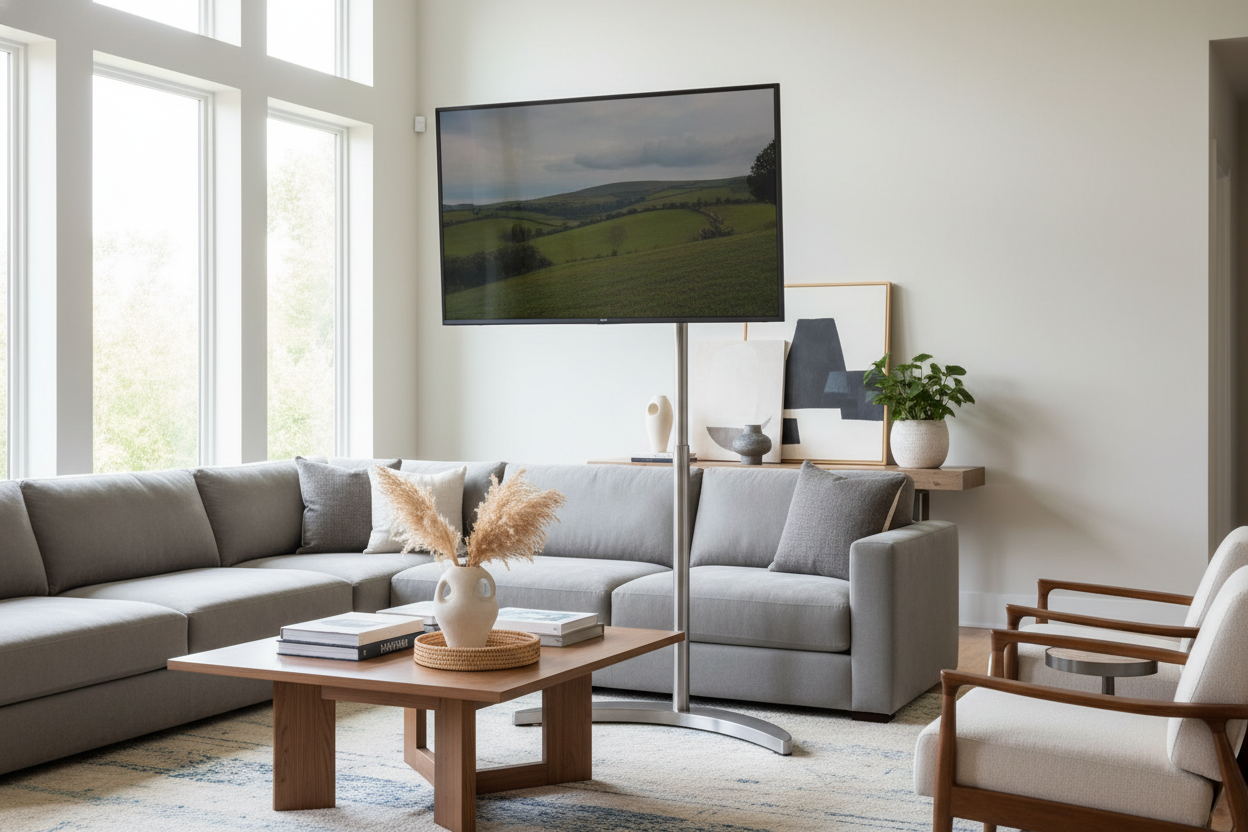
I spent three months agonizing over my open-concept layout. I finally found the perfect 84-inch velvet sofa, but as soon as it was delivered, I realized I had a major problem: I couldn't see the TV while making my morning coffee. The back of the couch was a total wall between my eyeballs and the morning news. Buying an extra tall tv floor stand was the only thing that actually worked without me having to drill massive holes into my rental's drywall.
Quick Takeaways
- Sightlines: You need the screen center to sit at least 50-60 inches high to clear most modern furniture.
- Flexibility: Swivel functions are non-negotiable for watching from different 'zones' like a kitchen or dining area.
- Rental Friendly: These stands provide the height of a wall mount without the security deposit deduction.
- Cable Management: Look for hollow-pole designs to avoid a mess of hanging wires.
The Open Concept Viewing Problem No One Warns You About
When you look at glossy interior design photos, the TV is always perfectly positioned at eye level for someone sitting on the sofa. That works great in a dedicated media room. But in a real house where the kitchen, dining, and living areas are all one big 'great room,' that low-slung placement is a disaster. If you're standing at the island chopping onions, you’re mostly just watching the back of your own couch cushions.
I tried propping my old stand up on books (don't do this) and even considered buying a taller dresser to use as a console. The problem is that most furniture is designed to be 'lounge height.' To actually see over the furniture line from 20 feet away, you need a vertical boost that standard furniture just doesn't offer.
Why Traditional Consoles Fail in Multi-Use Spaces
I’m a huge fan of the mid century modern TV stand aesthetic. The tapered legs and slatted doors look incredible, but most of them top out at 24 inches high. Mathematically, that’s just not enough clearance. If you browse standard TV stands, you'll find that 'tall' usually means 30 inches, which still leaves your screen buried behind the sofa line.
Traditional consoles are meant to be anchors for a room. They take up a lot of visual floor space. In an open plan, you want something with a smaller footprint that lets the light pass through, rather than a bulky wooden box that cuts the room in half.
How an Extra Tall TV Floor Stand Fixed My Line of Sight
The turning point for me was realizing I needed a 'pedestal' rather than a 'cabinet.' I switched to an extra tall floor tv stand that looked more like a gallery easel than a piece of heavy furniture. By lifting the bottom of the TV to about 40 inches off the floor, the entire screen became visible from the kitchen island. It was a revelation.
This is exactly why I bought a tall TV floor stand. It’s not just about the height; it’s about the swivel. Now, when I’m eating at the dining table, I just give the screen a 30-degree nudge, and the viewing angle is perfect. When I'm done, it swings back to face the sofa for movie night.
The Exact Height You Need to Clear a Standard Sofa
Let's talk numbers. Your average 'high-back' sofa sits around 32 to 34 inches tall. If you want a clear line of sight from a barstool or while standing, the bottom bezel of your TV needs to sit at least 36 inches off the ground. Most extra-tall stands allow the mounting bracket to slide up to 60 or 65 inches. I found that setting my 55-inch screen so the center is at 52 inches is the 'sweet spot' for both sitting and standing viewers.
Hiding the Cables When the Screen is Suspended in Mid-Air
The biggest worry people have with a pole-style stand is the 'spaghetti' look. Nobody wants three black cables dangling in the middle of their living room. Most quality stands have a hollow central column. I spent 20 minutes fishing my power cord and HDMI cable through the top and out the bottom. It's a clean, minimalist look that doesn't feel as heavy as a gold and marble TV stand might in a smaller apartment.
Is a Freestanding Unit Actually Stable Enough?
I’ll admit, I was nervous. Putting a $1,000 OLED on a single pole felt like a recipe for a heart attack. But these things are engineered with heavy, weighted steel bases. Mine weighs about 25 pounds just for the base alone. It’s remarkably sturdy, even on carpet.
However, if you have a 15-pound cat that thinks every vertical surface is a climbing tree, or a toddler who uses furniture as a jungle gym, you have to be realistic. In those cases, an extra long barn door TV stand pushed against a wall offers a lot more peace of mind. But for a household of adults or calm pets, the floor stand is a sturdy, space-saving hero.
FAQ
Do these stands work with any TV?
As long as your TV has VESA mounting holes on the back (which almost all do), it will work. Just check the weight limit; most stands handle up to 88 lbs easily.
Will it wobble on carpet?
If you have a high-pile shag rug, it might have a tiny bit of play. On low-pile carpet or hard floors, these units are rock solid thanks to the heavy base.
Is it hard to assemble alone?
I did mine in 30 minutes. The hardest part is lifting the TV onto the bracket, so maybe grab a friend for that last five-minute step.

Dejar un comentario
Este sitio está protegido por hCaptcha y se aplican la Política de privacidad de hCaptcha y los Términos del servicio.