










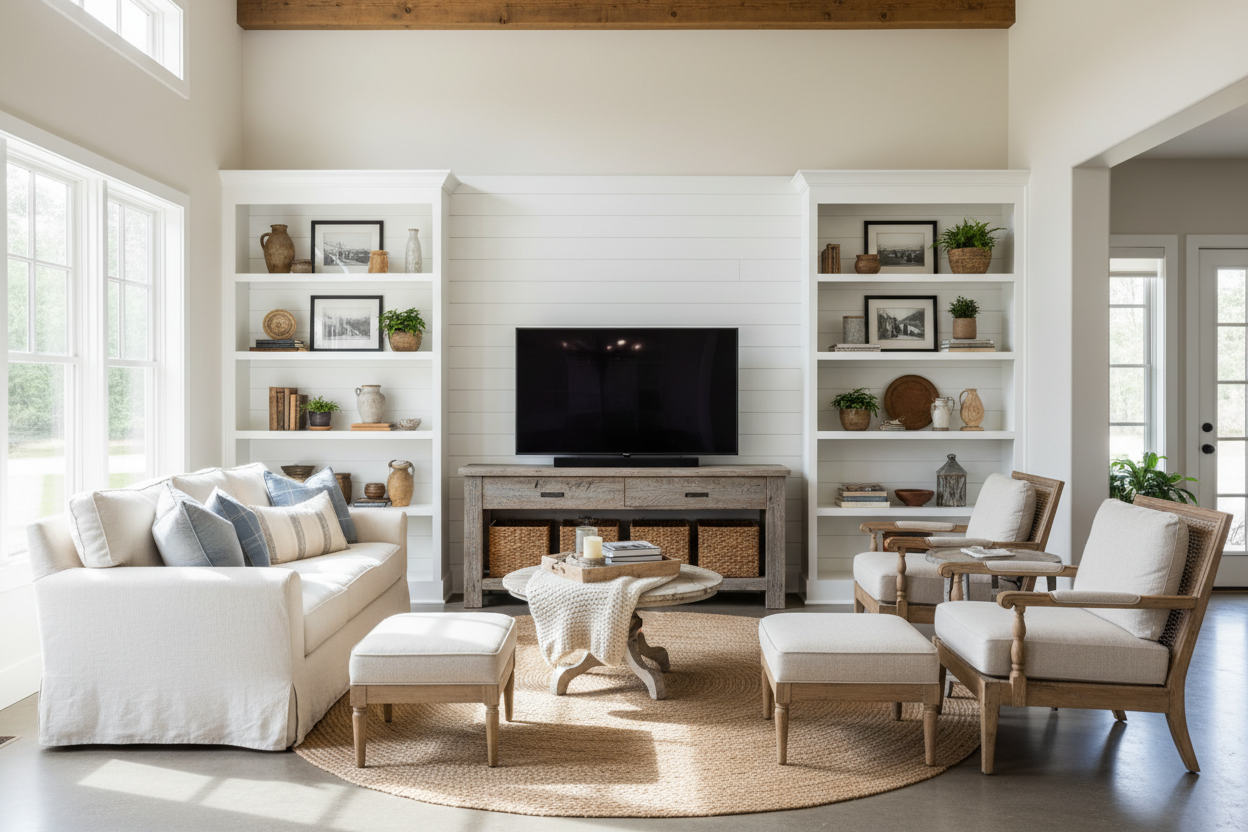
I spent three years living in what I thought was a minimalist dream. It was all white walls, a grey velvet sofa, and a glass-and-chrome media console that looked like it belonged in a tech startup lobby. It was clean, sure, but it was also soul-crushingly cold. Every time I sat down to watch a movie, I felt like I was waiting for a root canal rather than relaxing in my own home.
Searching for the best farmhouse tv stands wasn't even on my radar because I was terrified of my house looking like a craft store exploded. But I needed warmth. I needed something that didn't reflect the glare of my overhead lights like a mirror. I finally realized that my 'sleek' design was just another word for 'empty.'
- Texture is the cure for sterile design; wood grain adds immediate depth.
- Visual weight matters—flimsy metal legs make a large TV look top-heavy and anxious.
- Sliding barn doors are the ultimate hack for hiding messy cable boxes and tangled HDMI cords.
- Distressed finishes hide cat scratches and coffee rings better than any high-gloss lacquer ever could.
The 'Showroom Chill' (Why My Living Room Felt So Cold)
I realized the problem when my mom visited and didn't take her coat off. She said the room felt 'surgical.' She wasn't wrong. My media console was a 60-inch slab of tempered glass and black powder-coated steel. It collected dust like it was getting paid for it, and the tangle of black wires behind it was visible from every single angle. It was a high-maintenance mess that offered zero visual comfort.
The room had no soul because everything was too smooth. There was nowhere for the eye to rest. In a world of screens and plastic, you need something that looks like it actually came from the earth. That 'showroom chill' happens when you prioritize lines over life. I needed a piece that felt permanent, heavy, and a little bit imperfect to balance out the 4K precision of the television.
Swapping Sleek for Character: The Farmhouse Solution
I started hunting for a farmhouse style tv cabinet that actually felt like real wood. I didn't want that fake wood-grain contact paper that peels at the corners after six months of humidity. I wanted something with chunky hardware—iron latches, exposed bolts, and maybe those oversized rollers. When I finally started browsing a collection of TV stands, I looked for pieces with a bit of 'heft.' A solid base makes the TV feel like a permanent part of the room, not just a screen hovering in space.
The difference was immediate. The moment I swapped the glass for a distressed oak finish, the acoustics of the room even seemed to change. The wood softened the space. A farmhouse cabinet provides a tactile experience that metal simply can't. You run your hand over the grain and it feels like a home. Plus, the storage is actually functional. Instead of seeing my Xbox and router glowing in the dark, they were tucked away behind solid doors that actually fit my aesthetic.
Navigating Awkward Layouts Without Losing the Vibe
My living room has this weird alcove next to the fireplace that makes a standard 70-inch console look ridiculous. It is too narrow for a full sideboard but too wide for a simple plant stand. This is where farmhouse corner TV stands saved my sanity. They utilize that dead triangular space without making the room feel cramped or making the TV the 'bully' of the floor plan.
If you are dealing with an off-center fireplace or a room that is more of a hallway than a living space, don't try to force a rectangular piece where it doesn't want to go. The beauty of the farmhouse aesthetic is that it feels 'found.' It doesn't have to be perfectly symmetrical to look good. A corner unit in a soft white or a reclaimed grey finish can turn a frustrating architectural quirk into the coziest spot in the house.
How to Avoid the 'Barn Theme Park' Look
Don't go overboard. You do not need a literal pitchfork on the wall or a 'Farmers Market' sign to make this work. If you have a rustic media center, keep your coffee table modern or your rug geometric. It is the same logic as buying a farmhouse china cabinet; you want the piece to be a focal point, not a costume. I paired my reclaimed wood stand with a sleek, low-profile leather chair. The contrast makes the wood look intentional, not accidental.
Avoid the 'matchy-matchy' trap. You don't need the end tables, the coffee table, and the TV stand to all come from the same boxed set. Mix your woods. If your TV stand is a dark walnut farmhouse style, try a lighter oak or even a painted metal side table. This prevents the room from feeling like a furniture showroom and makes it feel like a space you’ve curated over time. Trust me, your living room will thank you for the breathing room.
Is farmhouse style going out of fashion?
Trends cycle, but natural wood and functional storage are timeless. To keep it current, avoid overly 'shabby chic' finishes and stick to clean lines with rustic textures. It’s about the material, not the gimmick.
How do I hide cables in a farmhouse stand?
Most quality stands come with pre-drilled holes in the back panels. If yours doesn't, a simple 2-inch spade bit and a power drill can fix that in ten seconds. Use Velcro ties to bundle cords behind the central support beam.
What size stand do I need for a 65-inch TV?
Do not just match the width. Your stand should be at least 4-6 inches wider than the TV on both sides. For a 65-inch TV (which is usually about 57 inches wide), look for a stand that is at least 65 to 70 inches long to keep it from looking top-heavy.


Dejar un comentario
Este sitio está protegido por hCaptcha y se aplican la Política de privacidad de hCaptcha y los Términos del servicio.