










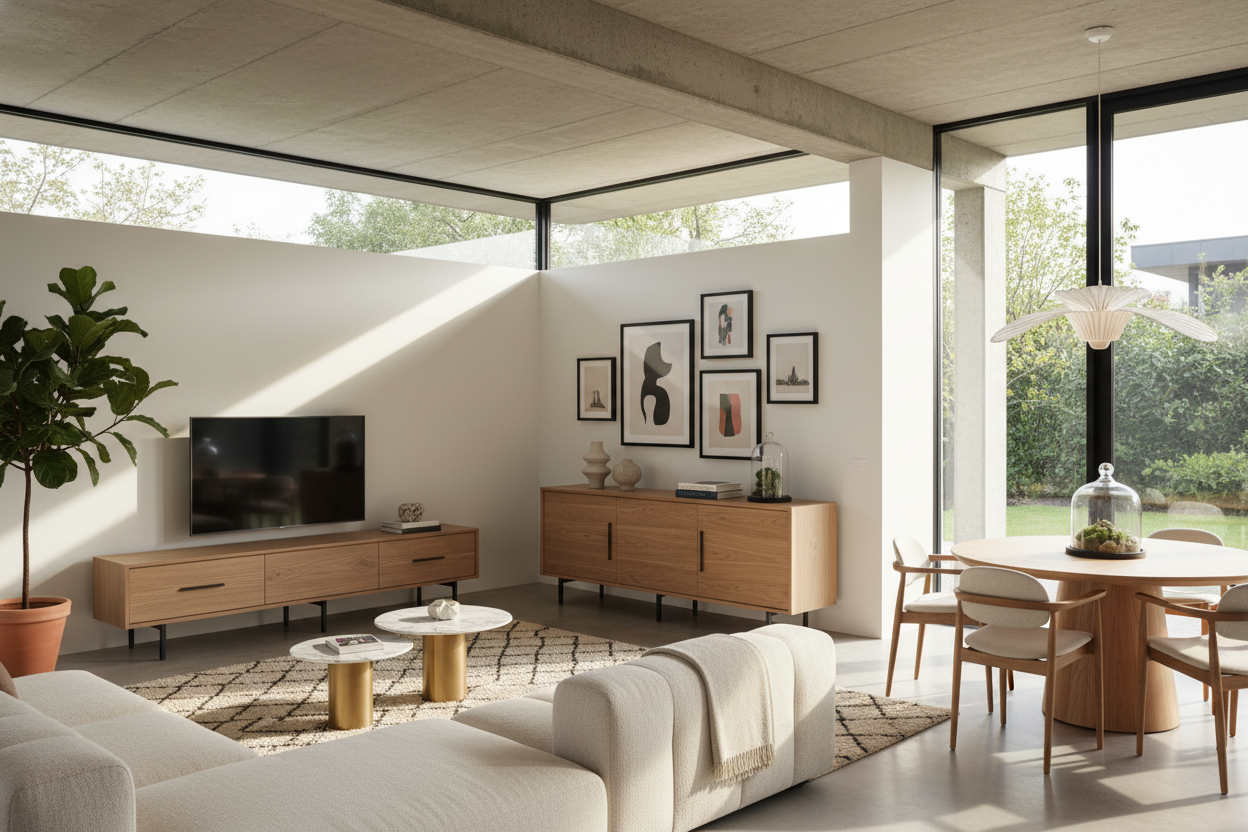
I spent three months living in what felt like a high-end basketball court. My apartment has gorgeous 10-foot ceilings and a massive open floor plan, but every time I sat on the sofa, I felt like I was floating in a void. I had the 10x14 rug, the sectional, and the floor lamps, but the room still felt like a series of disjointed islands rather than a home.
I finally realized that a coordinated tv unit and sideboard was the missing link to making the space feel intentional. By choosing pieces that shared a design DNA, I was able to anchor the living and dining zones without building a single wall or buying a tacky folding screen. Here is how I finally stopped the echo and started actually enjoying my layout.
- Rugs define the floor, but substantial furniture defines the vertical space.
- Matching wood tones across a tv unit sideboard pairing creates a visual 'anchor' for the whole room.
- Enclosed storage is the only way to stop dining room clutter from migrating to the sofa.
- Scale is everything—your TV stand should always be wider than your screen to avoid a top-heavy look.
The Open Concept Curse (And Why Rugs Are Not Enough)
We have all been told that a big area rug is the secret to zoning an open room. I tried it. I bought a plush wool rug for the living area and a flat-weave for the dining table. It looked okay from the ceiling, but at eye level, the room still felt like a chaotic mess. The problem is that rugs are flat. They don't provide the visual weight needed to stop your eyes from wandering across the entire apartment.
When you have a giant, echoey room, you need furniture that acts as a boundary. I realized my 'living room' was just a sofa facing a blank wall, while my 'dining room' was just a table in the middle of nowhere. There was no conversation between the two spaces. Without a heavy piece of furniture on the walls of each zone, the middle of the room just felt like a drafty corridor.
Why I Finally Bought Both a TV Unit and Sideboard
The breakthrough happened when I stopped looking for 'living room furniture' and 'dining room furniture' as separate categories. I needed a cohesive strategy. I started to browse dedicated TV stands that had enough presence to handle my tech, but I knew I couldn't stop there. If I got a beautiful walnut media console, my white IKEA dining table on the other side of the room would look even more out of place.
I decided to buy a sideboard for the dining area that mirrored the materials of my new media unit. This wasn't about being 'matchy-matchy' in a 1990s showroom way. It was about creating a visual thread. By placing a substantial sideboard against the far wall of the dining area and a matching TV unit in the living area, I created two heavy 'anchors' that pulled the room into alignment. Suddenly, the space between them felt like a purposeful transition rather than a mistake.
Creating Visual Flow (Without Looking Like a Catalog)
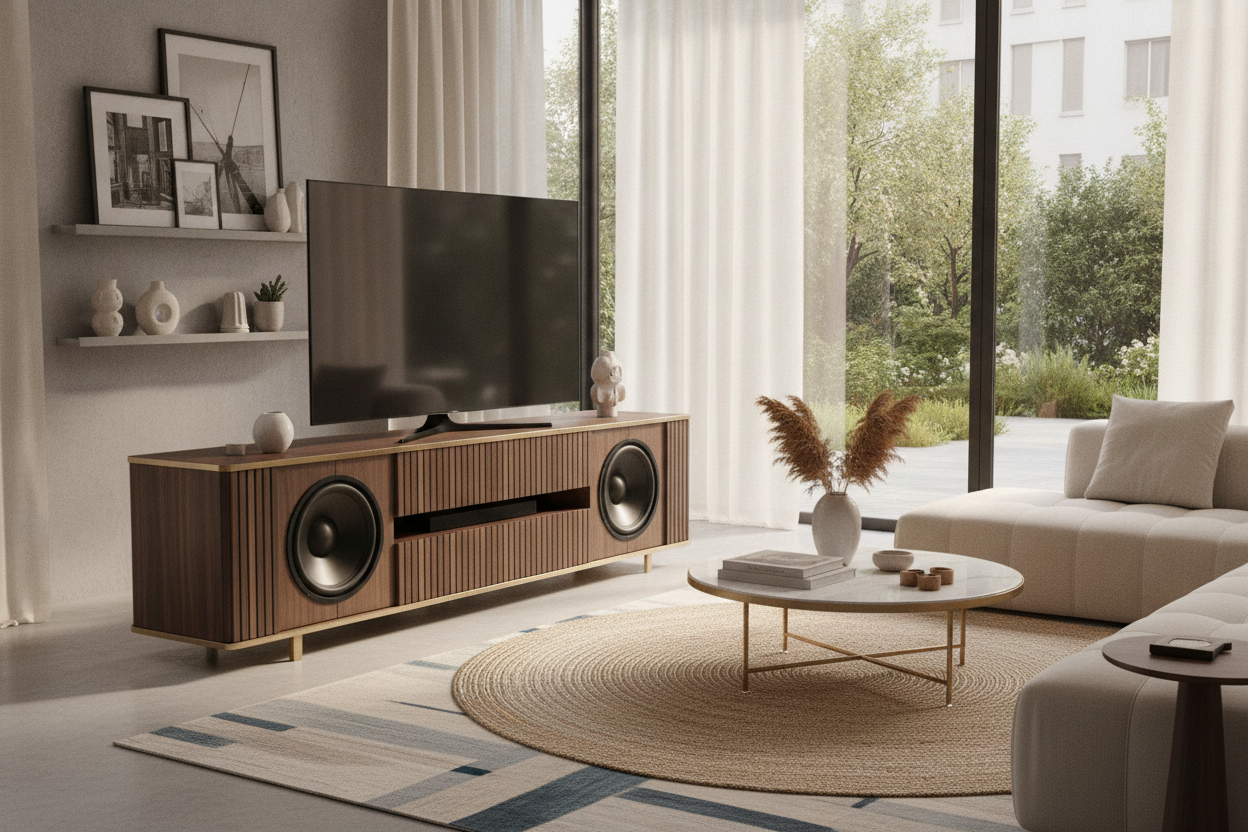
The fear of the 'matching set' is real. You don't want your house to look like you bought everything on page 42 of a discount flyer. To avoid this, I looked for pieces that shared a material—like a specific walnut veneer or powder-coated steel legs—but had slightly different silhouettes. For example, a mid century modern tv stand with slatted doors works beautifully with a sideboard that has solid doors in the same wood finish.
The slatted doors on the TV unit handle the infrared signals for my consoles, while the solid doors on the sideboard hide my messy collection of mismatched serving platters. They look like cousins, not twins. This shared design language tells your brain, 'Yes, these are two different rooms, but they belong in the same house.'
Taming the Shared Space Clutter
In an open floor plan, clutter is contagious. If you don't have a place for the mail in the dining area, it ends up on the coffee table. If you don't have a spot for the board games in the living room, they end up stacked on the dining chairs. Having both a tv unit sideboard setup gave me double the 'black hole' storage. I opted for units with 18-inch depths, which is the sweet spot for hiding everything from oversized cookbooks to a PlayStation 5.
Getting the Scale Right So It Does Not Look Awkward
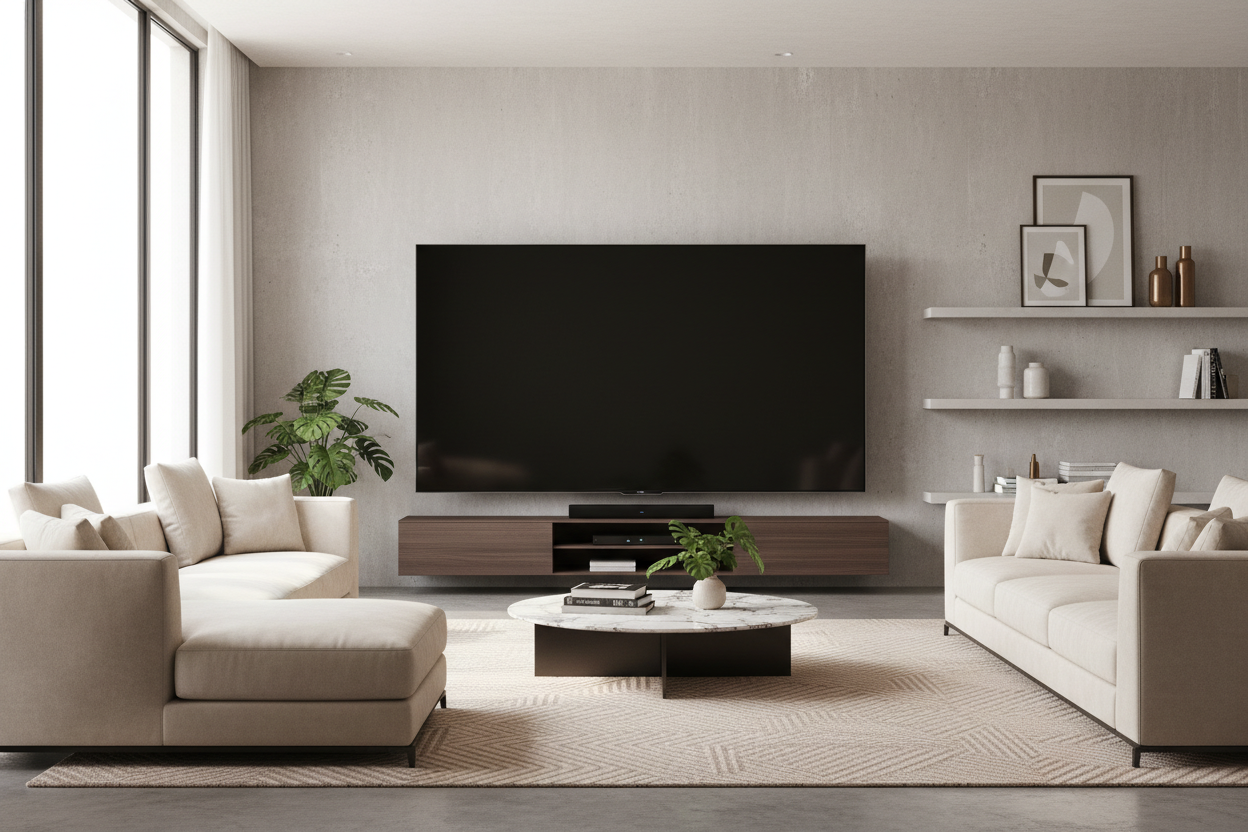
The biggest mistake I see—and one I made myself early on—is buying a TV unit that is too small for the screen. If your TV hangs over the edges of the stand, the whole room feels off-balance. I upgraded to a 65-inch OLED, and my old 50-inch console made it look like a mushroom. A massive 75 inch tv wall unit provides the necessary horizontal 'runway' to balance out that big black rectangle on the wall.
On the opposite side of the room, your sideboard should ideally be a similar height to your TV stand, or slightly taller. If one is 18 inches high and the other is 36 inches high, the room will feel like it's tilting. I kept both of mine within 6 inches of each other's height, which maintains a consistent horizon line across the open space. It’s a subtle trick, but it’s why professional interiors look so 'calm.'
The Final Verdict: Is Buying Two Large Pieces Worth It?
I’ll be honest: buying two pieces of high-quality furniture at once isn't cheap. I spent about $1,400 total. But compared to the cost of hiring a contractor to build a partition wall or buying three different 'room dividing' bookshelves that just collect dust, it was a bargain. The room finally feels finished. I don't feel like I'm camping in a warehouse anymore. If you're struggling with an open layout, stop buying small accessories and invest in two big, coordinating anchors. Your sanity (and your storage) will thank you.
FAQ
Do my TV unit and sideboard have to be the same brand?
Absolutely not. In fact, it's often better if they aren't. Just match the primary material (like oak or walnut) and the leg style. If one has tapered wooden legs and the other has chunky metal ones, they'll fight for attention.
Can I use a sideboard as a TV stand?
You can, but check the height. Sideboards are often 30-34 inches tall, which is great for a dining room but might give you neck strain if you're sitting on a low sofa. Aim for a viewing height where the center of the TV is at eye level.
What is the best depth for these pieces in a narrow room?
If your space is tight, look for 'slim' versions that are 14-15 inches deep. Most standard units are 18 inches, which can eat up a lot of floor space in a narrow apartment. Just measure your largest media component first!

Dejar un comentario
Este sitio está protegido por hCaptcha y se aplican la Política de privacidad de hCaptcha y los Términos del servicio.