










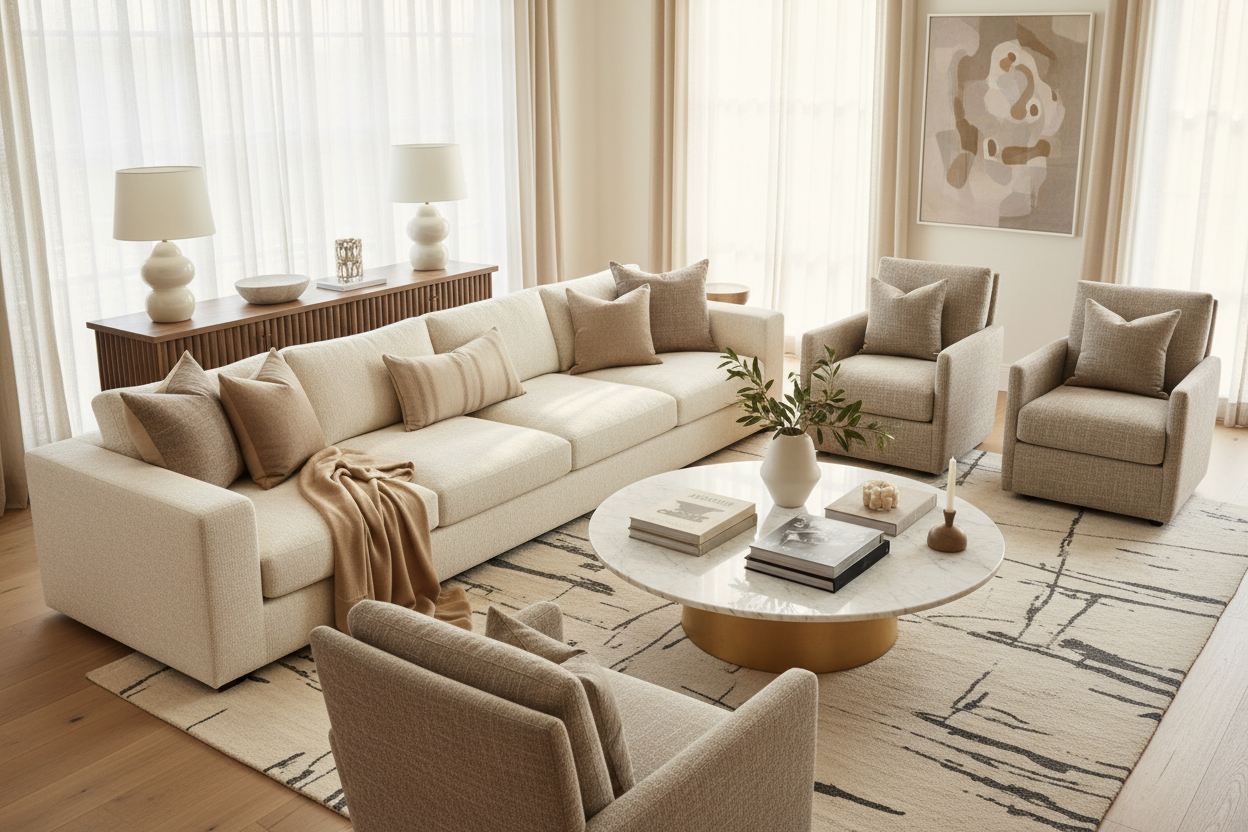
One of the most frequent dilemmas I encounter in the showroom is the fear of the "beige box." Clients worry that selecting furniture in creams, taupes, or grays will leave their living room feeling sterile or uninspired. However, the reality is quite the opposite. A high-quality neutral sectional couch serves as the ultimate architectural anchor. It allows your space to breathe and provides a sophisticated canvas that evolves with your taste, rather than locking you into a fleeting color trend.
Key Features to Look For
Before committing to a purchase, review these non-negotiables to ensure your investment stands the test of time. This checklist will help you filter through the overwhelming number of options:
- Frame Construction: Look for kiln-dried hardwood frames to prevent warping over time. Avoid particleboard.
- Fabric Performance: For a neutral sectional sofa, opt for Crypton or high-performance weaves that resist staining, especially if you choose lighter tones.
- Cushion Composition: A high-density foam core wrapped in down provides the best balance of structure and "sink-in" comfort.
- Configuration: Measure your traffic flow. Ensure the chaise or corner piece doesn't block the primary pathway into the room.
Choosing the Right Material for Longevity
When dealing with a neutral couch sectional, texture is your best friend. Since you aren't relying on bold color to make a statement, the tactile quality of the fabric becomes the focal point. A flat, cotton weave can look pedestrian in a large format. Instead, consider a heavy bouclé, a performance velvet, or a linen blend with a tight weave.
From a durability standpoint, pay attention to the "double rub" count. For a main living area, I recommend a fabric rated for at least 30,000 double rubs. This ensures that the friction from daily sitting won't wear bald spots into your beautiful ivory or oatmeal upholstery within the first year.
Space Planning and Visual Weight
Balancing the Silhouette
Sectionals are inherently large pieces of furniture. To prevent a neutral sectional from swallowing the room, consider the silhouette. If you have low ceilings, opt for a low-profile back. If your space is smaller, look for a design with raised legs. Seeing the floor beneath the sofa reduces its visual weight, making the room appear airier.
The Rug Rule
A common mistake is pairing a large sectional with a rug that is too small. To create a cohesive luxury look, your rug should extend at least six inches beyond the ends of the sectional. Ideally, all front legs of the sectional should sit firmly on the rug to ground the seating area.
Layering for Depth
To elevate the aesthetic, you must layer. A monochromatic palette falls flat without variation. If your sectional is a cool light gray, pair it with warm wood side tables and a leather ottoman to introduce contrast. Use throw pillows not just for color, but for material diversity—mix chunky knits with smooth silks or raw leathers. This creates a curated, high-end feel that looks collected rather than purchased from a catalog.
My Personal Take on the Neutral Sectional
I want to share a harsh reality from a project I managed about three years ago. I specified a stunning, high-end oyster linen sectional for a client. It looked magazine-ready on install day. Two weeks later, the client called me in a panic. The issue wasn't wine or coffee—it was blue dye transfer.
New, dark wash denim jeans had left a faint but noticeable blue haze on the seating cushions. It’s a detail showroom lighting rarely reveals. Since then, I always advise clients: if you live in denim, either opt for a slightly darker taupe or ensure the fabric is a treatable performance blend that can handle solvent-based cleaners. Also, I realized that with neutral fabrics, the "shadows" from sagging cushions are much more visible than on dark fabrics. You absolutely must rotate your cushions weekly. If the cushions are fixed (non-reversible), you will see the "favorite spot" divot much faster on a light neutral surface.
Conclusion
Investing in a neutral sectional is a decision to prioritize longevity and versatility. By focusing on performance fabrics, correct scaling, and rich textural layering, you create a living space that feels sophisticated and inviting. Don't just fill a corner; curate a foundation for your home's memories.
Frequently Asked Questions
How do I keep a light neutral sectional clean with pets?
Focus on "performance" fabrics like solution-dyed acrylics or microfiber. These materials are hydrophobic, meaning liquids bead up rather than soak in. Additionally, vacuuming the fabric weekly prevents dust and fur from embedding into the weave, which causes dinginess over time.
What is the difference between Left-Arm Facing and Right-Arm Facing?
This is the most common ordering mistake. Stand directly in front of the spot where the sofa will go, facing the wall. If you want the arm (or chaise) on your right side as you look at it, you need a Right-Arm Facing (RAF) unit. If you want it on the left, order Left-Arm Facing (LAF).
Can I put a sectional in a small living room?
Absolutely. In fact, one continuous piece of furniture often makes a small room feel larger than cluttering it with a sofa and separate chairs. Look for a "condo-sized" or modular neutral sectional that allows you to customize the length to fit your specific wall dimensions without overcrowding.


Dejar un comentario
Este sitio está protegido por hCaptcha y se aplican la Política de privacidad de hCaptcha y los Términos del servicio.