










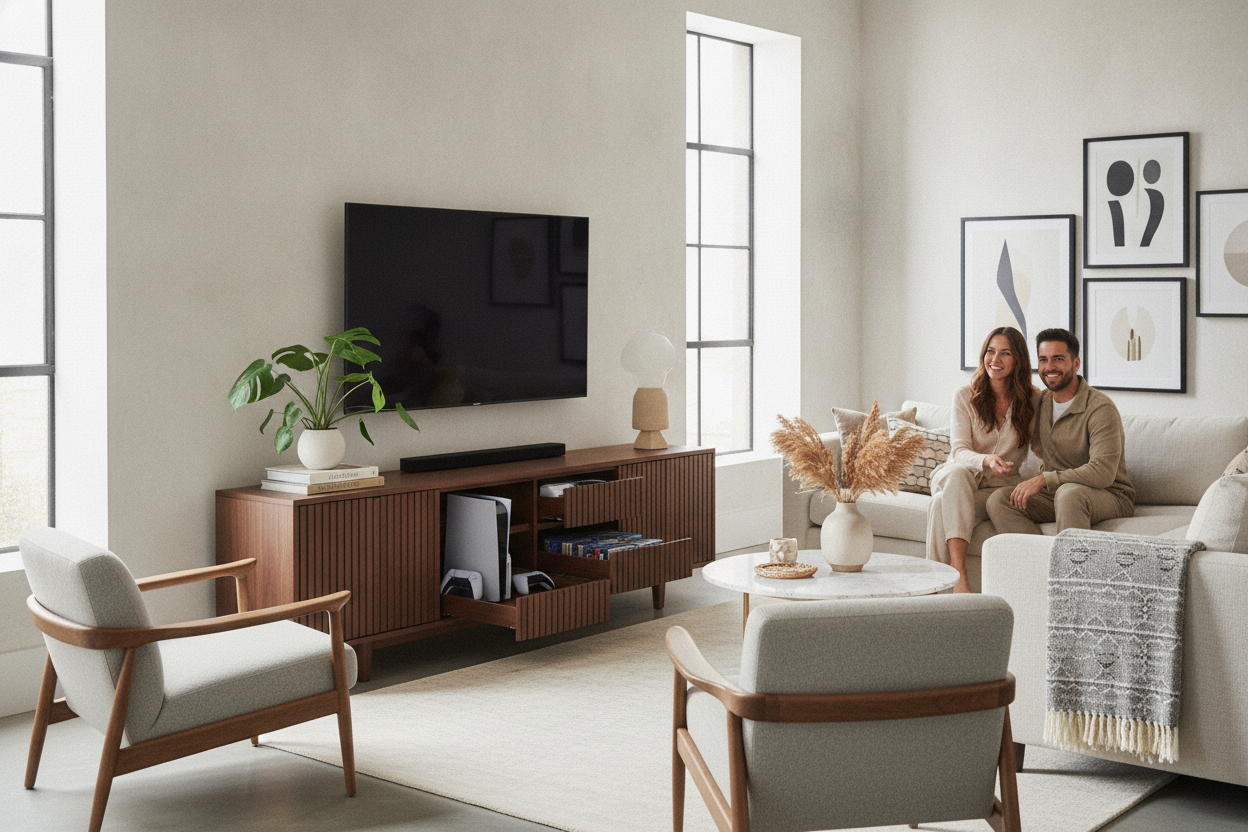
Moving in with my partner was a dream, right up until the 'entertainment center' setup began. I had spent three years curating a vibe that felt like a boutique hotel—lots of linen, light oak, and zero plastic. Then came the PS5. It is a massive, glowing, white plastic monolith that looks like it belongs in a sci-fi villain's lair, not on my vintage rug.
We spent weeks in a silent standoff. He wanted his gear accessible; I wanted it invisible. Finding the right playstation tv stand became an obsession because I refused to let our living room look like a dorm room. It turns out, you can have a grown-up house and a gaming hobby, but you have to be smarter than the furniture manufacturers.
Quick Takeaways
- Slatted doors are the holy grail for airflow and signal strength.
- Measure the height of your console twice—the PS5 is a staggering 15.4 inches tall.
- Avoid 'gaming' branded furniture; it usually relies on cheap MDF and ugly LEDs.
- Cable management is the difference between a 'setup' and a mess.
The Great Living Room Staring Contest
For the first month, the console sat on the floor. Every time I walked into the room, my eyes went straight to the tangle of black HDMI cables and the pulsing blue light. It felt like a tech lab. My partner argued that it needed to be 'out' so it wouldn't overheat, which is a fair point—nobody wants a $500 brick—but surely there was a way to hide the ps tv stand eyesore without a literal meltdown.
The problem is most media consoles are built for cable boxes or DVD players from 2005. They aren't deep enough for modern hardware, or they lack any meaningful ventilation. We needed something that felt intentional, not like a temporary fix.
Why We Refused to Buy 'Gaming Furniture'
If you search for 'gaming media units,' you’re greeted with a sea of carbon fiber textures, neon green accents, and flimsy metal frames. It’s a design disaster. I wanted a piece that felt like a real investment, something with weight and texture. A grown-up space is about balancing style and function, and most tech-specific furniture fails the style test miserably.
Cheap 1.2 lb/ft³ density particle board might look okay in a grainy thumbnail, but it sags under the weight of a large TV within six months. I was looking for kiln-dried wood or at least high-quality veneers that wouldn't peel the second a warm console touched them. We needed a piece that looked like a sideboard but worked like a server rack.
The Slatted Door Cheat Code
The breakthrough was the slatted door. It is the ultimate design hack for anyone who hates tech clutter. I found a mid century modern tv stand that used vertical wood slats for the front panels. It’s brilliant because it allows the Bluetooth signal from the controllers to pass through without any lag, and more importantly, it lets the hot air escape.
I’ve tested this with a thermal thermometer (yes, I’m that person). With the console running a high-intensity game, the internal temperature inside the slatted cabinet stayed within 5 degrees of the ambient room temperature. If that console were behind a solid wood door, it would be a slow-cooker. The slats provide that 'hidden' look while giving the fans the 360-degree breathing room they actually need.
Wait, Can I Just Use Glass Doors for a PS TV Stand?
A lot of people go the glass route because it solves the remote signal problem. It’s a valid choice, and something like a credenza with sliding glass doors can look incredibly sharp. It keeps the dust off the hardware, which is a huge plus for the longevity of the internal fans.
The catch? Glass is a heat trap. If you go this route, you have to be disciplined. You either need to leave the door slid open while playing, or you need to cut a much larger ventilation hole in the back panel than the factory provides. I’ve seen too many friends cook their GPUs because they thought a 2-inch cable hole was enough 'airflow.' It isn't.
Taming the Endless Controllers and Headsets
Even once the console was hidden, we had the 'peripheral problem.' Two controllers, a charging dock, and a bulky wireless headset were still cluttering the coffee table. My advice: don't look for a stand with built-in charging ports. They are usually outdated within a year. Instead, browse standard tv stands that offer deep drawers or adjustable shelving.
We ended up using small felt baskets inside the cabinet. All the controllers go in the basket, and I routed a single multi-head USB-C cable through the back of the unit. It’s a much cleaner system. When we’re done playing, everything disappears. No wires, no glowing plastic, just a clean room.
Personal Experience: The Overheating Incident
I learned the hard way that 'closed' means 'closed.' I once tried to hide our older console in a beautiful, solid-back mahogany chest. It looked amazing. Ten minutes into a session, the fans sounded like a vacuum cleaner. When I opened the door, the air inside was thick and smelled like hot electronics. I had to drill four 3-inch holes in the back with a hole saw attachment just to save the hardware. Always prioritize the back-panel ventilation, even if you think the front is 'breathable' enough.
FAQ
Will my controller work through a wooden door?
If it’s solid wood, you’ll likely experience lag or dropped connections. Bluetooth doesn't love thick oak. Slatted doors or mesh fronts are the only way to go if you want the doors closed while you play.
Does the PS5 fit horizontally in most stands?
Not usually. Most standard shelves are 12 to 14 inches deep. The PS5 is over 15 inches. You need to look for 'extra-deep' media consoles or a stand with an open-back design so the 'nose' of the console can hang off the back slightly if needed.
How do I keep the dust out of a slatted stand?
You don't—that's the trade-off for airflow. Just hit the inside with a can of compressed air once a month. It’s a small price to pay for a console that doesn't overheat and a living room that looks like adults live there.

Dejar un comentario
Este sitio está protegido por hCaptcha y se aplican la Política de privacidad de hCaptcha y los Términos del servicio.