










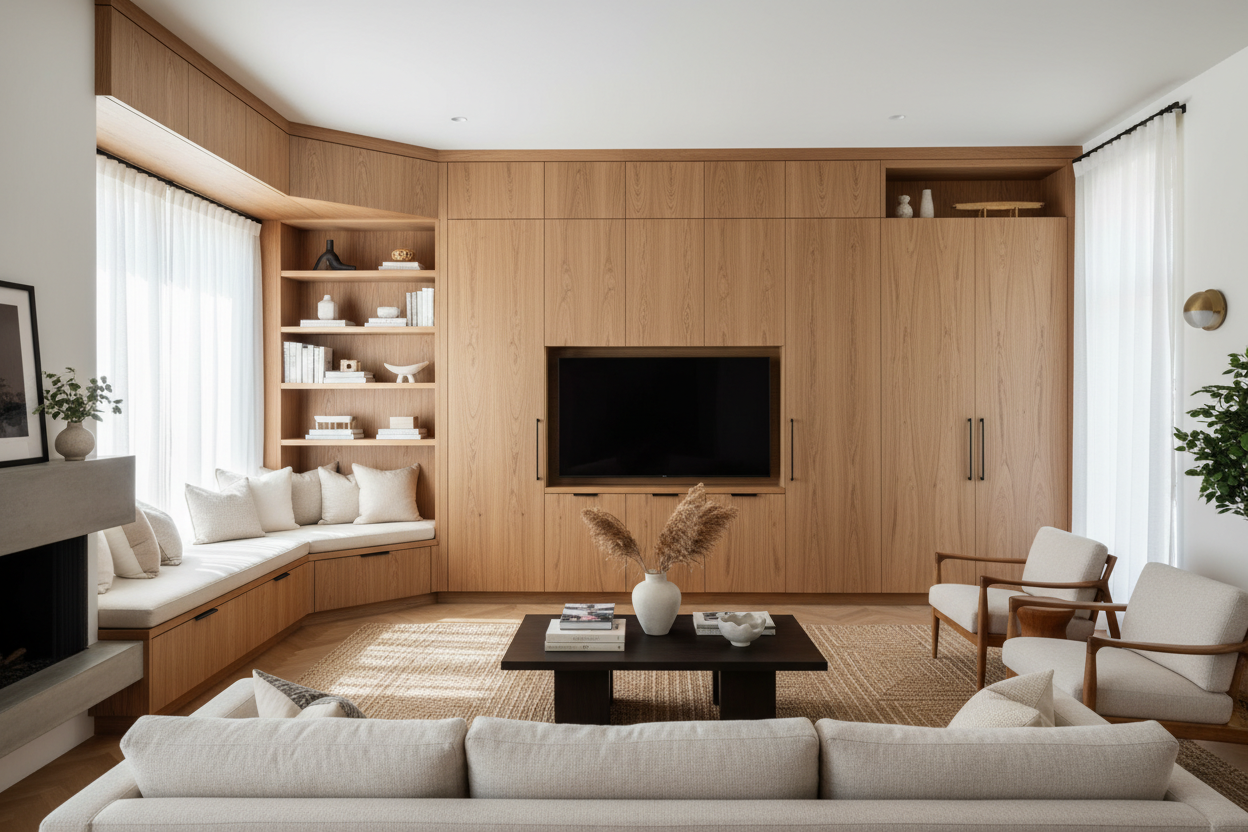
I spent three years staring at a living room that felt less like a sanctuary and more like a very expensive hallway. It is 22 feet long and barely 11 feet wide—a classic 'bowling alley' floor plan that makes standard furniture look like it was dropped in by accident. Every time I bought a new piece of furniture, I was just adding another hurdle to the obstacle course.
The breaking point was a Tuesday night when I tripped over a stray HDMI cord for the third time. My 'temporary' solution of mismatched shelves and a low-slung credenza was failing. I realized that if I wanted the room to feel intentional, I had to stop buying stuff to fill the space and start building the space itself. That is when I finally committed to wood built in cabinets.
- Stop buying 'placeholder' furniture that doesn't actually fit your dimensions.
- Vertical storage is the only way to make a narrow room feel wider.
- Real wood grain adds a texture that paint simply cannot replicate.
- Integrated cord management is the secret to lower cortisol levels.
The Problem With the Bowling Alley Living Room
When you have a long, narrow room, your instinct is to push everything against the long walls. It makes sense on paper, but in reality, it creates a weird, disjointed vibe. I had an 84-inch sofa on one side and a collection of random storage units on the other. The middle of the room was a literal 'no man's land' of empty floor space that served no purpose.
Standard freestanding furniture is rarely deep enough or tall enough to command a wall. My 30-inch tall media console left five feet of dead air above it. That empty space didn't make the room feel 'airy'—it made it feel unfinished. Every time I looked at that wall, I saw gaps. Gaps between the bookshelf and the TV stand, gaps between the stand and the wall, and a chaotic tangle of dust bunnies and wires in between.
I tried floating the sofa. I tried rugs to 'zone' the area. Nothing worked because the visual weight was all wrong. The room felt heavy at the bottom and empty at the top, which is the exact opposite of how a cozy living space should feel. I needed something that felt like part of the architecture, not just a box I bought online.
Why Media Consoles Kept Failing Me
I am a veteran of the 'quick fix' furniture cycle. I’ve owned the particle-board bookshelves that sag under the weight of three hardcovers and the 'mid-century' consoles that are really just flimsy veneers over sawdust. At one point, I even tried repurposing a few shoe cabinets to act as slim-profile storage for my gaming consoles and routers. It was a disaster.
The shoe cabinets were too shallow for the depth of a modern receiver, and I ended up having to saw holes in the back panels just to get the plugs through. It looked okay from across the room, but up close, it was a mess of hacked-together DIY projects. No matter how many 'hacks' I tried, I couldn't hide the cords. My living room looked like a server room at a failing tech startup.
The real issue with freestanding media units is that they are designed for the 'average' home, but nobody actually lives in an average home. My wall had a weird bump-out for a chimney flue and a radiator that limited where I could place things. A standard 60-inch console left a foot of awkward space on either side that was too small for a plant but large enough to collect every lost cat toy in the house.
Taking the Plunge on Real Millwork
After a lot of soul-searching (and budget-crunching), I decided to go for wall-to-wall, floor-to-ceiling wood built in cabinets. I didn't want the standard white-painted MDF that looks like every generic kitchen flip. I wanted something with soul. I’ve been reading about how cherry wood cabinets are back, and I fell in love with that warm, honey-toned grain that deepens over time.
I chose a natural white oak with a matte finish. It wasn't cheap. In fact, it cost more than my first car. But the difference between a custom-built unit and a flat-pack kit is staggering. We’re talking 3/4-inch plywood boxes, solid wood face frames, and soft-close hinges that feel like butter. There’s no wobble. There’s no sagging.
The decision to go with natural wood grain instead of paint was strategic. In a narrow room, a solid wall of white paint can feel clinical. The wood grain provides a natural pattern that draws the eye along the length of the wall without feeling overwhelming. It turned a flat, boring surface into a piece of art that happens to hold my stuff.
The Anatomy of My New Storage Wall
We designed this unit to be a workhorse. The bottom section consists of 24-inch deep drawers. If you’ve never had deep drawers in a living room, you are missing out. They hold all the bulky stuff—piles of extra throw blankets, the 'big' board games that never fit on standard shelves, and even my heavy-duty camera gear. It's similar to the logic of getting a wood table with built-in storage; you are reclaiming square footage that would otherwise be wasted.
In the middle, we built a dedicated 'tech hub.' It’s a cabinet with a mesh front that allows IR signals to pass through and keeps the router from overheating. All the cords are routed through internal channels in the millwork. You can’t see a single wire. It’s the closest I’ve ever come to true domestic bliss.
The upper shelves are adjustable and slightly shallower (12 inches) to keep the unit from feeling like it’s looming over the room. I use them for books, a few pieces of pottery, and some trailing plants. Because the unit goes all the way to the ceiling, we were able to add a library ladder rail. Is it a bit extra? Yes. Do I use it to reach my 'only for guests' glassware? Every single time.
The Verdict: Did It Shrink the Room?
This was my biggest fear. I thought adding a massive, 12-foot-long wooden structure would make the room feel like a coffin. I was wrong. By taking the cabinets all the way to the ceiling, it actually drew the eye upward, making the 8-foot ceilings feel much taller than they actually are.
The room feels wider now because the floor is clear. Instead of five different pieces of furniture breaking up the sightline, there is one continuous, beautiful surface. The 'bowling alley' effect is gone because the built-ins provide a focal point that anchors the entire space. It doesn't look like a hallway anymore; it looks like a library.
If you're on the fence, stop buying the $400 consoles that you'll want to replace in two years. Save that money, find a good local carpenter, and go for the built-ins. It is the only furniture decision I’ve made that I haven't second-guessed once.
FAQ
Are built-ins worth the investment?
If you plan on staying in your home for more than five years, absolutely. They add significant resale value and solve storage problems that freestanding furniture can't touch. If you're in a starter home you plan to flip in 18 months, maybe stick to high-quality modular units.
Do I have to use real wood?
You don't *have* to, but I highly recommend it for the base and the doors. MDF is fine for the interior boxes to save money, but for anything you touch or see daily, real wood grain ages better and handles dings and scratches with more grace than painted laminate.
How do I handle the outlets?
A professional installer will move your outlets forward so they are flush with the back of the cabinets or the toe kick. Never just cover them up—that's a fire hazard and a massive headache later.


Dejar un comentario
Este sitio está protegido por hCaptcha y se aplican la Política de privacidad de hCaptcha y los Términos del servicio.