










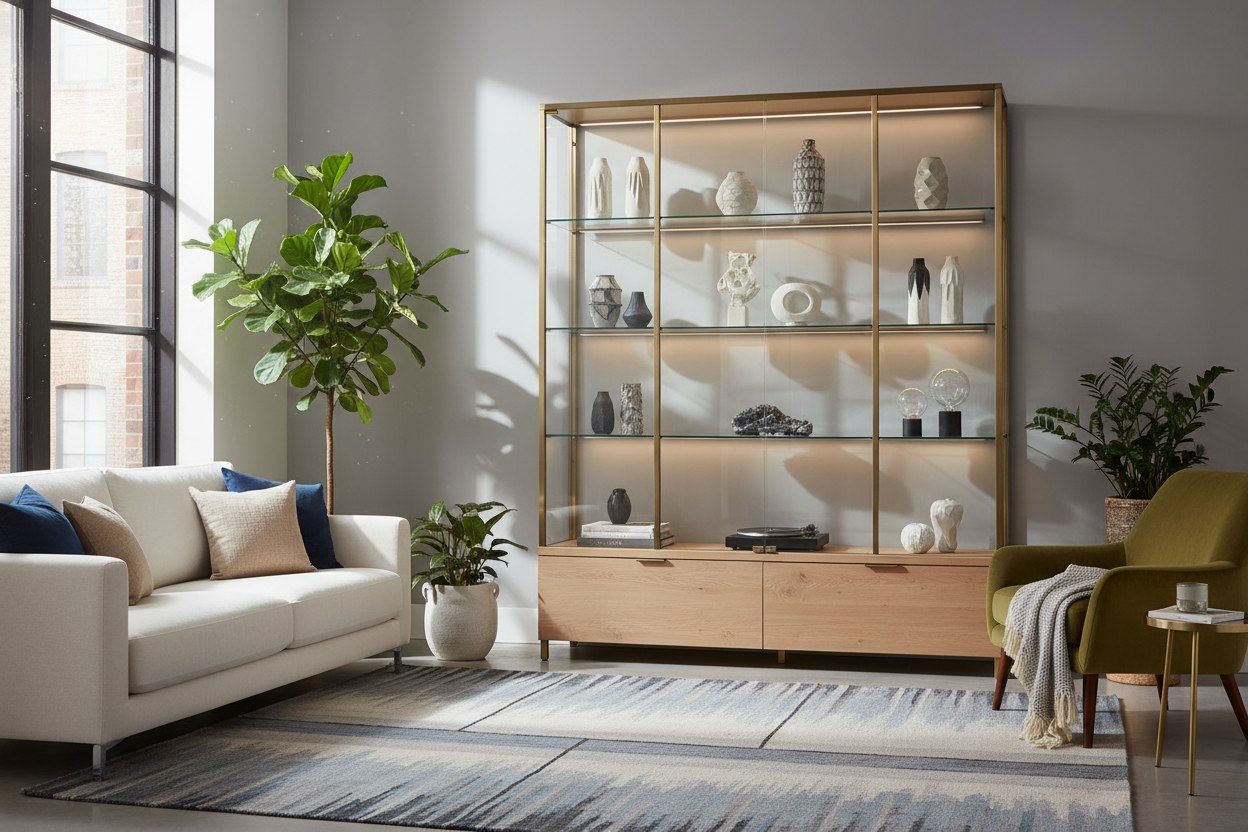
I spent three years of my life as a slave to a microfiber cloth. I have a collection of 1960s Italian glass and thrifted ceramics that looked incredible on my open oak shelving, but the maintenance was a part-time job. Every Saturday, I’d find myself gingerly wiping down forty-odd pieces of fragile glass because a thin layer of grey New York City soot had decided to settle on them. It wasn't just the cleaning; the open shelves made my prized possessions look like a cluttered yard sale instead of a curated collection.
I hit a breaking point after a particularly dusty summer. I stayed up until 2 AM scrolling through glass display retail options, realized I didn't want a flimsy bookshelf, and decided to go full commercial. Here is what I learned about bringing shop-level fixtures into a residential space without making your living room feel like a cell phone repair shop.
Quick Takeaways
- Commercial cases use tempered glass, which is significantly safer and more durable than the thin panes in cheap residential furniture.
- Dust protection is the primary benefit; a closed case cuts cleaning time by 90%.
- Built-in LED lighting in retail units is often superior to the 'puck' lights found in home curios.
- Styling with organic textures (wood, plants, books) is mandatory to prevent a clinical look.
The Day I Finally Gave Up on Open Bookshelves
The dream of the 'styled bookshelf' is a lie sold to us by people who have full-time housekeepers. In reality, open shelving is a magnet for grime. I started my search looking at standard bookcases display cabinets, but I kept running into the same problem: they were either too shallow to hold my larger art books or they had thick wooden frames that blocked the view of my pieces.
I wanted transparency. I wanted to see my collection from every angle without having to move three things out of the way. That is when I realized that what I actually needed wasn't a piece of furniture—it was a fixture. The moment I stopped looking at 'home decor' and started looking at retail solutions, the options actually became functional.
Why I Actually Chose a Glass Display Retail Fixture
Retail units are built for abuse. While a standard home cabinet might use 3mm glass, a glass display retail case typically uses 6mm or 8mm tempered glass. It feels substantial. When you close the door, there is a satisfying 'thud' rather than a 'clink.' I also opted for a frameless aesthetic, which gives that museum-quality look where the objects seem to float.
I chose to buy glass display cabinets retail rather than scouring Craigslist for a deal. Why? Because moving used glass is a nightmare. One hairline fracture in a tempered pane and the whole thing can shatter during transport. Buying new meant I got a unit with integrated LED tracks that run vertically down the corners, illuminating every shelf evenly instead of just the top one.
The Trick to Making Retail Display Glass Look Cozy
The biggest fear people have is that retail display glass will look cold or 'mall-ish.' It can, if you just line up your stuff in a single row. The secret is layering. I mix my vintage glass with heavy art books and small trailing plants like a Philodendron Micans. The greenery softens the hard edges of the glass and metal.
I also didn't shy away from the security aspect. Some people think a lockable cabinet glass display is overkill for a home, but if you have kids or a rowdy dog, it’s a lifesaver. It doesn't look like a jewelry store if you style it with intention; it looks like a protected gallery. I use the lock to keep my toddler from 'reorganizing' my 19th-century apothecary jars, and I have zero regrets.
Residential Alternatives If Commercial Is Too Cold
I get it—the industrial, all-glass look isn't for everyone. If you want the dust protection and the visibility but need something that breathes a bit more warmth into the room, you should look for transitional pieces. A white display case with glass doors is a fantastic middle ground. It offers the same vertical storage and protection but uses painted wood to bridge the gap between a modern gallery and a cozy home.
Ultimately, the goal is to stop cleaning and start enjoying your things. Whether you go for a heavy-duty retail unit or a softer residential curio, the closed-door policy is the only way to keep your sanity and your collection intact.
Frequently Asked Questions
Is it hard to assemble a commercial glass case?
Yes, it's a beast. These units are heavy and require two people to hold the glass panels in place while the hardware is tightened. Do not try to DIY this alone on a Sunday afternoon unless you want to end up in the ER.
How do you hide the power cords for the lights?
Most retail cases have a small gap in the base or the corner extrusions. I use clear adhesive cable clips to run the wire down the back leg of the case. If you have a rug, tuck the cord underneath to reach the nearest outlet.
Does the glass get fingerprints easily?
It’s a glass box, so yes. However, since the items inside are protected, you only have to wipe down the exterior handle area once a week. It is still 90% less work than dusting individual items on an open shelf.



Dejar un comentario
Este sitio está protegido por hCaptcha y se aplican la Política de privacidad de hCaptcha y los Términos del servicio.