










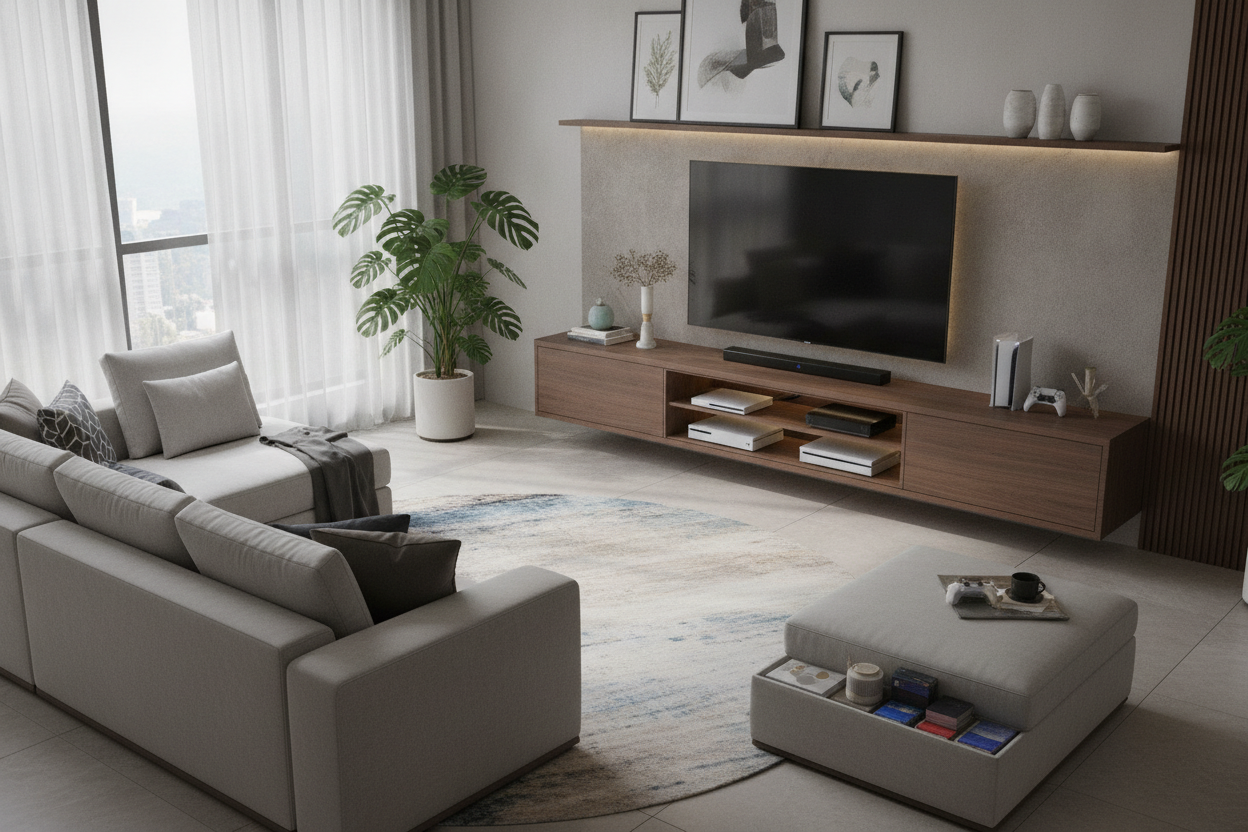
I remember unboxing my PS5 and feeling a genuine sense of dread. It wasn't the price tag; it was the fact that I’d just purchased a piece of alien architecture that looked like it belonged in a Dubai skyscraper rather than my cozy, mid-century-inspired living room. It sat on my floor for three weeks because it literally didn't fit in my vintage credenza. Finding a gaming stand for tv shouldn't feel like choosing between a piece of fine furniture and a neon-lit arcade cabinet.
- Prioritize a depth of at least 16 to 18 inches for next-gen consoles.
- Look for slatted doors or mesh fronts to prevent hardware overheating.
- Avoid 'gamer' brands in favor of high-quality media credenzas with cable management.
- Measure your tallest console vertically before committing to shelf heights.
Why Is It So Hard to House a PS5?
Modern gaming consoles have become massive, heat-generating monoliths. The PS5 is over 15 inches tall, and the Xbox Series X is a literal brick. They defy the dimensions of almost every standard media unit built before 2020. Most furniture is still designed for the era of the slim DVD player or a thin cable box that generates zero heat. When you try to shove a next-gen console into a standard cabinet, you aren't just making it look cramped; you're essentially putting it in an oven.
I’ve seen high-end consoles throttle their performance or even shut down because the internal fans were just recycling the same hot air inside a closed particle-board box. Most 'standard' furniture manufacturers use 0.5-inch plywood or flimsy MDF that sags under the weight of a large TV and three consoles. We need to stop treating tech as an afterthought in our interior design. If you're spending $500 on a console, don't put it in a $40 shelf that's going to choke it to death.
The Anatomy of a Proper TV Gaming Stand
A real tv gaming stand needs to be built with physics in mind. While standard living room TV stands often focus on a slim 12-to-14-inch profile to save space, a gaming setup requires girth. You need enough clearance for the console itself plus the 3 inches of rigid HDMI and power cables that stick out the back. If you don't have that depth, you'll end up with your furniture sitting two inches away from the wall, which looks messy and collects dust bunnies like a magnet.
Airflow is Non-Negotiable
Airflow is the hill I will die on. If your console sounds like a jet engine taking off, it’s because it’s suffocating. I look for furniture with slatted wood doors or perforated metal fronts. This allows the hot air to escape while keeping the 'tech clutter' hidden from view. I once tried to run my setup inside a closed IKEA cabinet; the fan got so loud I had to turn my TV volume up to 40 just to hear the game. I eventually had to leave the door hanging open like a broken jaw, which completely defeated the purpose of having a cabinet in the first place. Look for units with completely open backs or generous ventilation cutouts that aren't blocked by the shelves themselves.
The Depth Dilemma
Let’s talk real numbers. A PS5 is nearly 16 inches deep when you account for the curve and the cables. If you want to hide it behind a door, your internal shelf depth needs to be at least 17 or 18 inches. I’ve made the mistake of buying a 'modern' 15-inch deep stand only to realize I couldn't close the doors without putting dangerous pressure on my HDMI ports. I ended up having to take a steak knife to the back panel of a brand-new unit just to make room for the wires. It was heartbreaking. Always carry a tape measure. If a salesperson says 'it fits most consoles,' they are probably thinking of a Nintendo Switch, not a Series X.
How to Hide the Chaos (Without Strangling the Tech)
The wire situation is usually what kills the aesthetic of a room. Between the charging docks, the VR headsets, and the external hard drives, it can look like a spiderweb exploded in your living room. I finally found peace when I hid four gaming consoles behind sliding doors in my own den. The beauty of sliding doors is that you can keep one side open for maximum cooling while you’re actually playing, then slide it shut to hide the plastic when company comes over.
Strategic furniture choices make all the difference. Look for units that feature a full-length cable channel along the back rather than just one or two small holes. This allows you to move devices between shelves without re-threading every single wire. I also highly recommend using adhesive cable clips inside the cabinet walls to keep the 'spaghetti' off the floor. It’s a 10-minute job that makes your $2,000 setup look like it belongs in a magazine.
Please, Step Away from the RGB Lighting
I am begging you: stop buying furniture with built-in blue LED strips that look like they were stripped off a Fast and Furious set. You can have a high-tech setup that still feels like a home. Even a fireplace TV stand with LED lighting can be styled to look sophisticated if you choose a unit with matte finishes and clean, architectural lines rather than cheap plastic. The goal is 'stealth gaming.' You want people to walk into your living room and see a beautiful, curated space, not a 'gamer zone.'
Choose natural wood grains, solid steel legs, and high-quality hardware. Your house should look like an adult lives there, even if you spend your Saturday nights grinding for loot. Real walnut or oak veneers age beautifully, whereas that 'carbon fiber' wrap on gaming desks starts peeling the second you spill a drink. Buy for the room you want to live in, not just the hobby you're currently obsessed with.
FAQ
Can I put my console on the floor?
Please don't. Dust is the natural enemy of electronics, and floors are dust highways. You'll be cleaning your fans every month, and if you have pets, it's a death sentence for your hardware. Always get it at least 4-6 inches off the ground.
What is the best material for a gaming stand?
Solid wood or high-grade plywood is best for weight. If you go with MDF, ensure it's high-density. Avoid thin glass shelves; they don't dissipate heat well and can vibrate when your console's disc drive kicks into high gear.
How much clearance should I leave around the console?
Ideally, you want at least 2 to 3 inches of space on all sides. If you're putting it in a cubby, make sure the back of that cubby is wide open. If the air has nowhere to go, it just circles back into the intake.

Dejar un comentario
Este sitio está protegido por hCaptcha y se aplican la Política de privacidad de hCaptcha y los Términos del servicio.