










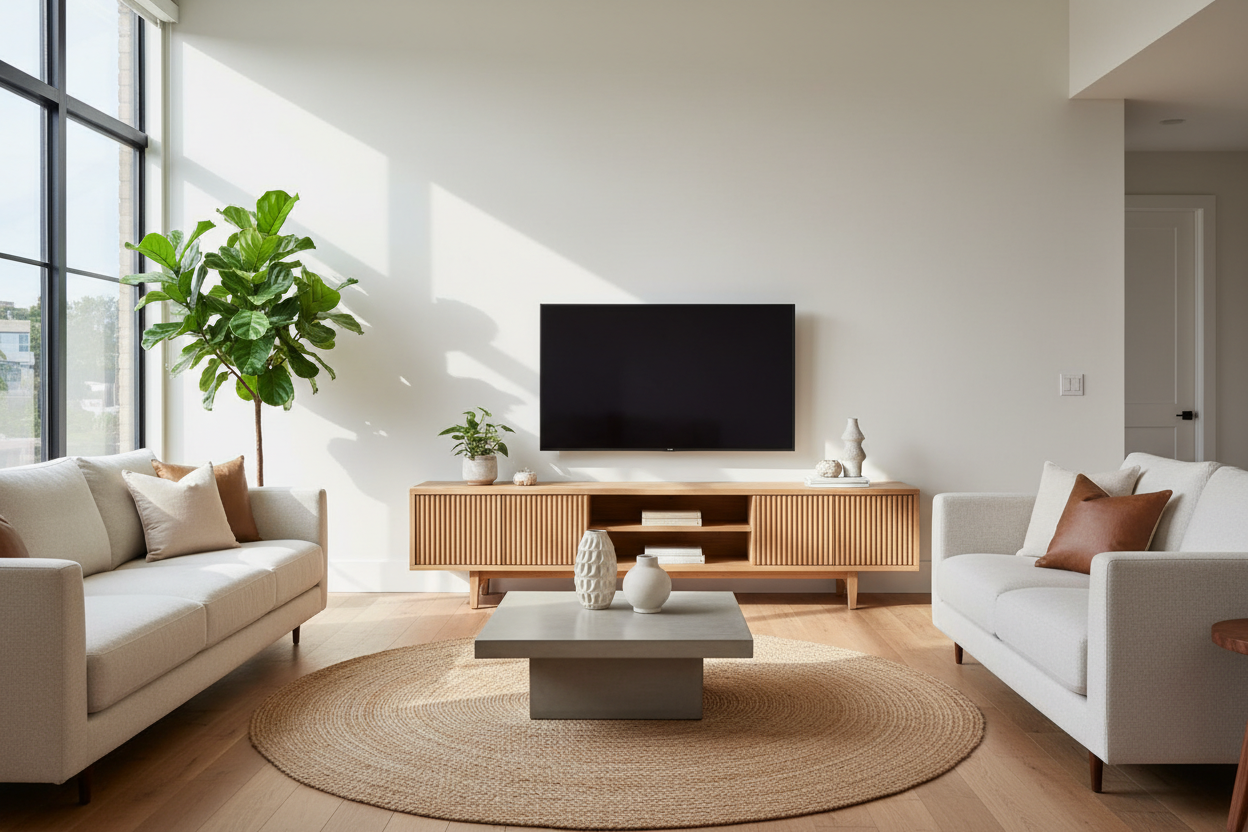
I was three glasses of wine deep at 1 AM when I finally hit 'Buy Now' on a 58-inch amazon tv stand wood console. My current setup was a stack of milk crates that felt more 'unemployed artist' than 'functioning adult,' and I just couldn't stare at those plastic holes anymore.
We've all been there: scrolling through endless listings where every photo looks like a CGI render and every review says either 'BEST EVER' or 'ARRIVED IN PIECES.' I wanted to see if the $140 mid-century modern knockoff could actually survive my living room without looking like a temporary dorm fix.
Quick Takeaways
- Assembly Time: 90 minutes of focused effort (and one minor existential crisis).
- Material: It's high-grade particle board with a very convincing paper laminate—not solid oak.
- Weight Capacity: Handled my 55-inch TV and a heavy soundbar without bowing.
- The Look: From five feet away, it looks like a $600 West Elm piece; up close, the stickers covering the screws give it away.
The Late-Night Prime Purchase
The paradox of choice on Amazon is real. You start looking for a simple media console and suddenly you're comparing the tensile strength of cam-locks at 2 AM. I spent hours finding a real wood TV stand that didn't cost a month's rent, only to realize that most 'wood' on Prime is actually just 'wood-adjacent.'
I eventually settled on a 'Rustic Oak' model with over 10,000 reviews. It promised a 250-pound weight limit and 'easy assembly.' I knew the 'easy' part was a lie, but the price was too good to ignore for a rental I might leave in a year anyway. Plus, I needed something that could actually fit my soundbar and a stray PlayStation 5 without looking cluttered.
What 'Wood' Actually Means in the Description
Let's get honest about terminology. When you see 'wood' in a budget listing, you're usually getting MDF (Medium Density Fiberboard) or particle board wrapped in a thin vinyl sticker. If you're looking for an actual designer's honest guide to solid wood, you'll quickly learn that real timber doesn't ship in a flat box for $150.
The stand I bought used a surprisingly dense particle board. It didn't have that hollow, cardboard feel of the ultra-cheap stuff. The laminate texture even had 'pores' printed on it to mimic grain. It's durable enough for a TV, but don't let a sweating water glass sit on it for an hour, or that 'wood' will bubble up like a blister. It's a surface meant for viewing, not heavy living.
The Assembly Reality (Sweat and Allen Wrenches)
The box arrived looking like it had been tossed off a moving truck. Miraculously, the Styrofoam did its job. I cleared my floor, grabbed a screwdriver (don't rely on the tiny L-wrench they give you), and started the 34-step process. My living room immediately looked like a lumber yard exploded.
The instructions were mostly pictures—some of which looked like abstract art. I accidentally put the back panel on backwards, meaning the unfinished brown side was facing out. I had to unscrew twelve tiny nails and flip it, which is exactly when I started questioning my life choices. Pro tip: use a real drill on the lowest torque setting. Your wrists will thank you, and you'll cut thirty minutes off the build time.
Does It Actually Look Cheap in a Real Room?
Once I wiped off the factory dust and shoved it against the wall, I was shocked. It looks good. The matte finish doesn't have that fake plastic shine that screams 'college dorm.' The doors aligned—mostly—after I spent twenty minutes fiddling with the hinges to get the gap even.
The hardware is the weak point. The plastic handles felt light and flimsy, so I swapped them for some $5 brass pulls I found at a hardware store. That one change made the whole unit look triple the price. It blends into my decor without drawing attention to its budget origins, which is exactly what a good media console should do. It provides a clean, mid-century vibe without the $1,200 price tag.
Final Verdict: Keep It or Kick It to the Curb?
If you're a renter who moves every two years, this is a win. It's light enough to move with a friend but sturdy enough to hold your tech. However, if you're looking for a 'forever' piece that your grandkids will fight over, this isn't it. This furniture is built for the now, not the next decade. It’s a functional, stylish bridge between your first apartment and your dream home.
For those who have a bit more room in the budget and want something that won't wobble when the cat jumps on it, I'd suggest looking at a collection of heavy-duty TV stands instead. But for the price of a nice dinner out, this Amazon find is a solid placeholder that actually looks like you have your life together. It’s staying in my living room for the foreseeable future.
FAQ
Can I put a 65-inch TV on a 58-inch stand?
You can, but it'll look top-heavy. Always aim for a stand that is at least 3-6 inches wider than your TV screen on both sides for visual balance and safety. A 58-inch stand is perfect for a 50 or 55-inch set.
Is it hard to move once assembled?
Don't slide it. Budget furniture uses cam-locks that can snap or pull through the particle board if you drag the unit across carpet. Always get a friend to help you lift it straight up if you need to reposition it.
How do I hide the cables?
Most of these stands have pre-cut holes in the back. If yours doesn't, a 2-inch hole saw bit on a drill will go through that flimsy back panel like butter. Just make sure you do it before you load it up with electronics.

Dejar un comentario
Este sitio está protegido por hCaptcha y se aplican la Política de privacidad de hCaptcha y los Términos del servicio.