










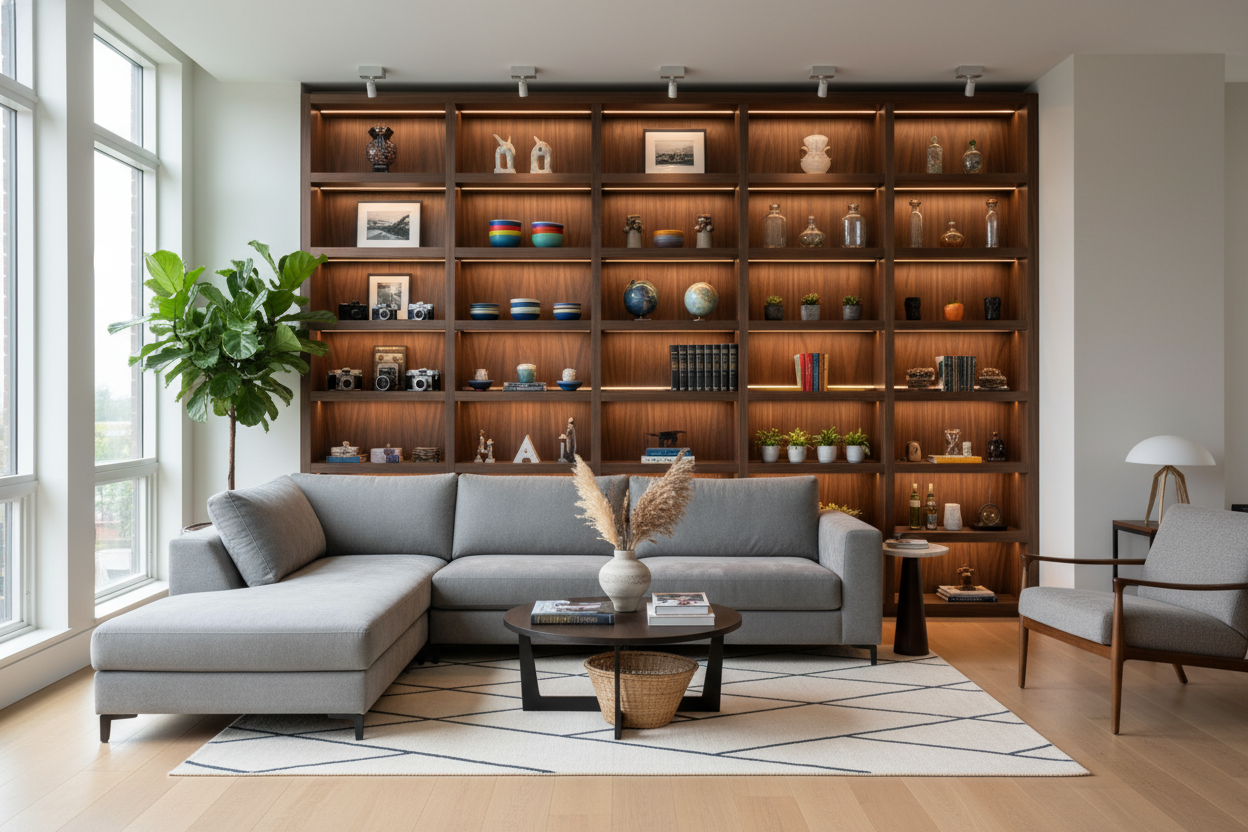
I spent three weekends scouring estate sales for a specific set of 1960s Japanese stoneware only to realize they looked like gray lumps once I got them home. My living room has the natural light of a basement bunker by 4 PM, and my bookshelves were essentially black holes. I finally decided to fix it with display lighting for shelves, thinking I could just slap some stickers on and call it a day. I was wrong.
Quick Takeaways
- Stick to 2700K–3000K color temperatures for a cozy, high-end feel.
- Battery-powered puck lights are a trap; you will tire of charging them in two weeks.
- Always use a diffuser channel for LED strips to avoid the 'string of pearls' reflection.
- Integrated lighting is worth the extra cost if you hate visible wires.
My 'Bright Idea' That Completely Backfired
I went to a big-box store and grabbed the cheapest LED strips I could find. The box said 'Bright White,' which I interpreted as clean. It wasn't clean; it was clinical. The second I plugged them in, my cozy study looked like a 24-hour urgent care clinic. The cool blue light washed out the rich wood grain of my walnut shelves and turned my cream-colored pottery into a sickly shade of gray.
It was a total mood killer. I realized that shelf display lights aren't just about visibility; they're about atmosphere. If you're displaying vintage finds or old books, that blue-white glow makes everything look like a cheap reproduction. I ended up ripping the strips off an hour later, taking a small chunk of veneer with them. Lesson learned: cheap LEDs are expensive in the long run.
The 3 Types of Display Shelves Lighting I Actually Tested
I moved on to puck lights. They are easy to install, but unless you’re buying the expensive hardwired ones, you’ll be replacing AAA batteries every other Tuesday. They also create 'hot spots' of light rather than an even wash. Then came raw LED strips. Without a diffuser, you see every individual tiny light bulb reflected in your glassware, which looks incredibly tacky. It’s like putting a neon sign inside your cabinet.
Finally, I tried diffused channel lighting—basically an LED strip tucked into an aluminum track with a frosted cover. It’s the only DIY way to get that soft, high-end glow. However, I learned the hard way that if you have adjustable shelf storage, fixed wiring is your enemy. I moved a shelf up three inches to fit a tall vase and ended up ripping the soldered connection right off the track because I hadn't accounted for the movement.
Why 'Color Temperature' Will Make or Break Your Setup
Most people ignore the 'K' rating on the box, but it’s the most important number in your lighting project. 5000K is daylight (blue and harsh), 4000K is 'cool white' (still too office-like), and 2700K to 3000K is the warm, golden-hour territory. For display shelves lighting, you want that 3000K sweet spot. It mimics the glow of a high-end gallery.
My vintage brass pieces finally looked expensive again instead of looking like scrap metal. Warm light adds depth to shadows and highlights the texture of your decor. If your lights make your skin look green when you walk past the shelf, they are the wrong color temperature. Stick to the warm end of the spectrum and your home won't feel like a laboratory.
When to Just Buy a Pre-Lit Unit Instead
After drilling sixteen holes into my built-ins and still seeing a stray wire peeking out from behind a stack of National Geographics, I gave up on the dining room DIY. Managing cords is a nightmare. You think you can hide them with electrical tape, but gravity always wins. I eventually traded my old mismatched hutch for a dedicated display bookcase with LED light.
The difference was night and day. No messy adhesive strips peeling off in the humidity, no wires to hide, and the light is perfectly recessed so you never see the source—just the glow. It saved me about six hours of frustrating cable management and the finished look is significantly more polished than my 'custom' drill job. Sometimes, admitting defeat is the best design choice you can make.
My Final Setup (And What It Cost)
My current setup is a mix. The living room has the diffused DIY strips which cost about $120 for the tracks, strips, and power supply. It looks great now, but it took a lot of sweat equity. In the dining room, the integrated unit does the heavy lifting. If you have the patience for soldering and wire-tucking, DIY is fine. But if you value your Saturday afternoons, the best display cases use built-in lighting right out of the box.
FAQ
Can I use battery lights?
Only for low-use areas like a guest room. If you want them on every night, you will go broke buying batteries or go crazy recharging them. Hardwired is always better for daily use.
Do LED strips ruin wood?
Not usually, but cheap adhesive can leave a nasty residue or pull off finish. I recommend using small mounting clips or aluminum channels instead of just sticking the tape directly to the wood.
What is the best brightness?
Look for a dimmable kit. What looks good during a dinner party is often way too bright for a cozy movie night. Being able to drop the brightness to 20% makes a huge difference.

Dejar un comentario
Este sitio está protegido por hCaptcha y se aplican la Política de privacidad de hCaptcha y los Términos del servicio.