










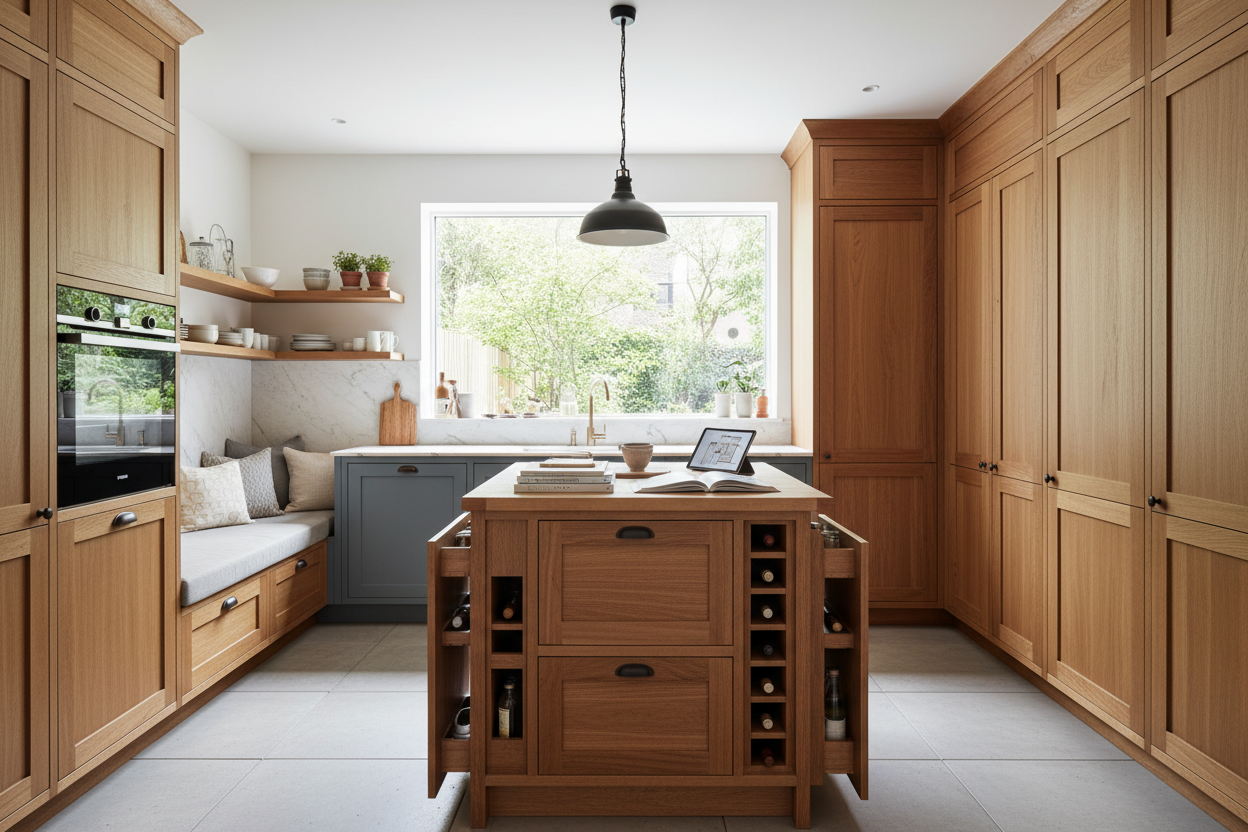
I spent three weeks staring at a blueprint of my 1920s kitchen, trying to convince myself that a 30-inch cabinet and a 3-inch filler strip were basically the same as a 33-inch unit. They aren't. Not even close. When you are working with a room where nothing is square and the walls have a gentle wave, standard boxes are your worst enemy.
My realization was simple: kitchen custom cabinets aren't just a luxury for people with massive renovation budgets; they are a survival tactic for anyone living in a house built before the era of laser-leveled drywall. If you try to force stock increments into a quirky space, you end up paying for wood that literally does nothing but hide empty air.
- Standard cabinets come in 3-inch increments, which creates 'dead zones' in most layouts.
- Filler panels are purely cosmetic and offer zero storage value.
- Custom millwork can be built to 1/8-inch precision to hug wonky walls.
- A hybrid approach (custom perimeters + stock islands) can save you thousands.
The Day I Realized Standard Sizes Weren't Going to Cut It
My kitchen is small—about 100 square feet of usable floor space. When I started looking at stock options, the math was depressing. Because standard boxes only come in fixed widths, I was looking at losing nearly 14 inches of horizontal space across two walls just to accommodate the 'standard' sizes. In a tiny galley, 14 inches is the difference between a dedicated trash pull-out and having a plastic bin sitting in the middle of the floor.
I started looking into how to custom build kitchen cabinets that actually touched the walls. I didn't need gold-plated hinges; I just needed boxes that didn't leave a 4-inch gap next to the fridge. The 1920s plaster in my house was the real enemy. Standard boxes assume your walls are flat. Mine are not. If I had gone with off-the-shelf options, the gaps would have been so wide I could have lost a small pet behind the cabinetry. Using a custom build was the only way to ensure every square inch of my footprint was actually working for me.
The Dreaded 'Filler Panel' Trap
If you talk to a designer at a big-box store, they will tell you filler panels are 'standard practice.' That is code for 'we don't have the size you actually need.' A filler panel is a flat piece of wood used to bridge the gap between a cabinet and a wall. It looks fine from five feet away, but it’s a total waste of square footage. I see this most often in corners where people try to save money.
While a pre-made corner kitchen pantry cabinet set works great for a perfectly square modern room, it leaves weird gaps in unlevel corners of older homes. You end up with a custom built kitchen cabinet experience that is actually just a standard box with a lot of expensive trim covering up the mistakes. Every inch of a filler panel is an inch where you could have had a wider drawer for your oversized Tupperware or a skinny slot for baking sheets. When you pay for bespoke, you're paying to eliminate the dead air that big-box stores sell you for $50 a strip.
What Bespoke Millwork Actually Fixed for Me
When I finally bit the bullet and went with custom-made cabinets, the first thing I did was take the storage all the way to the ceiling. Most stock uppers stop at 30 or 42 inches, leaving a 'dust shelf' on top that serves no purpose other than collecting grease. My units went to my 96-inch ceiling, giving me two extra shelves per cabinet for things I only use once a year, like the holiday turkey roaster.
The millworker also accounted for my floor's 'character'—which is a polite way of saying it sags an inch toward the back door. Instead of shimming a standard box until it looked like it was on stilts, he built the bases to compensate for the slope. The result was a kitchen cabinet custom made to the specific geometry of my house. It looks like it grew out of the walls rather than being bolted onto them. It is that 1/8-inch precision that makes a custom-built kitchen cabinet feel like a permanent part of the architecture.
If you're worried about the price tag, you should look for ways to find quality without the designer markup. Dealing directly with a local shop instead of a high-end showroom can save you 20-30% while still getting you boxes made of 3/4-inch plywood rather than that flimsy 1/2-inch particle board stuff that swells the second a pipe leaks.
Are They Always Worth the Splurge? (An Honest Look)
I’m not going to tell you to spend $40,000 on custom made kitchen cupboards if you’re flipping a rental or living in a cookie-cutter condo with perfectly plumb walls. If your room is a perfect rectangle, stock boxes are a smart way to save money. However, you need to watch out for the hidden costs in your custom kitchen cabinet quote. Some shops will upcharge you for 'custom' sizes that are actually just their standard sizes with a different label. True custom means you choose the depth, the width, and the height to the fraction of an inch.
I’d skip the custom route for basic laundry rooms or mudrooms where the layout isn't tight. But for the kitchen—the place where you spend four hours a day—having drawers that actually fit your specific silverware organizer is a small daily win. I opted for 27-inch deep counters instead of the standard 24-inch, and that extra 3 inches of workspace felt like a massive upgrade for a relatively small price increase.
The Hybrid Approach: Mixing Custom Walls with Stock Centers
If your budget is screaming, try the hybrid method. Use bespoke boxes for the perimeter walls where the weird angles and pipes are located. This ensures your made kitchen cabinets fit the footprint perfectly without those ugly gaps. It also allows you to hide plumbing or electrical chases that would normally require a giant, ugly soffit.
Then, save your money on the center of the room. By incorporating freestanding kitchen islands, you avoid the high cost of custom-built centerpieces. An island doesn't have to touch a wonky wall, so it doesn't need to be bespoke. You can buy a high-quality standard island and spend the savings on better stone for the countertops or a high-end range. This approach gives you the built-in look where it matters most while keeping the overall project cost from spiraling into second-mortgage territory.
FAQ
How much more does custom cabinetry actually cost?
Expect to pay 50% to 100% more than stock. If a stock kitchen costs $10,000, a custom one will likely run you $18,000 to $25,000. You're paying for the labor of measuring, the higher-grade materials, and the fact that a human actually looked at your specific walls.
Can I just buy custom doors for cheap boxes?
You can, but it doesn't solve the space issue. New doors make old or cheap boxes look pretty, but you're still stuck with the standard widths and those annoying filler panels. It’s a cosmetic fix, not a functional one for layout problems.
What is the lead time for custom work?
Usually 8 to 12 weeks. Stock cabinets can sometimes be picked up the same day, but custom pieces are built to order. If you're in a rush to finish a flip, custom is going to break your timeline.

Dejar un comentario
Este sitio está protegido por hCaptcha y se aplican la Política de privacidad de hCaptcha y los Términos del servicio.