










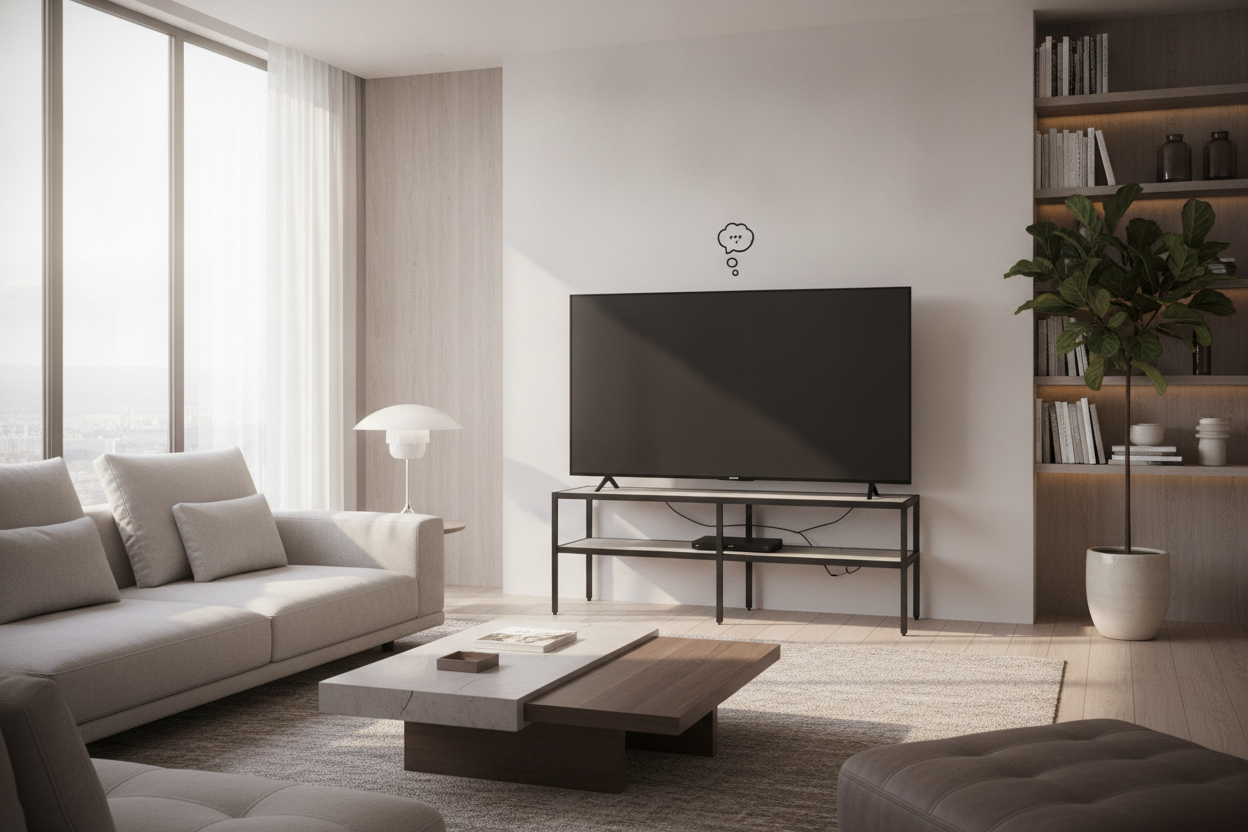
You just spent two grand on a screen that is essentially a small IMAX theater for your living room. You are standing in the aisle, dazed by the 4K demo loop, and the salesperson points to a best buy 86 inch tv stand that looks 'good enough' to get the job done. Resist the urge to just check the box and leave.
I have been that salesperson. I have also been the guy who watched a $150 particle-board console slowly banana-fold under the weight of a premium panel. Buying furniture at a big-box electronics store is a trap of convenience that usually ends with a sagging shelf and a tilted screen.
- Showroom ceilings are 20 feet high; your living room is not.
- MDF (particle board) has a weight limit that 86-inch TVs often ignore.
- The furniture markup is where the store makes the profit they lost on the TV.
- If it wobbles in the store, it will sag in your home.
The Showroom Illusion: Why Everything Looks Normal in the Store
Walking through a massive retail space is like looking through a reverse telescope. Everything feels smaller than it actually is because the ceilings are cavernous and the floor plan is wide open. I learned this the hard way with a default Best Buy 55 inch TV stand I bought years ago. In the store, it looked sleek; in my apartment, it looked like a literal obstacle course.
When you are looking at an 86 inch tv stand best buy has on display, you are not seeing the reality of its footprint. These screens are over 70 inches wide. If the stand does not have at least six inches of breathing room on either side, your room is going to feel like the TV is wearing a shirt three sizes too small. It is a visual claustrophobia that is hard to fix once the box is open and the heavy lifting is done.
The 3 Rules for Evaluating Any 86 Inch TV Stand Best Buy Sells
Do not just look at the price tag and the 'fits up to' sticker. Those stickers are marketing, not engineering. You need to get hands-on with the floor model before you let them wheel a flat-pack box to your car. Most of these units are held together by cam locks and hope.
Rule 1: Count the Center Support Legs
A standard four-leg design is a recipe for disaster with a screen this size. An 86-inch TV can easily push 100 to 120 pounds, and that weight is concentrated. If the stand does not have a fifth, sixth, or even seventh support leg directly under the middle span, the top shelf will bow within six months. I have seen $500 consoles develop a permanent 'smile' because they lacked a simple $5 support post in the center.
Rule 2: The 'Wiggle Test' on Floor Models
Walk up to the display unit and give it a firm shoulder nudge. Does it sway? Do the joints creak? Retail floor models are usually built by a third-party assembly service. If their assembly results in a wobbly unit, your DIY version at home will not be any better. A stand for a massive TV needs to be a rock. If it shudders when you walk past it, your expensive glass panel is at risk every time the dog runs through the room.
The Retail Markup Reality Check
Here is a secret from my days on the floor: we barely made money on the TVs. The margins on a name-brand 86-inch screen are razor-thin. The real profit lives in the 'attachments'—the HDMI cables, the mounting brackets, and the furniture. When you see a TV stand for 70 inch TV Best Buy pushes, you are often paying a 40% markup on what is essentially sawdust and glue.
They bank on your exhaustion. You have already spent two hours picking the TV; you just want to go home and watch it. But buying a convenience stand means you are overpaying for lower-quality materials. For the same $400 they are charging for a laminate-wrapped MDF box, you could find a solid wood or heavy-gauge steel alternative elsewhere that actually lasts.
Before You Swipe: Better Alternatives for Your Living Room
Instead of settling for the first thing you see next to the checkout counter, look for high-density materials. If you cannot find kiln-dried hardwood, at least look for engineered wood with a high-pressure laminate finish. Your TV is an investment; the thing holding it up should not be an afterthought that ruins the aesthetic of your home.
I always tell people to check out a dedicated collection of sturdy TV stands that prioritize weight capacity over sheer aesthetics. You want something with integrated cable management that does not feel like a flimsy plastic tube. Look for metal-to-metal connections for the hardware—cam locks are fine for a nightstand, but they are not great for a piece of furniture holding a triple-digit weight load.
FAQ
Can I use a stand that is shorter than the TV?
Technically yes, if the feet fit, but it looks terrible. An 86-inch TV hanging over the edges of a stand is a massive tipping hazard and ruins the room's proportions.
Is MDF really that bad for big TVs?
Standard MDF sags under constant heavy pressure. If you go with MDF, ensure it has a steel support rail or a center leg underneath the top shelf to prevent it from warping over time.
Should I just wall mount an 86-inch TV?
If you have the studs for it, yes. It is safer and cleaner. But if you are renting or have plaster walls, a heavy-duty media console with a high weight rating is your best bet.

Dejar un comentario
Este sitio está protegido por hCaptcha y se aplican la Política de privacidad de hCaptcha y los Términos del servicio.