










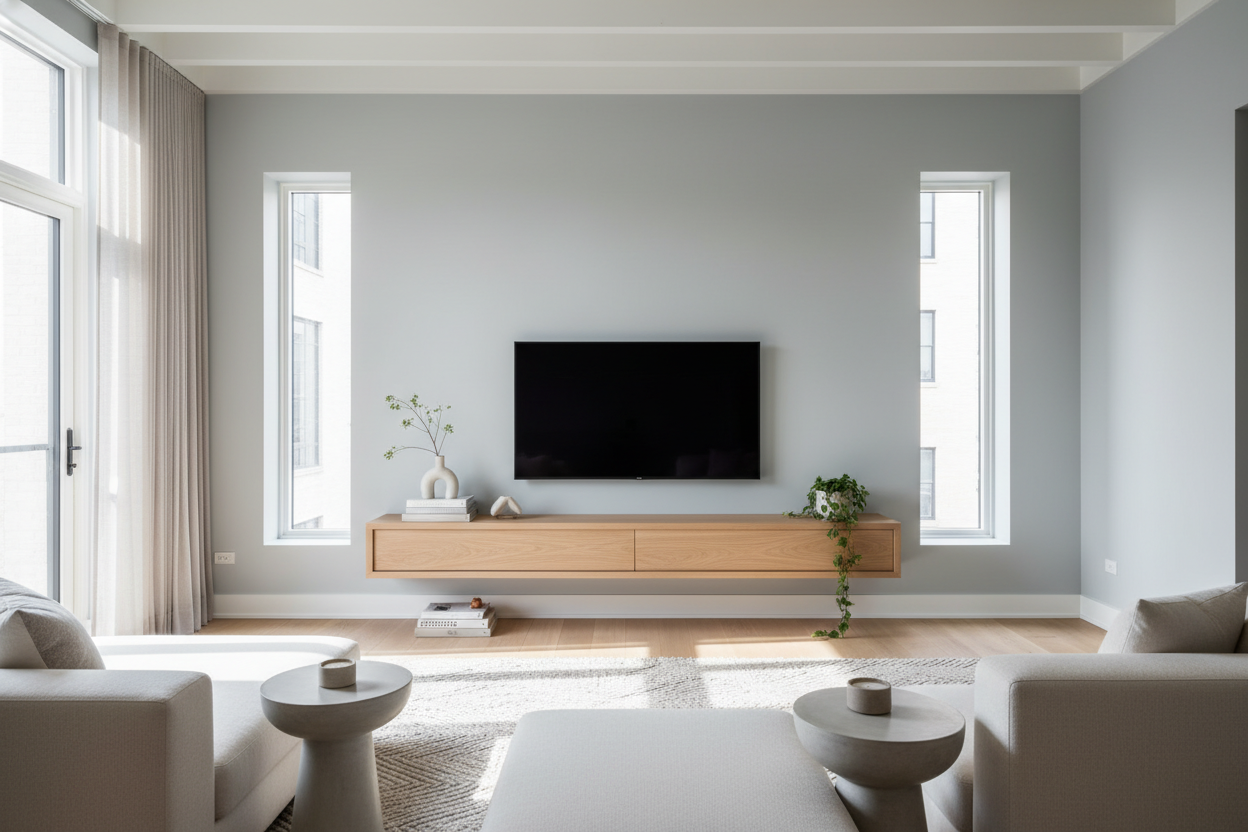
I spent three years living in a 650-square-foot apartment with ceilings so low I could almost palm them. I tried every trick in the book: vertical stripes, tall floor lamps, painting the baseboards the same color as the walls. Nothing worked until I finally admitted the 72-inch oak sideboard under my television was the real culprit. It was a beautiful piece, but it sat on the floor like a lead weight, anchoring my gaze to the bottom third of the room.
The moment I swapped it for a tv wall console, the entire room breathed. Suddenly, I could see four extra feet of floorboards, and my brain stopped registering the ceiling as a lid. It’s the oldest trick in the book, but it works every single time because it addresses the visual weight that standard furniture ignores.
Quick Takeaways
- Visible floor space creates an immediate illusion of more square footage.
- Floating units remove the visual clutter of furniture legs and heavy bases.
- Proper installation requires a stud finder and about an hour of your Saturday.
- Cables must be hidden inside the wall or a sleek raceway to maintain the effect.
The 'Bottom-Heavy' Living Room Problem
Most of us default to floor-standing media units because that’s what we’ve always seen. But in a standard room, chunky furniture creates a visual anchor that drags the energy down. It’s like wearing heavy boots with a summer dress—it just feels off. When your media center takes up physical and visual floor real estate, it cuts the room in half and makes those 8-foot ceilings feel like they’re pressing down on your head.
I realized this after swapping out my clunky console for something that actually hovered. The oppressive feeling of my living room vanished. If your furniture has a massive footprint—say, a 24-inch deep cabinet in a 12-foot wide room—it’s basically shouting at you to look at the floor. By removing the base of the unit, you break that anchor. The room feels lighter because the eye is no longer stopped by a solid block of wood or MDF at knee height. You’re essentially reclaiming the 'horizon line' of your living space.
Enter the Optical Illusion: Why Floating Furniture Works
There is a specific design psychology at play here. When the floor extends seamlessly all the way to the baseboard under your furniture, the room feels wider. Your eye doesn't hit a dead end at the front of a cabinet. A floating media console entertainment center exploits this by keeping the sightlines open. It’s the same reason interior designers love chairs with skinny legs—it’s all about seeing as much of the floor as possible to trick the brain into perceiving more volume.
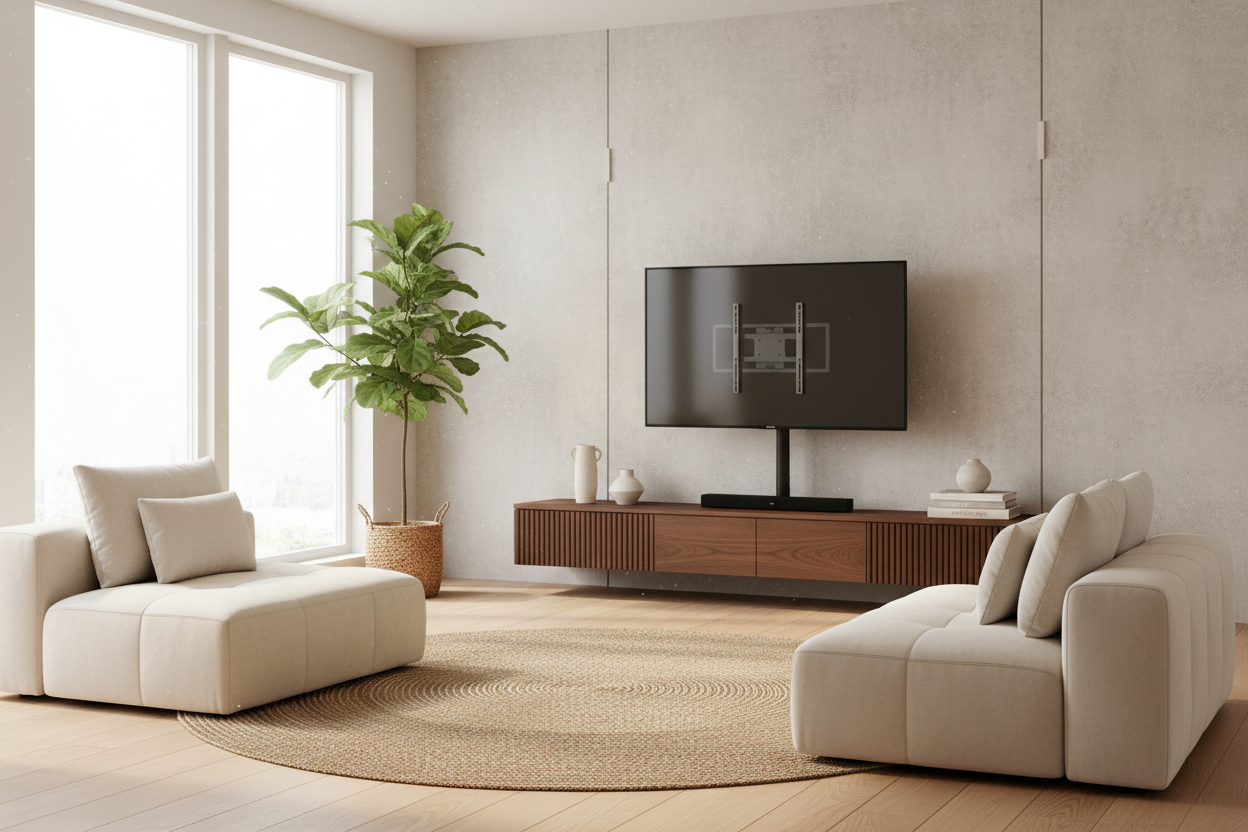
I usually recommend a unit that is at least 10 to 12 inches off the ground. This height is the sweet spot where you can easily run a vacuum or a Roomba underneath but still feel like the piece is substantial. If you go too high, it looks like a kitchen cabinet that lost its way. Too low, and you lose the lifting effect entirely. I've found that a console with a depth of about 15 inches is perfect; it’s deep enough for a modern receiver but doesn't stick out so far that you'll bump your shins on it in the dark. This creates a sense of 'negative space' that makes the wall appear further back than it actually is.
Yes, You Still Need Something Under the Screen
I’ve seen people try to go minimalist by mounting a TV on a totally bare wall. Please don't do this. It looks like a giant black hole floating in a void, and it makes the TV feel like an afterthought. You need a wall console for tv setups to provide a visual landing pad for the screen. Without it, the TV looks like it’s just stuck there, waiting for the rest of the furniture to arrive. It creates a weird tension in the room that actually makes the ceiling feel lower because the screen is just 'hanging' in the middle of your vertical space.
Think of it as grounding a wall-mounted screen. The console gives the TV a sense of place and purpose, while also giving you a spot to stash your Apple TV, soundbar, and those three remotes you only use once a month. It bridges the gap between tech and decor. Plus, it provides a surface for a small plant or a couple of books, which helps the tech blend into your actual life rather than dominating it. It’s the difference between a 'media room' and a living room that happens to have a TV.
Will It Actually Hold My Heavy Gear?
This is the number one question I get. Is my 65-inch OLED going to rip the drywall out? The answer is no, provided you aren't an idiot about installation. You cannot—I repeat, cannot—rely on plastic drywall toggles for a piece of furniture you plan to put weight on. You need to find the studs. Most houses have studs spaced 16 inches apart; find them, mark them, and use them. If you're dealing with metal studs in a high-rise, you'll need specific toggle bolts, but the principle remains the same: you need a structural connection.
Modern mounting brackets are incredibly over-engineered. Most are rated for 150+ pounds, which is way more than your receiver and a few coffee table books. If you hit two studs with three-inch lag bolts, that console isn't going anywhere. I’ve personally seen a properly mounted unit hold up through a move and a very curious toddler. If you're worried about the weight of an older, heavier receiver, just make sure the unit you buy has a solid back panel or a steel internal frame. Avoid the ones that are held together by nothing but wooden dowels and hope. A kiln-dried hardwood frame will always beat out cheap plywood in the long run.
The Verdict: Should You Finally Ditch the Legs?
If you live in a modern apartment or a mid-century ranch, a floating unit is a no-brainer. It cleans up the lines of the room and makes your ceilings feel like they’ve had a growth spurt. The only time I’d hesitate is if you’re in a 19th-century Victorian with original crown molding and ornate details—sometimes the hovering look can feel a bit too clinical for those spaces. In those cases, a traditional piece with actual feet might be the better play to keep the historical vibe alive.
The installation takes more effort than just sliding a box across the floor, but the payoff is permanent. If you’re a renter who isn't allowed to drill massive holes, you might have to browse traditional TV stands instead, but look for ones with tall, tapered legs to mimic that airy feeling. For everyone else? Get the drill out. The extra floor space and the visual lift are worth the thirty minutes of measuring twice and drilling once. It’s the easiest way to make a 12x14 room feel like a showroom.
My Personal Experience
I once bought a cheap MDF floating shelf from a big-box store that claimed it could hold 50 pounds. Three days later, I found it sagging at a 15-degree angle because the mounting plate was made of thin aluminum that bent under the weight of a single PlayStation. Lesson learned: buy something with a solid steel mounting track. Don't cheap out on the hardware, or your living room will look like a sinking ship. I ended up replacing it with a solid wood version that cost twice as much but has stayed perfectly level for four years.
FAQ
How high should I mount my console?
Aim for 10 to 12 inches off the floor. This provides enough clearance for the floating effect without making the TV sit too high for comfortable viewing. Your eye level should ideally hit the center of the TV screen when you're seated on your sofa.
Can I hide the wires without cutting into the wall?
You can use a paintable cable raceway that sticks to the wall. It’s not as seamless as running wires behind the drywall, but if you paint it the exact same color as your wall, it mostly disappears. It’s a great compromise for renters.
What if my studs aren't centered where I want the TV?
Most high-quality mounting brackets allow the console to slide left or right along the track after it’s bolted into the studs. This lets you center the unit perfectly even if your home's framing is a bit chaotic. Always check the bracket design before you buy.

Dejar un comentario
Este sitio está protegido por hCaptcha y se aplican la Política de privacidad de hCaptcha y los Términos del servicio.