










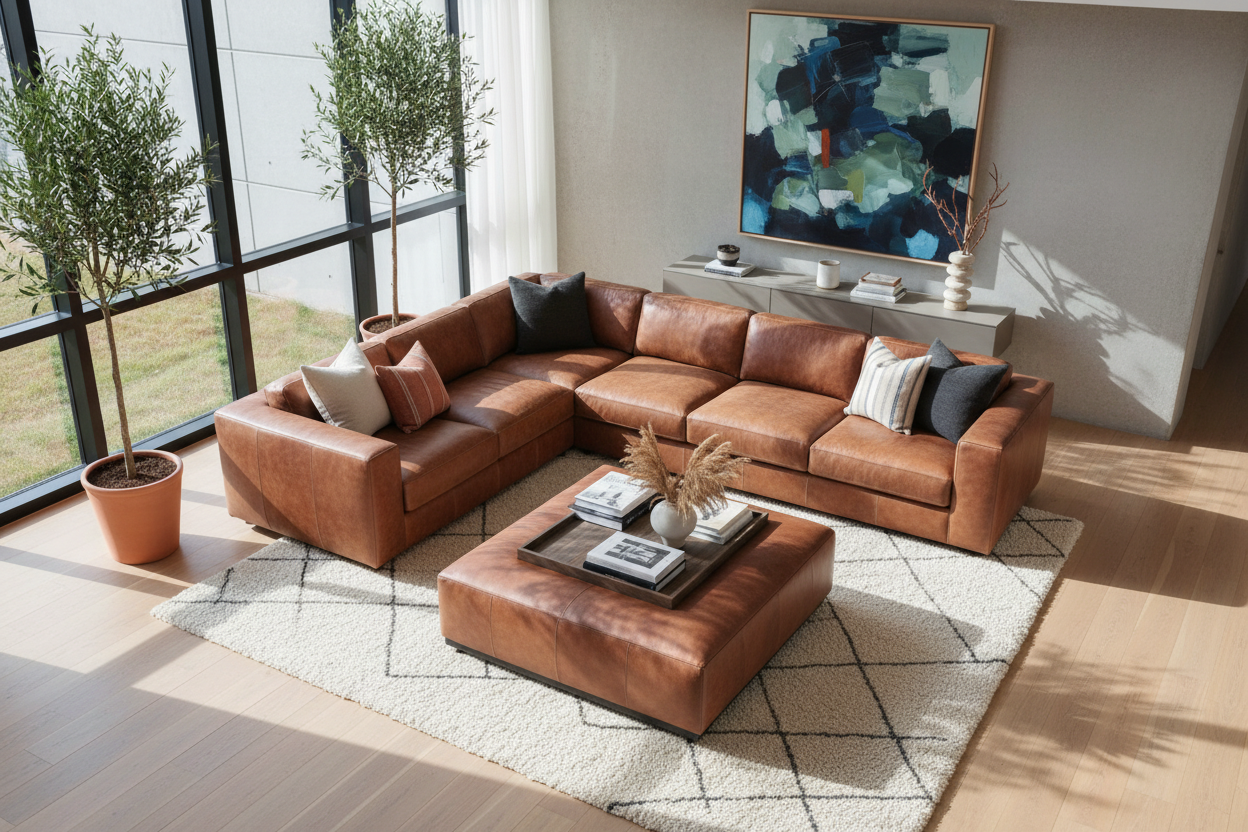
There is a delicate tension in interior design between rugged durability and refined elegance. Clients often come to me wanting a centerpiece that can withstand daily life—pets, spills, and movie nights—without sacrificing that sophisticated, architectural look. The answer is almost always a well-chosen leather couch and ottoman. This combination anchors a room with visual weight while offering a versatility that standard sectionals simply cannot match. Whether you are aiming for Mid-Century Modern minimalism or a rich Industrial aesthetic, getting this pairing right requires more than just picking a color.
Quick Decision Guide: Key Features to Look For
If you are rushing to make a purchase, prioritize these four elements to ensure your investment lasts decades rather than years:
- Leather Grain Quality: Opt for Full-Grain or Top-Grain leather. Avoid "bonded" leather, which will peel within a few years.
- Frame Construction: Look for kiln-dried hardwood frames rather than particle board to prevent warping.
- Cushion Density: High-resiliency foam wrapped in down provides the best balance of structure and sink-in comfort.
- Ottoman Functionality: Decide if the ottoman will serve primarily as a footrest, a coffee table substitute, or hidden storage.
Choosing the Right Leather Grade and Patina
When sourcing a leather sofa and ottoman, the terminology can be deceptive. As a designer, I steer clients toward Aniline or Semi-Aniline leathers. These finishes retain the hide's natural surface, meaning your leather couch ottoman will develop a rich, unique patina over time. It tells a story.
Conversely, a "corrected grain" or pigmented leather sofa with ottoman might look pristine initially, but it can feel plasticky and cold to the touch. Remember, leather is a natural material; it should breathe. If you are buying a leather couch and ottoman set, ensure the dye lots match perfectly, as slight variations in tanning can be glaringly obvious when the pieces are placed side-by-side.
Mastering the Layout and Spatial Flow
A common mistake is treating a leather sofa set with ottoman as a static block. Unlike a chaise lounge that is permanently attached, a separate ottoman offers fluidity. In smaller urban apartments, I often recommend a leather couch with ottoman over a massive sectional.
You can float the ottoman in the center of the rug to act as a coffee table (styled with a sturdy tray), or push it against the sofa to create a makeshift chaise for lounging. This flexibility allows you to manipulate the traffic flow of the living room based on the occasion.
Visual Weight and Balance
Leather is visually heavy. To prevent your room from feeling like a dark cave, balance your leather sofa and ottoman set with lighter textures. If you have a bulky Chestersfield-style sofa, pair it with a sleek, leggy ottoman rather than a boxy one. Contrast the smooth, cool texture of the leather with a chunky wool rug or linen throw pillows to soften the overall aesthetic.
The Ottoman: More Than Just a Footrest
The utility of a leather couch ottoman extends far beyond comfort. In many of my recent designs, we utilize the ottoman as the focal point of the conversation area. When selecting a leather sofa and ottoman set, consider the height differential. Ideally, the ottoman should be about one inch lower than the seat height of the couch to prevent uncomfortable pressure on the legs.
Lessons from My Own Projects
I want to share a specific realization I had while installing a custom cognac leather couch and ottoman for a client in a sun-drenched loft. We chose a stunning, buttery full-grain aniline leather. It looked incredible on install day.
However, two weeks later, the client called in a panic because a fingernail scratch had appeared on the ottoman. This is the reality of high-end, untreated leather that brochures don't always highlight: it marks easily. I had to go over and demonstrate that by simply rubbing the scratch with the warmth of a thumb, the oils in the leather redistribute and the mark fades into the patina.
Furthermore, we found that because the leather was so smooth, the ottoman kept sliding away from the sofa on the hardwood floor. We had to install heavy-duty rubber grip pads—not felt pads—to keep the configuration tight. It’s these unpolished, practical details that define living with leather.
Conclusion
Investing in a leather sofa and ottoman is a commitment to quality. It is furniture that improves with age, softening and darkening as you live your life on it. By focusing on grain quality, balancing the visual weight, and embracing the inevitable patina, you create a space that feels curated and timeless.
Frequently Asked Questions
How do I maintain a leather couch and ottoman?
Dust weekly with a microfiber cloth and condition the leather every 6 to 12 months using a pH-balanced conditioner. Avoid placing the set in direct sunlight, as UV rays can fade and dry out the hide.
Can I mix a leather ottoman with a fabric sofa?
Absolutely. In fact, mixing materials is a designer trick to add depth. A leather ottoman pairs beautifully with a velvet or linen sofa, adding a touch of masculinity and texture to the soft upholstery.
What is the ideal size for an ottoman paired with a leather couch?
The ottoman should be roughly two-thirds the width of the seating area it is placed in front of. This ensures everyone has access to it without it blocking the flow of movement around the sofa.

Dejar un comentario
Este sitio está protegido por hCaptcha y se aplican la Política de privacidad de hCaptcha y los Términos del servicio.