










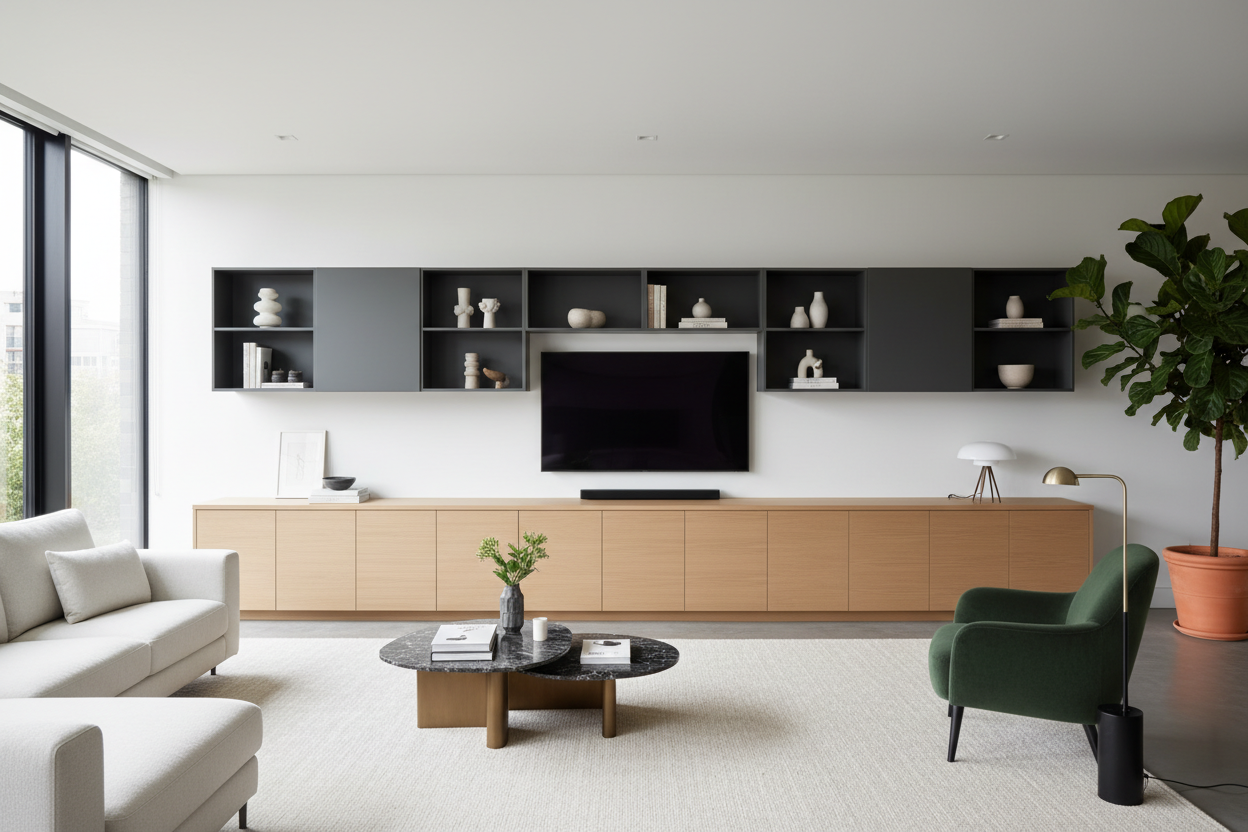
If you live in a typical North American open-concept home, you probably have one: the massive, intimidating blank wall. It usually sits right across from the sofa, mocking your attempts to make the room feel cohesive. Pushing a standard-sized console against it only highlights the awkward proportions. This is where a long storage cabinet becomes your best design tool. It grounds the room, eats up negative space, and hides the inevitable clutter of daily life.
Getting this piece right requires more than just picking a finish you like. Scale, structural integrity, and layout math dictate whether the piece looks custom-fitted or completely out of place.
Quick Decision Guide
- Scale to the wall: Aim for the cabinet to cover 70 to 80 percent of your wall's width to maintain proper visual proportion.
- Check the center support: Any unit over 60 inches wide must have a center support leg to prevent bowing over time.
- Respect the walkway: Leave a minimum of 36 inches of clearance between the cabinet face and your seating.
- Watch the depth: Stick to 15 to 18 inches deep for living rooms to avoid encroaching on foot traffic.
Taming the Open-Concept Layout
Getting the Proportions Right
In large suburban family rooms, a standard 50-inch media console looks like a postage stamp on a king-sized envelope. To properly anchor the space, you need visual weight. When placed correctly, long cabinets for storage stretch the eye horizontally, making ceilings feel higher and the room feel more intentional. If you are placing a television above it, the cabinet should be at least 25 percent wider than the screen itself. This creates a visually stable pyramid shape rather than a top-heavy, precarious look.
Structural Integrity and Materials
Preventing the Dreaded Sag
When you stretch wood across a wide span, gravity eventually wins. This is the biggest failure point I see in budget furniture. A long shelf cabinet made entirely of low-density particleboard will start to sag—or 'smile'—in the middle within a year, especially if loaded with heavy books or a television. Look for solid wood construction, or at least high-quality plywood with a thick veneer. If you opt for engineered wood, verify that the interior shelving is reinforced with a solid wood edge band, which drastically increases rigidity.
Lessons from My Own Projects
A few years ago, I sourced a stunning 96-inch floating walnut credenza for a client's basement media room. It looked incredible on installation day. But I learned a hard lesson about North American residential framing: walls are rarely perfectly flat. The subtle bow in the drywall created a noticeable, uneven gap behind the center of the unit.
Worse, because the client loaded it with a heavy vintage receiver and hundreds of vinyl records, the piece started to sag within six months despite being mounted directly into the studs. I had to retro-fit adjustable metal legs underneath it to save the piece. Now, I strictly advise against floating units for extreme lengths unless the wall is custom-built and perfectly plumb. I almost always specify floor-standing units with adjustable center feet for anything over 72 inches.
Frequently Asked Questions
How deep should a storage credenza be?
For most living rooms and dining spaces, a depth of 15 to 18 inches is ideal. This provides enough interior room for standard media components, board games, or serving platters without eating up valuable floor space.
How do I style a long flat surface without it looking messy?
Avoid lining objects up in a uniform row. Group items in odd numbers (clusters of three work best) and vary the heights. Use a tall table lamp on one end, a low stack of books in the middle, and a medium-height vase on the opposite end to guide the eye across the piece.
Can I use multiple smaller cabinets pushed together?
Yes. If navigating tight stairwells or narrow hallways makes delivering a massive 90-inch piece impossible, pushing two or three identical smaller cabinets together is a great workaround. Just ensure they have straight, flush sides so the seams disappear.

Dejar un comentario
Este sitio está protegido por hCaptcha y se aplican la Política de privacidad de hCaptcha y los Términos del servicio.