










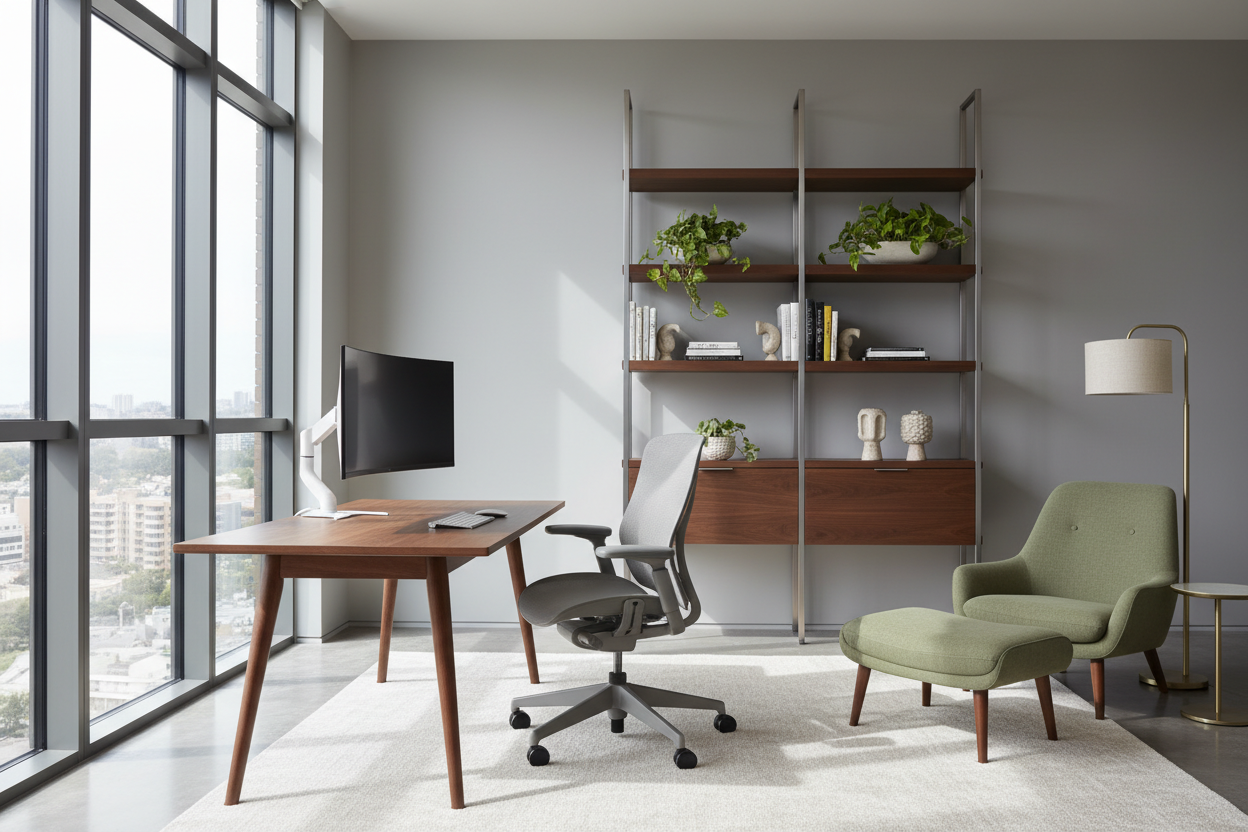
We have all been there. You spend hours scrolling through Pinterest or Instagram, saving stunning office room images, convinced that if you just buy that specific chair or that exact desk, your productivity will skyrocket. Yet, when the furniture arrives, the space feels flat, cluttered, or surprisingly uncomfortable. The disconnect often isn't your budget; it is the translation of a 2D image into a 3D living space.
As a designer, I see clients struggle to replicate the "editorial look" because photos often hide the functional realities of a workspace. This guide will teach you how to decode a professional office room photo and extract the design principles that actually make the space work, rather than just mimicking the aesthetic.
Key Features to Analyze in Design Photos
- Scale and Proportion: Note how much negative space exists around the furniture. A massive executive desk looks great in a loft but suffocates a standard bedroom.
- Lighting Layers: Look for three sources: ambient (overhead), task (desk lamp), and accent (floor lamps or LED strips).
- Texture Variance: High-end spaces mix materials—wood grain, metal accents, and textiles—to prevent the room from feeling sterile.
- Cable Management: Professional photos usually edit out cords. You must plan for where the wires actually go.
Decoding Layout and Flow
When you look at an inspiring office room pic, your eye is guided by the composition. In your actual home, your body is guided by the layout. The most common mistake I see is placing a desk directly against a wall simply because that is how it fits best in a photo frame. In reality, "floating" the desk (placing it perpendicular to the wall or facing into the room) often commands better authority and utilizes natural light more effectively.
Consider the "work triangle" of the office: your chair, your reference materials (shelving), and your digital interface (screen). A static office room picture captures a moment, but your layout must accommodate movement. Ensure you have at least 36 to 48 inches of clearance behind your chair to slide back without hitting a bookshelf.
Materiality: The Tactile Reality
Photos can be deceiving regarding material quality. A laminate surface might look identical to solid walnut in a low-resolution image, but the tactile experience is vastly different. When sourcing furniture based on a design you admire, prioritize touch points.
Solid Wood vs. Veneer
Solid wood offers longevity and can be refinished, but it is susceptible to humidity changes. High-quality veneer over MDF is often more stable for large desk surfaces and resists warping. Avoid hollow-core particle board if you plan to mount heavy monitor arms, as the clamp pressure can crack the surface over time.
Fabric and Acoustics
A sleek, minimalist office with concrete floors and glass desks looks incredible in a photo. However, without soft surfaces to dampen sound, the echo can be maddening during conference calls. If your inspiration image features hard surfaces, look closer: is there a high-pile rug? Are there heavy drapes? These elements are crucial for acoustic comfort.
My Personal Take on Office Room Images
I learned a hard lesson early in my career regarding the "floating desk" aesthetic often seen in high-end editorials. I designed a home office for a client based entirely on a sleek, cord-free image she loved. We installed a beautiful writing desk in the center of the room. It looked sculptural and perfect.
Three days later, she called me. The reality of running a power strip across the floor to plug in her laptop and lamp created a tripping hazard and ruined the visual serenity. We had to cut into the floor to install a floor outlet—a costly retrofit. Now, whenever I see a pristine office room photo with a floating desk, I don't look at the wood finish first; I look for the floor outlet. If you are replicating this look, always solve the power equation before buying the desk.
Conclusion
Transforming your workspace isn't about buying the most expensive furniture you see online; it is about understanding the mechanics behind the image. By focusing on scale, lighting layers, and material durability, you can create an office that feels as good as it looks. Stop scrolling, start measuring, and build a space that supports your best work.
Frequently Asked Questions
How do I make a small room look like the spacious office room images?
Use verticality. Tall shelving draws the eye up, making ceilings feel higher. Also, opt for furniture with exposed legs rather than solid blocks; seeing the floor underneath the desk and sofa creates an illusion of more square footage.
Why does my lighting never look as warm as the photos?
Design photography often uses a mix of natural light and color-corrected strobes. For home use, aim for bulbs with a color temperature of 2700K to 3000K (warm white) and use dimmer switches to control intensity. Avoid cool daylight bulbs (5000K) unless you are doing color-critical art work.
Is it worth investing in a custom desk seen in a luxury office room pic?
If you have non-standard dimensions or specific ergonomic needs (like an extra-low keyboard tray), custom is worth it. However, for standard layouts, high-end modular systems from reputable manufacturers often provide the same look and durability at a lower price point.

Dejar un comentario
Este sitio está protegido por hCaptcha y se aplican la Política de privacidad de hCaptcha y los Términos del servicio.