










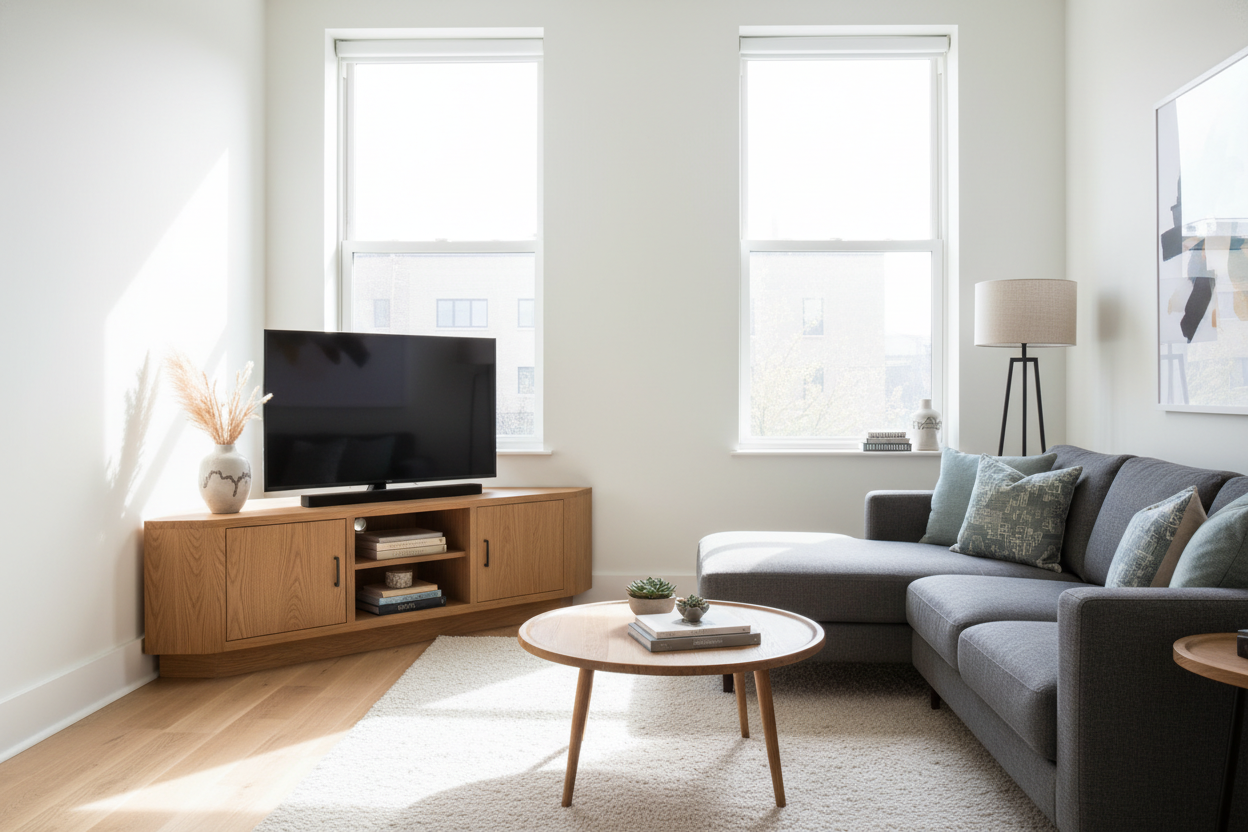
I spent three weeks staring at a blank wall in my new apartment, trying to figure out why the living room felt like a waiting room. I had a 55-inch screen and a long console that took up the only wall long enough for my sofa. It was a mess—the sofa was shoved into the middle of the room like a lonely island, and I was constantly dodging the coffee table just to get to the kitchen. Then I looked at the 'dead corner' by the window. I realized that a oak corner tv stand was the only way to save my sanity and my floor plan.
- Corner units reclaim 'dead' square footage that usually goes to waste in small rooms.
- A light oak finish prevents the furniture from feeling like a heavy, dark visual anchor.
- Measuring the depth is more important than the width to ensure it doesn't block walkways.
- The triangular void behind the unit is a secret weapon for hiding messy cables.
The 'Dead Corner' Dilemma (And Why My Layout Sucked)
My apartment is one of those 'charming' pre-war builds with three doors, two radiators, and two windows all in the same living area. Finding continuous wall space is like finding a parking spot in Manhattan—nearly impossible. I originally tried using standard flat-wall TV stands, but they were a disaster. If I centered the TV on the main wall, the sofa had to sit right in the path of the front door. It felt cramped, awkward, and totally inefficient.
That corner by the window was doing nothing. It was just sitting there, collecting dust and a stray floor lamp I didn't even like. I finally accepted that my layout wasn't the problem; my furniture choice was. By moving the screen to that 90-degree junction, I suddenly opened up the entire room. It’s a classic small-space trick that I’d ignored for years because I thought corner units were for grandma's house. I was wrong.
Why I Specifically Chose an Oak Corner TV Stand
When I started shopping, I knew I wanted wood, but the finish was everything. I’ve seen dark wood corner units that look like they belong in a 90s basement—heavy, clunky, and depressing. I went with a light oak corner tv stand because the honey-toned wood reflects light rather than absorbing it. It keeps the corner feeling airy and modern, which is vital when you're tucking a piece of furniture into a spot that already gets less light.
Oak is also a beast when it comes to durability. I’m tired of that flimsy plywood stuff that bows the second you put a soundbar on it. A corner tv stand light oak offers that solid, kiln-dried feel that actually lasts. It has a natural grain that adds texture to the room without needing extra decor. It doesn't scream 'I am a piece of media furniture'; it just looks like a high-quality accent piece that happens to hold a TV.
Getting the Geometry Right (It's Harder Than It Looks)
This is where most people mess up. You can't just eyeball a oak corner tv cabinet. You have to measure the 'clipped' back—the part that actually fits into the corner. I learned the hard way that if your oak corner tv unit is too deep, it'll jut out into the walkway and you'll be stubbing your toe every time you go for a snack. I aimed for a unit that sat about 20 inches deep from the corner point to the front edge.
You also need to think about your viewing angle. Since the TV is now at a 45-degree angle to the walls, you might need to shift your sofa. I found that angling the main chair slightly toward the corner made the whole room feel more conversational. It’s not just about fitting the furniture; it’s about making sure you don’t have to crane your neck like you’re in the front row of a movie theater.
Wait, Does a Corner TV Unit Oak Actually Hold Anything?
An honest review: You aren't getting the eight-foot-long shelf space of a massive credenza. But an oak corner entertainment center is surprisingly efficient. Most designs feature a deep central cabinet because of that triangular shape. I managed to tuck my PS5, a mesh router, and a stack of board games into the main section of my corner tv cabinet oak without it looking cluttered.
The real win is the cable management. In a flat stand, cables often spill out the sides. With a corner unit, there is a natural 'void' behind the stand where all the wires can live. It’s much cleaner than a solid wood TV stand in black, which shows every single speck of dust and every stray white power cord. I tucked my power strip right into the corner gap, and now the 'cable spaghetti' is completely invisible from the sofa.
The Real Payoff: I Got My Main Wall Back
The relief I felt once the TV was moved was instant. For the first time in two years, I had a long, uninterrupted wall to work with. I didn't just fill it with more furniture—I put up a massive gallery wall with art I’d been keeping in storage. It changed the entire vibe of the apartment from 'media room' to 'living room.'
If you have the space, you could even put a sleek electric fireplace console on that newly freed-up wall to create a real focal point that isn't a black glass rectangle. Moving my screen to the corner wasn't just a layout fix; it was a way to reclaim the aesthetic heart of my home. If your room feels 'off,' look at your corners. They might be the solution you're ignoring.
FAQ
Will a 55-inch TV fit on a corner stand?
Yes, but check the legs. Most 55-inch TVs will fit, but the edges of the screen might overhang the sides of the stand. As long as the TV's feet are securely on the top surface, you're fine, but measure the width of your TV's base first.
Is light oak hard to keep clean?
Actually, it's easier than dark wood. Light oak hides dust and fingerprints remarkably well. A quick wipe with a damp cloth once a week is usually all it takes to keep it looking fresh.
Does a corner TV stand make the room look smaller?
Quite the opposite. By clearing up the main walls and utilizing a 'dead' corner, you create more open floor space in the center of the room, which usually makes the entire area feel significantly larger.


Dejar un comentario
Este sitio está protegido por hCaptcha y se aplican la Política de privacidad de hCaptcha y los Términos del servicio.