










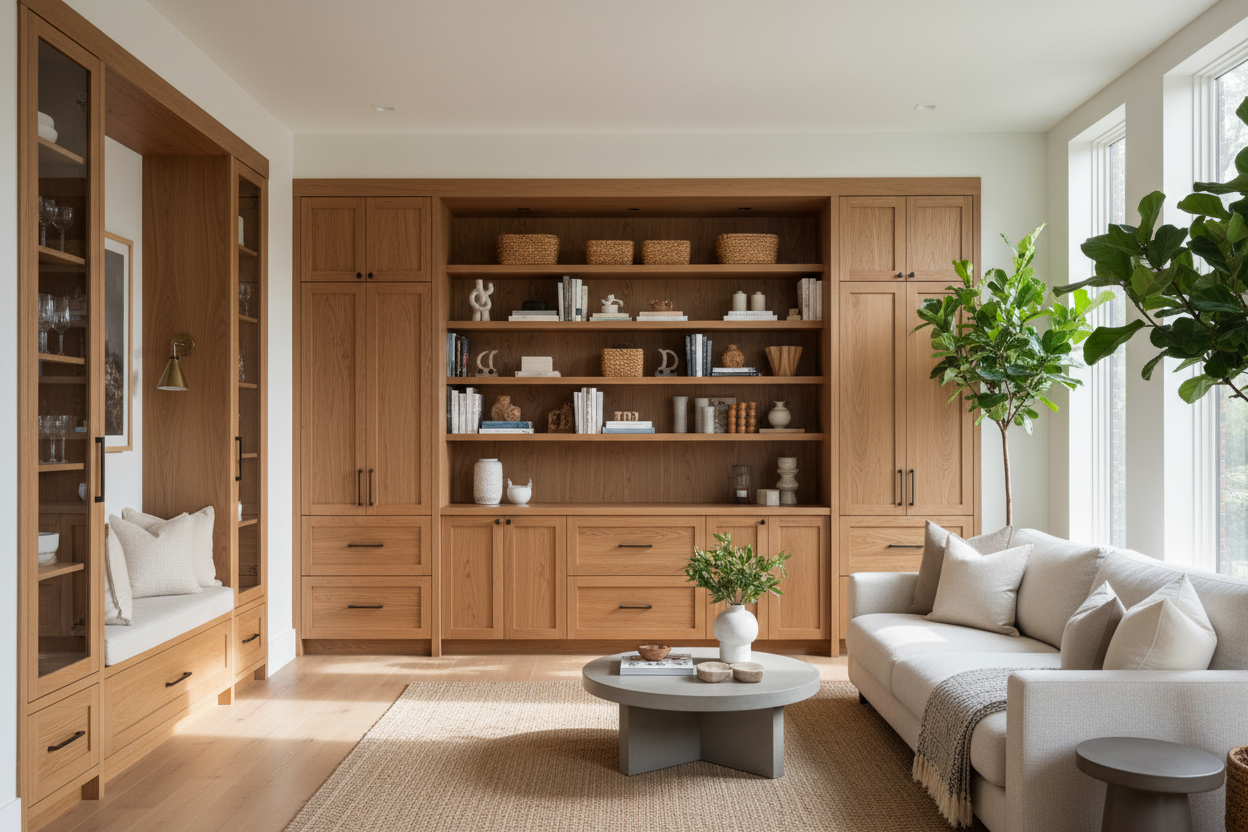
I remember staring at my checkbook after writing a deposit for my first set of custom-built cabinets. I felt like a 'real' adult, finally moving past the era of wobbly flat-pack furniture and into the big leagues of bespoke millwork. I expected perfection to arrive in a van six weeks later, assuming the price tag guaranteed a flawless result.
Instead, I ended up with a beautiful set of boxes that didn't actually fit my life. I spent thousands on 'custom' only to realize I’d made some amateur design calls that no amount of expensive oak could fix. If you're about to hire a pro, learn from my expensive mistakes first.
- Don't assume your builder is an interior designer; they are construction experts.
- Measure your largest items (platters, mixers, bins) before the first sketch is drawn.
- Budget for the 'jewelry'—the trim and end panels—or the project will look unfinished.
- Standard depths are suggestions, not laws.
I Thought 'Custom' Meant 'Perfect' (I Was Wrong)
There is a massive misconception that paying for cabinet custom made solutions means the builder will magically know how you use your kitchen or office. I fell into this trap hard. I thought that because I was paying for custom built cabinetry, the 'experts' would guide me through every functional detail.
The reality? Most built in cabinet makers are focused on the 'build' part of their title. They want to know the dimensions of your wall and the wood species you want. They aren't going to ask if you prefer your spices in a drawer or a pull-out rack. If you don't show up with a specific plan, they will default to 'standard'—which defeats the entire purpose of going custom.
I learned the hard way that personalized cabinets require intense personal involvement. You have to be the one to say, 'I need this drawer to be exactly 7 inches deep to fit my specific flour canisters.' If you leave it to chance, you’re just paying a premium for a handmade version of something you could have bought at a big-box store.
Mistake 1: Not Measuring My Actual Stuff Beforehand
I assumed standard depths were standard for a reason. When I ordered my purpose built cabinets, I didn't think twice about the 24-inch depth for the lowers. Then I tried to put away my oversized Thanksgiving turkey platter and realized the cabinet door wouldn't shut by a half-inch. I was devastated.
I’d spent all this money on bespoke storage, yet I still had to store my best serving pieces in the garage. Even a basic corner kitchen pantry cabinet set from a retail store often has more thoughtful clearance than the poorly planned units I commissioned. I should have measured my stand mixer, my tall cereal boxes, and my stack of dinner plates before the wood was even cut.
Wasted space is the biggest sin of hand built cabinets. I ended up with a 'dead' corner that was 30 inches deep with no pull-out mechanism. It became a graveyard for Tupperware lids. If you're going custom, measure your 'problem' items first and build the box to fit them, not the other way around.
Mistake 2: Leaving the Interior Layout to the Builder
This was my $2,000 mistake. I told the maker I wanted a 'pantry unit' and left it at that. He built beautiful, sturdy shelves, but they were spaced 12 inches apart and weren't adjustable. I ended up with a lot of empty air above my cans and not enough room for my olive oil bottles.
It’s a bitter pill to swallow when you realize a DIY cabinet desk IKEA setup I did in my guest room actually functioned better. Why? Because with the cheap stuff, I had to think through every shelf pin and drawer divider myself. I got lazy with the custom order because I thought the price point included the 'thinking'—it didn't.
You must explicitly design the interior. Do you want soft-close slides? Do you want a hidden drawer inside a larger drawer? Do you need a vertical slot for baking sheets? If it’s not on the blueprint, it’s not happening. Your builder is there to execute your vision, but you have to provide the vision.
Mistake 3: Skipping the Finishing Trim and End Panels
In an effort to save a few hundred dollars at the end of a long project, I told the builder to skip the decorative end panels and the heavy crown molding. I figured I could add it later or that it wouldn't matter. I was wrong. Without those finishing touches, my expensive custom cabinets looked like high-end boxes just hanging on a wall.
Truly personalized cabinets need the 'jewelry' to look integrated. This means thick end panels that match the door style and molding that meets the ceiling perfectly. If you find yourself cutting these corners to save money, you might be better off pivoting. Sometimes buying a standalone modern white wardrobe armoire looks more intentional and 'finished' than a custom build that lacks the proper trim.
Those finishing details are what bridge the gap between 'furniture' and 'architecture.' Without them, you lose that seamless, built-in look that makes custom work worth the investment in the first place.
How to Actually Brief Your Cabinet Maker Next Time
If I could go back and talk to my younger, naive self, I’d hand her a checklist. Don't go to a consultation with just a 'vibe.' Go with data. Bring photos of your current messy cabinets and explain exactly why they don't work. Show them how you want to style a cabinet desk combo if you're doing an office, so they understand the scale of your decor.
Here is what you need in your 'brief' folder:
- A list of the 5 largest items that must fit inside.
- Photos of hardware you love (don't let them pick the hinges).
- A clear preference on 'inset' vs. 'overlay' doors.
- A sketch of how you want the interior shelves divided.
Do custom cabinets add value to a home?
Yes, but only if they look like they belong there. High-quality millwork in kitchens and primary suites offers the best ROI. Cheap-looking 'custom' work can actually hurt you if it looks like a DIY project gone wrong.
What is the most durable finish for custom cabinets?
Conversion varnish is the gold standard in the industry. It’s a chemical-cure finish that is incredibly tough against moisture and scratches. If your builder suggests just 'regular house paint,' find a new builder.
How long does the process usually take?
Expect 8 to 12 weeks from the time you sign the contract to installation. If someone says they can do it in two weeks, they are likely using pre-made carcasses and just slapping custom doors on them.


Dejar un comentario
Este sitio está protegido por hCaptcha y se aplican la Política de privacidad de hCaptcha y los Términos del servicio.