










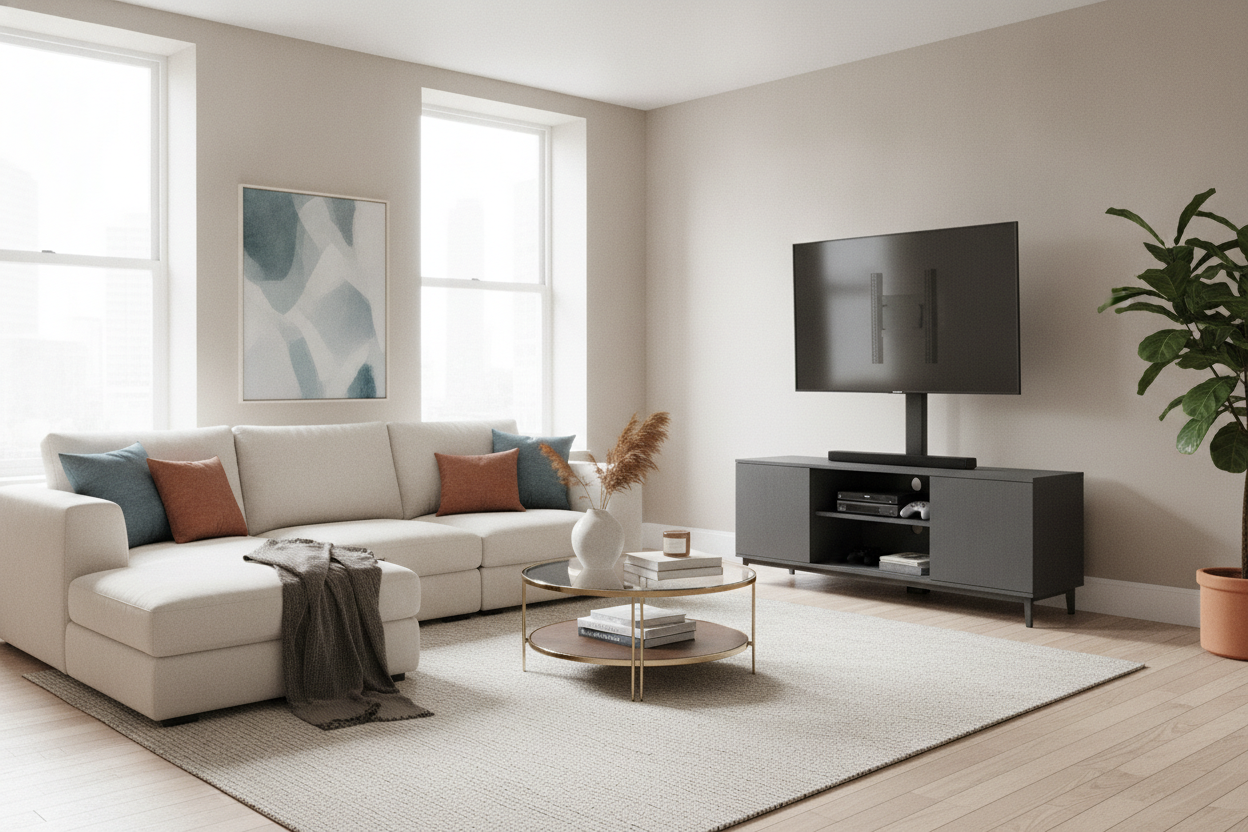
I spent three hours staring at a 1/2-inch drill bit and my landlord's 'no holes larger than a thumbtack' clause before I finally gave up on the wall-mount dream. We all want that Pinterest-perfect floating screen, but when you are living in a pre-war apartment with plaster walls that crumble if you look at them wrong, drilling massive lag bolts feels like a recipe for a lost security deposit. It was that specific moment of DIY paralysis that led me to the 60 inch tv stand with mount.
- Get the floating screen look without the structural risk.
- Hide messy cables inside an integrated steel spine.
- Adjust the height to save your neck from 'the tilt.'
- Swivel the screen to dodge afternoon window glare.
The Wall-Mount Dilemma (And My Security Deposit Fear)
Let's be real: wall mounting a television is a high-stakes gamble. If you are a renter, you are basically betting $1,500 of your deposit that you can find a stud and not hit a pipe. Even if you own your place, plaster and lath walls are notorious for cracking the moment you apply pressure. I have seen too many friends end up with a 'floating' TV that actually sits four inches lower on one side because the toggle bolt slipped.
I wanted the aesthetic of a high-end gallery, but I didn't want to spend my Saturday patching drywall and matching paint textures. There is a specific kind of anxiety that comes with hanging 50 pounds of glass and electronics over a hardwood floor. I needed a solution that felt permanent and sleek but was actually as mobile as a standard piece of furniture.
Faking the Floating Look: How It Actually Works
When I started shopping for tv stands, I realized I was looking for a unicorn. I wanted the floor space of a console but the height of a mount. A flat screen tv stand 60 inch model with an integrated mount is essentially a hybrid. It uses a heavy, weighted base—usually wood or tempered glass—and a vertical steel spine that bolts to the back of your TV.
The result is a screen that looks like it is hovering about 10 inches above the console surface. Because the weight is distributed straight down to the floor through the metal column, you don't have to worry about gravity pulling your TV off the wall. It gives you that minimalist, airy vibe while keeping the footprint compact enough for a standard living room layout.
Why Standard Consoles Weren't Cutting It Anymore
Traditional consoles have one major flaw: the TV takes up the entire top surface. You buy a beautiful piece of furniture and then immediately cover it with a plastic base and a giant black rectangle. By using a tv unit for 60 inch tv that lifts the screen, you suddenly get that surface area back. I finally had room for a soundbar, a couple of coffee table books, and a plant that isn't constantly being scorched by the heat from the back of the processor.
Lifting the screen also helps visually. Large furniture can feel like a massive anchor in a small room. This is especially true when considering darker media console designs; if the TV is sitting directly on a black or navy cabinet, the whole thing becomes a giant visual void. Lifting the screen creates a 'gap' of light that makes the entire setup feel significantly less heavy.
3 Things to Check Before Buying
Not all mounts are created equal. First, check your VESA pattern. This is the distance (in millimeters) between the four mounting holes on the back of your TV. Most 60-inch screens use a 400x400 or 600x400 pattern. If the stand doesn't support your specific numbers, you are going to be stuck with a very expensive paperweight.
Second, look at the weight capacity. A modern tv stand for 60 inch flat screen should easily handle 60 to 80 pounds, but always double-check the specs. Finally, prioritize wire management. The best stands have hollow spines or clips along the back. If you can't tuck your HDMI and power cords inside the frame, the 'floating' look is immediately ruined by a spaghetti mess of black wires hanging down the middle.
The Ergonomic Sweet Spot
Most people sit too low for their TV. If you are looking up at your screen, you are going to have a sore neck by the end of a movie marathon. Finding a 60 inch tall tv stand—or one with an adjustable mounting bracket—allows you to line up the bottom third of the screen with your eye level. It sounds like a small detail, but it is the difference between a comfortable Sunday binge and a trip to the chiropractor.
Swivel Capabilities Are a Total Win
One benefit I didn't expect from these 60 tv stands for flat screens was the swivel. Unlike a fixed wall mount, these brackets usually allow for 20 to 30 degrees of movement. When the 4 PM sun hits my window and creates a blinding glare on the screen, I don't have to get up and close the curtains. I just give the TV a slight nudge, and the glare is gone. It is also great for open-concept layouts where you might want to turn the TV toward the kitchen while you're cooking.
Are They Actually Sturdy? (Addressing the Wobble Fear)
I’ll be honest: I was terrified my 70-pound Lab would knock the whole thing over. However, a quality tv stand for 60 inch flat screen is surprisingly bottom-heavy. The base is usually the heaviest part of the assembly to act as a counterweight. I have found that as long as you aren't worrying about center bowing on a cheap particle board unit, the metal spine provides a lot of structural integrity. In fact, the metal mount often reinforces the entire unit, preventing the wood from sagging under the concentrated weight of the TV legs.
Other Alternatives if You Hate Seeing Cords
If you are a total minimalist who wants the TV to disappear when it’s off, there are even more advanced options. You could look into an electric vertical lift tv cabinet. These are the ultimate 'clean look' solution, hiding the entire screen inside the furniture until you hit a button on a remote. It’s a bit more of an investment, but for a multi-purpose room, it keeps the focus on your decor rather than the tech.
FAQ
Will a 60 inch stand fit a 65 inch TV?
Usually, yes. TV stands are rated by weight and VESA pattern, not just screen size. If your 65-inch TV is within the weight limit and the mounting holes match, it will work fine, though it might overhang the sides of the base slightly.
How hard is the assembly?
Expect about 45 minutes. You will need a second person to help you lift the TV onto the bracket once the stand is built. Don't try to solo-lift a 60-inch screen unless you want to buy a new one tomorrow.
Do I need special tools?
Most tv stands for a 60 in flat screen come with the hex keys needed, but having your own screwdriver set and a small level will make the process much faster and more precise.


Dejar un comentario
Este sitio está protegido por hCaptcha y se aplican la Política de privacidad de hCaptcha y los Términos del servicio.