










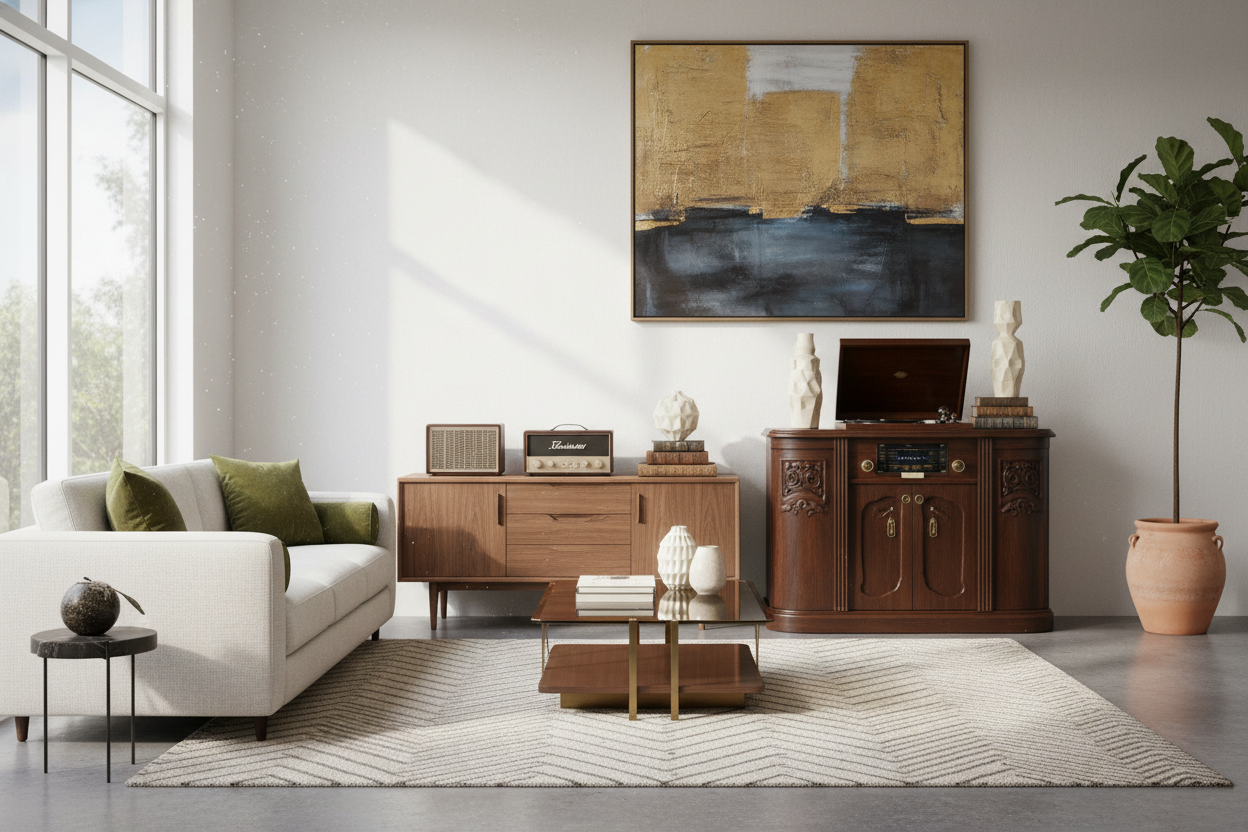
There is perhaps no design dilemma quite as frustrating as the modern living room TV wall. You hang a sleek, ultra-thin screen, only to anchor it with a sterile, mass-produced box that immediately strips the room of its personality. This is exactly why I consistently steer my clients toward vintage media consoles. Swapping a generic unit for a piece with history brings immediate warmth and character to an otherwise tech-heavy focal point. By the end of this read, you will know exactly how to source, size, and style these pieces without sacrificing modern functionality.
Quick Decision Guide: Sourcing Vintage
- Measure internal depth: Modern AV receivers need at least 15 to 18 inches of internal clearance, plus room for cables.
- Check the height: The ideal viewing height for a TV console is typically between 24 and 30 inches from the floor.
- Look for solid wood: Prioritize old-growth timber and dovetail joints over mid-century pieces that rely heavily on peeling veneers.
- Plan for ventilation: Vintage furniture was not designed to house heat-producing electronics. You will likely need to modify the back panel.
- Scale appropriately: Your console should be at least 20 percent wider than your television to avoid a top-heavy, unbalanced silhouette.
Material & Build Quality: Why Old Wood Wins
When you evaluate a media console antique, you are generally paying for a level of craftsmanship that is prohibitively expensive to replicate today. Pieces built before the 1980s often utilize solid hardwoods like walnut, mahogany, and teak, featuring mortise-and-tenon or dovetail joinery. This structural integrity matters when you are loading a cabinet with heavy amplifiers, gaming consoles, and record players.
Identifying Solid Wood vs. Veneer
Not all vintage pieces are solid wood, and that is not necessarily a dealbreaker. Mid-century modern designs frequently used high-quality veneers over solid cores to achieve continuous grain patterns. However, you must inspect the edges. If the veneer is chipping or bubbling, moisture has penetrated the glue. Repairing damaged veneer is costly, so factor that into your budget when inspecting an antique media console.
Space Planning: Fitting Vintage in Modern Floor Plans
North American living rooms have evolved, and so have our televisions. A common mistake I see is forcing a delicate, low-profile vintage media cabinet under a massive 75-inch screen. The proportions simply clash. You need to consider the visual weight of the furniture relative to the room and the technology.
The Golden Ratio of TV to Console
As a general rule, your console should extend at least three to four inches past the edges of your TV on both sides. If you have a 65-inch TV (which is roughly 57 inches wide), you need a console that is at least 65 to 70 inches long. If you find an antique media cabinet you absolutely love but it is too short, consider flanking it with tall, visually heavy items like floor lamps, large potted olive trees, or matching bookshelves to widen the focal point.
Style & Coordination: Mixing Eras
You do not need a retro home to pull off an older piece. In fact, a vintage media console looks most striking when placed in a transitional or contemporary space. The friction between a sleek, modern television and a weathered, patinated credenza creates a layered, collected-over-time aesthetic.
Taming the Visual Weight
Darker woods like mahogany or dark-stained oak carry heavy visual weight. If your living room is small or lacks natural light, a massive, dark wood console can feel like a black hole. To counteract this, I recommend mounting the TV on the wall rather than using the console stand, leaving negative space between the screen and the furniture. You can also style the top surface with reflective objects, like brass candlesticks or a light-colored marble tray, to bounce light around the room.
Lessons from My Own Projects
A few years ago, I sourced a stunning 1920s French oak sideboard to use as a vintage media cabinet for a client's suburban family room. Aesthetically, it was flawless. It grounded the room and hid all the ugly plastic routers and gaming systems behind beautiful carved doors.
But I learned a hard lesson about modern electronics. The client's high-end AV receiver ran incredibly hot. Because the piece was solid oak with tight-fitting doors and no rear ventilation, the internal temperature spiked. Within three months, the heat actually caused one of the antique doors to warp and crack. I had to hire a carpenter to cut out a large section of the back panel and install a whisper-quiet, temperature-controlled cooling fan. Now, I never place modern tech inside antique furniture without a strict ventilation plan.
Frequently Asked Questions
How do I modify an antique media cabinet for cords?
The easiest method is to use a hole saw drill bit (usually 1.5 to 2 inches in diameter) to carefully cut a hole in the back panel. If the back panel is original, solid wood and you are hesitant to cut it, consider removing the back panel entirely and storing it, leaving the back of the cabinet open to the wall.
What size vintage media console do I need for my room?
Beyond the TV ratio, ensure you maintain at least 36 inches of clear walkway between the front of the console and your coffee table or seating arrangement. If you have a narrow room, look for pieces with a depth of 14 to 16 inches rather than the standard 18 to 20 inches.
Can I put a heavy modern TV directly on a vintage piece?
Most solid wood vintage consoles can easily support the weight of a modern flat-screen TV, which are surprisingly light compared to older tube TVs. However, if the piece has tall, spindly legs (common in mid-century designs), check for any wobble. If the joints are loose, have them re-glued and clamped by a professional before loading it with expensive electronics.

Dejar un comentario
Este sitio está protegido por hCaptcha y se aplican la Política de privacidad de hCaptcha y los Términos del servicio.