










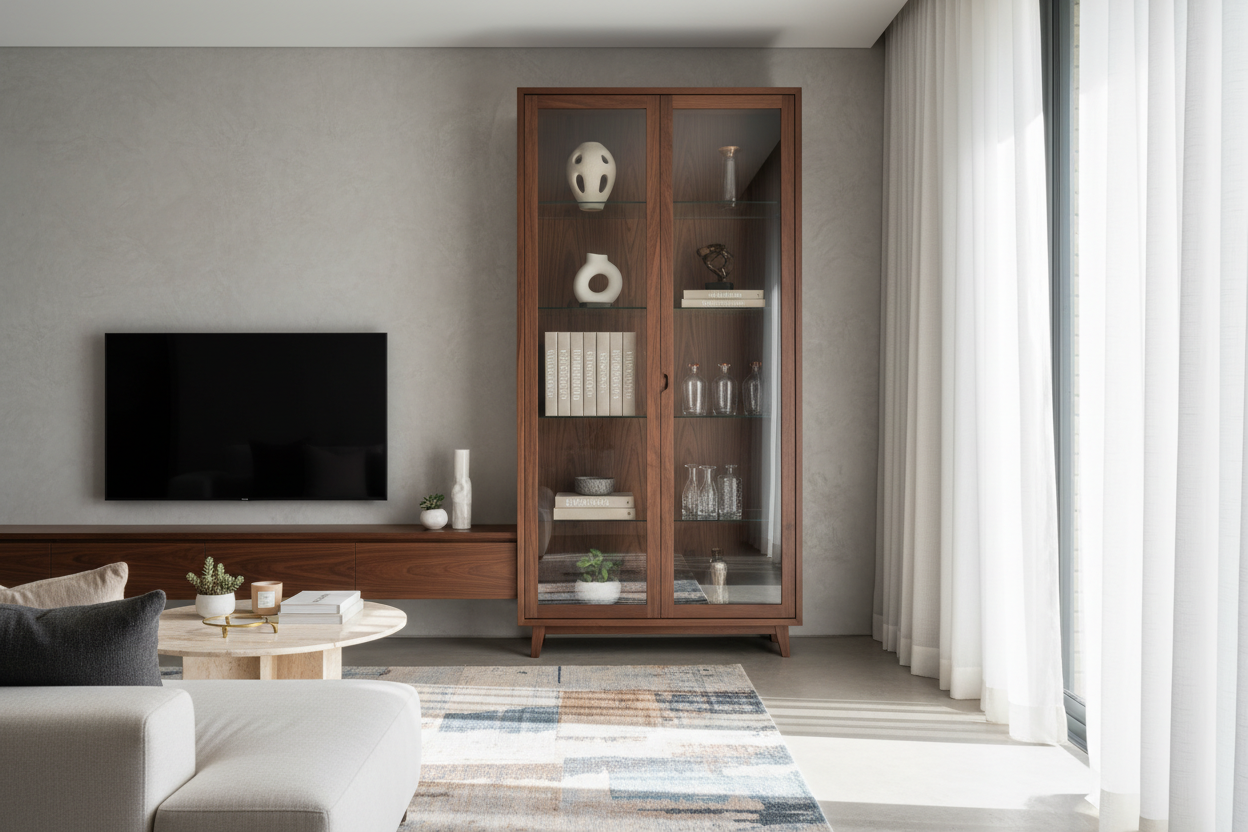
It usually starts with a common design dilemma: you have a growing collection of beautiful objects—ceramics, vintage books, travel finds—but scattered across your living room, they just look like clutter. You want a dedicated place to show them off, so you bring home a walnut display cabinet. Suddenly, instead of a curated focal point, you are staring at a massive, dark block of wood that seems to swallow all the light in the room.
Styling and placing large, dark wood furniture requires a specific approach to proportion and visual weight. In this guide, I will walk you through how to integrate this classic piece into a modern North American home without making your space feel heavy or dated.
Quick Decision Guide
- Respect the visual weight: Walnut is a dark, dominant wood. Balance it by placing it against a lighter wall or styling the interior with bright, reflective objects.
- Mind the humidity: Solid walnut moves with seasonal humidity changes. High-quality walnut veneers on engineered cores are often better for large cabinet panels to prevent warping.
- Embrace negative space: Keep shelves roughly 30% empty. Overstuffing a glass-front cabinet turns curation back into clutter.
- Plan your lighting: Dark wood absorbs light. Look for cabinets with integrated lighting, or position the piece to catch ambient room light without sitting in direct, fading sunlight.
Material & Build Quality: Understanding Walnut
Solid Wood vs. High-End Veneers
There is a persistent myth that solid wood is always superior. When it comes to a large piece with expansive side panels, that is not necessarily true in North American climates. The drastic shift from humid summers to dry, forced-air heating in winter causes solid wood to expand and contract. This movement can crack glass panes or warp cabinet doors over time.
For a reliable piece, I often recommend designs that use solid walnut for the frame and legs, but utilize high-grade walnut veneers over an engineered core for the large flat panels. This construction provides the rich, cathedral grain of real wood while ensuring structural stability over decades.
Space Planning & Visual Weight
Managing a Heavy Footprint
Walnut has a strong presence. If you place a tall, solid-sided cabinet in a tight corner, it will instantly make the room feel smaller. To mitigate this, consider the silhouette. A walnut glass cabinet with glass on three sides (the front and both sides) allows light to pass through the piece, significantly reducing its visual weight.
When mapping out your floor plan, leave at least 36 inches of clearance in front of the cabinet. You need room to comfortably open the doors and step back to arrange your items. If your living room is narrow, look for a shallow profile—anything under 16 inches deep will hold most books and decor without eating up your walkway.
Styling Your Shelves Without the Clutter
The 70/30 Rule for Glass Doors
A walnut display cabinet with glass doors is unforgiving when it comes to mess. The dark backdrop highlights every item you place inside. To achieve a high-end look, practice the 70/30 rule: fill 70 percent of the shelf space and leave 30 percent as negative space. This gives the eye a place to rest.
Because the wood is dark, avoid displaying dark objects. Instead, pull in contrasting textures. Think matte white ceramics, brass accents, and books with light-colored spines. Group items in odd numbers, and vary their heights to create a subtle, rolling visual rhythm across the shelves.
Lessons from My Own Projects
Early in my career, I sourced a stunning, vintage mid-century cabinet for a client in a suburban Chicago home. It was a gorgeous piece, but I made a rookie mistake: I placed it on a dark oak floor against a deep navy wall. The cabinet practically disappeared into the shadows, and the interior looked like a black hole.
I learned the hard way that dark wood needs contrast to shine. We ended up having to paint the interior back panel of the cabinet a soft cream color and retrofitting it with LED channel strips hidden behind the front frame. It completely saved the design, but it was a costly fix that could have been avoided with better planning.
Another honest caveat: dusting. If you choose a piece with glass shelves rather than wood ones, be prepared for constant maintenance. Glass shelves inside a dark wood frame show every single speck of dust and every fingerprint. If you have kids or pets, stick to wood shelves.
Frequently Asked Questions
How do I clean a display cabinet walnut finish?
Skip the heavy silicone-based polishes, which leave a cloudy buildup over time. Use a slightly damp microfiber cloth to wipe away dust, followed immediately by a dry cloth. For seasonal maintenance, apply a light coat of high-quality beeswax or a specialized wood conditioner.
Is a walnut piece too dark for a small living room?
Not necessarily, but proportion is key. In a small room, avoid wide, imposing units. Opt for a tall, narrow silhouette with legs that lift the base off the floor. Seeing the floor underneath the furniture tricks the eye into perceiving more space.
What should I look for when buying this style of furniture?
When searching for a display cabinet walnut is often the wood of choice for a rich, timeless look, but the hardware matters just as much. Glass doors are heavy; they require sturdy, adjustable soft-close hinges so they do not slam and shatter. Additionally, ensure the shelves are adjustable so you can accommodate taller vases or oversized art books as your collection changes.


Dejar un comentario
Este sitio está protegido por hCaptcha y se aplican la Política de privacidad de hCaptcha y los Términos del servicio.