










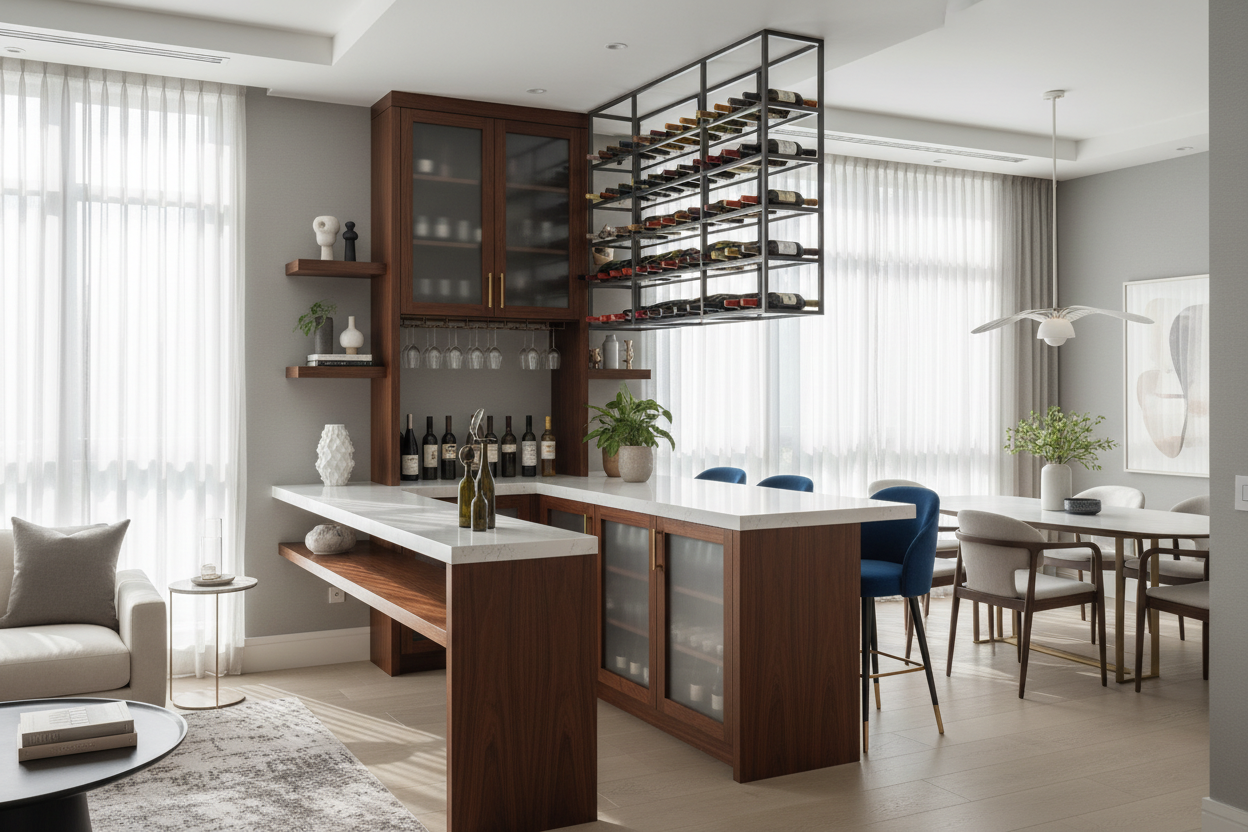
I spent three years staring at a bottle of Angostura bitters sitting next to my toaster. In an open-concept apartment, 'storage' usually means just shoving things into the corners until the whole place looks like a disorganized garage sale. If you are like me, you probably bought a gold-plated bar cart thinking it would solve the problem, only to realize it is a dust magnet that rattles every time you walk past it.
The struggle with bars and wine racks in an open floor plan is that they can quickly turn a sophisticated living area into a frat house basement if you do not pick the right spot. You need a dedicated zone that feels intentional, not like you just ran out of room in the pantry. Here is how I finally stopped the bottle creep.
- Avoid the 'Floating Cart': Carts look messy; anchored cabinets look like architecture.
- Use the 'Dining Radius': Keep storage 3-5 feet from the table for easy refills.
- Contrast the Finishes: If your kitchen is white, go for a dark wood or black bar cabinet.
- Verticality is Key: If you lack floor space, a 60-inch tall unit beats a 40-inch wide one every time.
The 'Floating Bottle' Problem (And Why Bar Carts Just Don't Cut It)
We have all been there. You have three half-empty bottles of gin, a dusty vermouth, and twelve mismatched wine glasses taking up precious real estate on your kitchen island. The open-concept layout promised 'flow,' but all it really gave you was a lack of walls to hide your clutter. I tried the bar cart route, but unless you only own three aesthetically pleasing bottles, it looks like a mess within a week.
Most wine and bar cabinets are designed to solve this by providing actual weight and presence. A flimsy cart wobbles when you cork a bottle; a real wine rack bar stays put. You need something with a bit of 'heft'—think solid wood frames or heavy-duty MDF with a reinforced base—to anchor the room. When your liquor and wine cabinet has a back panel and doors, the visual noise of mismatched labels disappears instantly.
The Dining Zone Trick: Sneaking Storage Into the Background
The most natural place for a wine and bar console is just on the periphery of your dining area. You want it close enough to reach for a second bottle of Malbec without leaving the conversation, but far enough that it does not feel like an extension of the table. I found that placing a unit about four feet away from the head of the table creates a perfect 'service station' vibe.
If you have a collection of vintage crystal or high-end Riedel glasses, this is the place to merge display and entertainment. By choosing a piece that mimics the height of a sideboard, you keep the sightlines low and clean. It keeps the focus on the meal while subtly hinting that the after-party is already organized. I prefer cabinets with a mix of open wine cubbies and closed drawers for those ugly plastic pourers and cocktail napkins.
Carving Out a Moody Living Room Lounge
If your dining area is already cramped, move the wine bar cabinet into the living room. The trick here is to make it look like furniture, not a commercial kitchen rack. I am a huge fan of using a black cabinet with glass doors for this. The dark finish recedes into the shadows, making the space feel more like a moody speakeasy and less like a storage unit.
When you put a wine bar for the living room near a velvet armchair or a leather sofa, you’ve created a destination. It’s no longer just a place to store booze; it’s a 'lounge.' Look for units that are at least 15-18 inches deep. Anything shallower feels like a bookshelf and won't fit a standard oversized Cabernet bottle. I also suggest avoiding anything with too much chrome if you want that cozy, high-end feel.
The 'Kitchen Fringe' Strategy for Day-to-Night Pours
There is usually a weird 'no man’s land' between the kitchen cabinets and the start of the living room. This is the prime spot for a hybrid station. I’ve seen people use a wine bar cabinet with light to bridge the gap between morning espresso and evening cocktails. By day, it holds your Chemex; by 6 PM, the LED lighting makes your scotch collection look like a work of art.
This strategy works because it keeps the 'wet' activities near the kitchen tile but out of the primary cooking triangle. You don't want someone trying to mix a Manhattan while you are draining pasta. A dedicated bar and wine storage cabinet in this 'fringe' zone keeps the foot traffic directed away from the stove. It’s a functional boundary that defines where the work ends and the relaxing begins.
What If You Have Literally Zero Wall Space?
I once lived in a loft where every single wall was either a window or a radiator. If you are maxed out on horizontal space, stop looking at consoles and start looking up. A tall, narrow pantry cabinet with glass door wine storage can tuck into a corner that’s only 24 inches wide. It uses the vertical height of the room—usually 60 to 72 inches—to store twice as much as a standard bar.
Vertical wine and liquor storage is a lifesaver for small apartments. You can keep the 'good' bottles at eye level and the back-stock or mixers down low. Plus, a taller piece of furniture acts as a visual anchor in an open room, helping to break up the monotony of low-slung sofas and coffee tables. Just make sure you anchor it to the wall; a top-heavy wine cabinet is a disaster waiting to happen.
My Personal Bar Disaster
I once bought a 'minimalist' wine rack that was essentially just a series of wire loops. It looked cool in the catalog, but the first time I tried to pull a bottle from the bottom, the whole thing did a slow-motion tilt. I lost a 2012 Bordeaux and spent three hours scrubbing red wine out of my rug. Since then, I only buy wine and bar furniture with a solid, wide base and a weight capacity of at least 100 lbs. Wine is heavy; don't trust a spindly frame with your collection.
FAQ
Do wine racks need to be in the dark?
Ideally, yes. UV light is the enemy of wine. If your bar is in a sun-drenched living room, choose a wine bar cabinet with solid doors or tinted glass to protect your bottles from 'light strike.'
How much space do I need for a home bar?
At minimum, you need a 24-inch wide footprint for a small cabinet. If you want a full 'station' with room to pour and mix, look for a console that is 47 to 55 inches wide.
Is MDF okay for a liquor cabinet?
High-density MDF is fine for the frame, but I always look for a solid wood or water-resistant top. Spilled bourbon can bubble cheap laminate in minutes, so a durable surface is non-negotiable.


Dejar un comentario
Este sitio está protegido por hCaptcha y se aplican la Política de privacidad de hCaptcha y los Términos del servicio.