










I used to spend my weekends hunting for mid-century modern teak on Facebook Marketplace, convinced that if it wasn't solid timber, it wasn't real furniture. Then I spent $1,200 on a solid oak dresser that warped the second my apartment's humidity hit 60% in August. The drawers stuck, the top bowed, and I was left with a very expensive, very heavy paperweight. It was a painful lesson in material science that changed how I shop.
Staring at that stuck drawer, I realized my obsession with 'real' wood was actually making my life harder. I needed storage that looked decent but could actually handle the chaos of a lived-in home without a $2,000 price tag. That is when I finally caved and bought a pressed wood storage cabinet for my hallway. I expected it to feel like a compromise; instead, it felt like a relief. Here is why the high-end snobbery needs to end.
- It is significantly more stable in humid environments than solid wood.
- Modern veneers look incredibly realistic, not like the contact paper of the 90s.
- It is much lighter, making it easier to move when you inevitably rearrange your layout.
- You can get three times the storage volume for a fraction of the cost of timber.
Confessions of a Former Solid-Wood Purist
My bias started in college. I had a bookshelf made of what I can only describe as compressed crackers and hope. By the end of the first semester, the shelves were 'smiling' at me, sagging under the weight of three textbooks and a lamp. I told myself I was done with manufactured wood forever. I associated it with wobbly dorm rooms and furniture that disintegrated if you spilled a glass of water near it.
For a decade, I overpaid for heavy, clunky pieces that were a nightmare to move. I thought I was buying 'heirlooms,' but I was actually just buying back pain. I ignored the fact that even high-end furniture brands often use engineered wood for the parts of a cabinet that need to stay perfectly straight over time. I once spent four hours trying to level a solid pine wardrobe that had twisted just enough to make the doors click. It was exhausting. I finally realized that 'solid' doesn't always mean 'better'—sometimes it just means 'unpredictable.'
What Actually Is Pressed Wood These Days?
The industry has moved on from the flaky particleboard of the early 2000s. Today, we have Medium Density Fiberboard (MDF) and High-Density Fiberboard (HDF), which are made by breaking down wood residuals into fibers and combining them with wax and resin under high heat. This creates a material that is incredibly dense and, most importantly, uniform. There are no knots to fall out and no grain patterns that might cause the board to 'cup' or twist.
When you look at what designers actually think, you realize that engineered wood is a secret weapon in modern interiors. High-quality pieces use thick, high-pressure laminates or real wood veneers that are bonded so tightly you can't see the seam. It’s the stability that pros love. If you want a perfectly flat, painted finish that won't show wood movement cracks in two years, you go with a composite core. It’s about choosing the right tool for the job.
Where Composite Actually Beats Solid Timber
If you have ever tried to put a solid wood wardrobe in a bathroom or a damp laundry room, you know the heartbreak of swelling wood. Solid timber is a living material; it 'breathes,' which is a poetic way of saying it grows and shrinks until your doors don't close. Pressed wood, especially when sealed with a quality melamine or veneer, is far more indifferent to your steam cycle.
For high-traffic utility spaces, I always recommend a manufactured wood armoire. It is consistent, easy to wipe down, and it won't crack if the radiator kicks on in the winter. I put one in my mudroom for heavy coats and boots, and three years later, the doors still hang perfectly straight. If that had been solid birch, the hinges would have needed three adjustments by now. Plus, if you're a renter, your back will thank you when it’s time to move a 70-pound unit instead of a 250-pound oak beast that requires a professional moving crew.
The High-Low Mixing Trick for Furniture
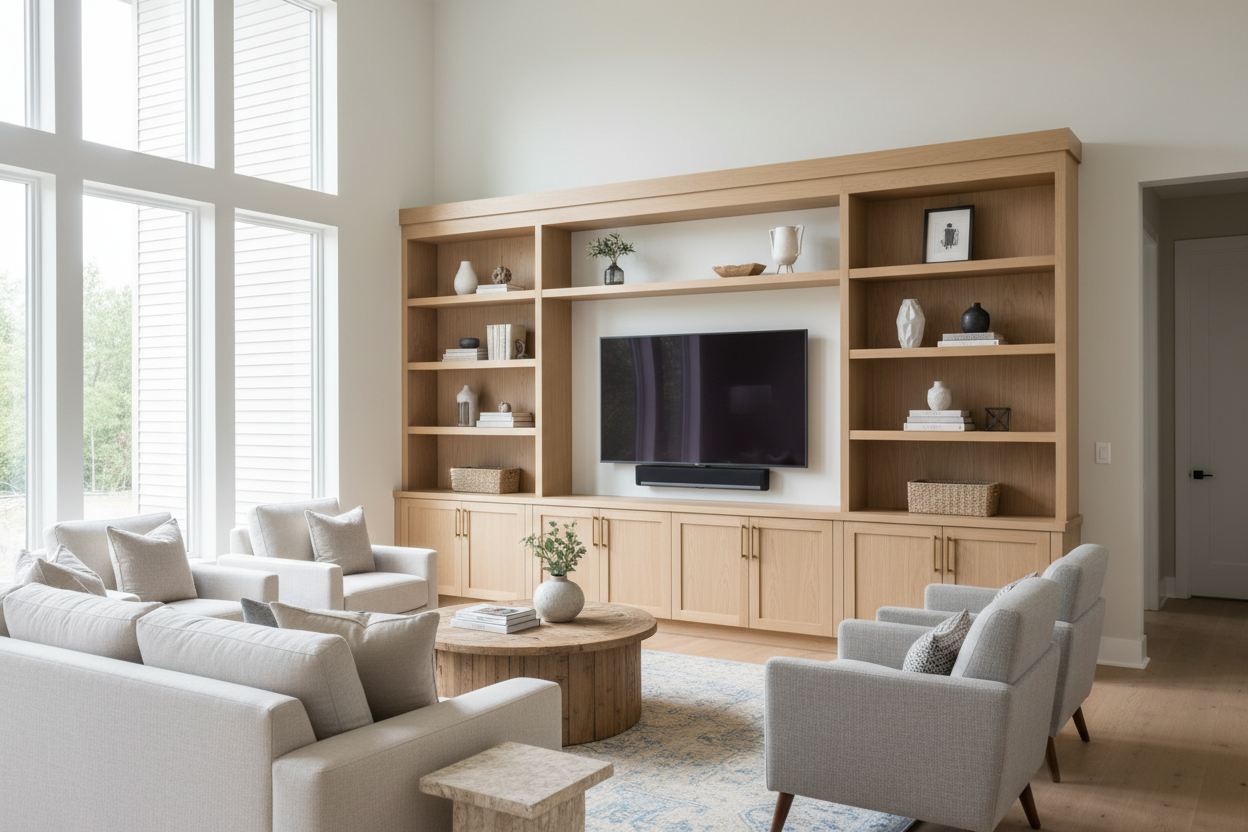
You don't need a house full of expensive timber to make a room feel premium. The secret is the high-low mix. I put my money into 'anchor' pieces that people see and touch immediately. For example, a solid wood modern sideboard in the dining room sets a high-end tone for the whole floor. You can feel the weight and the natural grain when you serve dinner.
Once that anchor is in place, you can use pressed wood cabinets for the 'workhorse' storage tucked in corners, hallways, or home offices. My trick? I often swap out the stock plastic or zinc knobs on my composite pieces for heavy, solid brass hardware. It’s a $20 upgrade that tricks the eye and the hand. When the colors match and the hardware feels substantial, no one is going to knock on your cabinet to check the density of the inner core. It’s about balance, not being a purist for the sake of a label.
Is a pressed wood storage cabinet actually durable?
It depends on the density. Look for 'high-density' or 'MDF' rather than 'low-density particleboard.' If you treat it right—don't drag it across the floor and don't let water sit on raw edges—it will easily last a decade. I’ve had some pieces for eight years that still look brand new.
Does it smell like chemicals?
Lower-end pieces can off-gas for a day or two. To avoid this, look for CARB Phase 2 compliant furniture, which meets strict emission standards. I usually let mine sit in a room with a window open for 24 hours after assembly just to be safe, but with quality brands, it's rarely an issue anymore.
Can I paint a pressed wood cabinet if I hate the color?
Yes, but don't just slap wall paint on it. You need a shellac-based primer like Zinsser BIN to make the paint stick to the slick surface. Sand it lightly with 220-grit sandpaper, prime it, and then use a high-quality cabinet paint. It’s the easiest way to make a budget piece look custom.


Dejar un comentario
Este sitio está protegido por hCaptcha y se aplican la Política de privacidad de hCaptcha y los Términos del servicio.