










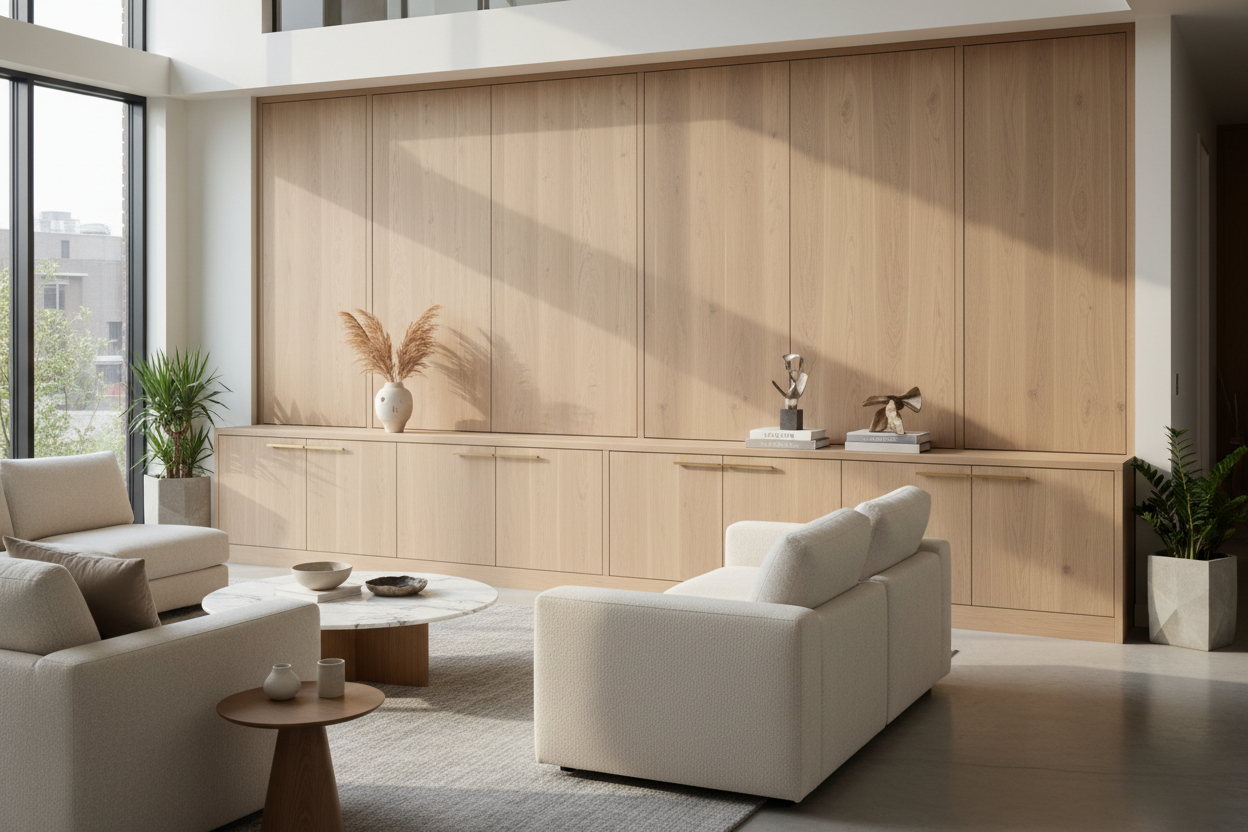
I spent three years staring at a fifteen-foot living room wall that felt like a puzzle I could not solve. I tried the 'gradual' approach, which is code for buying four different skinny bookshelves from three different big-box stores and lining them up like a row of mismatched teeth. It looked cluttered, cheap, and honestly, a little desperate. It was not until I ditched the verticality for wide storage cabinets that the room finally felt like a grown-up lived there.
The problem with narrow furniture is the visual noise. Every gap between units is a line that breaks your eye's path. When you swap those out for a single, long horizontal piece, the room feels wider and calmer. It is the difference between a cluttered shelf and a purposeful design choice.
- Horizontal lines make a room feel wider and more grounded than vertical ones.
- Closed storage is the only way to truly hide the 'tech' clutter of modern life.
- A mix of drawers and doors handles both the small junk and the bulky items.
- Aim for a piece that covers at least two-thirds of the wall or the sofa it sits behind.
The 'Skinny Furniture' Trap I Kept Falling Into
We have all done it. You move into a place with a massive blank wall and panic. Instead of investing in one substantial piece, you buy a narrow bookcase because it is $50 and fits in your car. Then you buy another. Then a third. Pretty soon, your living room looks like a waiting room for a very disorganized library.
I call this the 'toothpick effect.' These tall, thin units do not have enough visual weight to anchor a room. They just stand there looking flimsy. Even if you spend hours styling the shelves with color-coordinated books and succulents, the overall vibe is still chaotic. In my last apartment, I had three of these 'skinny' units. They wobbled every time the cat ran past, and the gaps between them were magnets for dust bunnies and lost mail.
The breakthrough came when I realized that a wide storage cabinet does the work of three small ones but looks like a deliberate architectural choice. It creates a clean horizon line that draws the eye across the room rather than up and down in jagged spurts. It is about commitment—committing to a footprint that actually matches the scale of your walls. I eventually gave my old shelves to a college student down the hall and never looked back.
The Day I Finally Looked Into Wide Storage Cabinets
The 'aha' moment happened when I saw a photo of a mid-century sideboard that was nearly seven feet long. It looked expensive, but more importantly, it looked stable. I started hunting for wide storage cabinets that could mimic that built-in look without the custom-cabinetry price tag. I needed something with enough 'heft' to stop the wall from feeling like an empty void.
Scale is everything here. If you have an eight-foot wall, a three-foot cabinet looks like a toy. You need something like a 60 inch wide storage cabinet with doors to actually make an impact. At five feet wide, it fills the visual field without eating up the entire walking path. It is the sweet spot for most standard apartments where you need to anchor the wall without making it a hallway obstacle course.
When I finally hauled my first wide unit home, I was worried it would make the room feel cramped. It did the exact opposite. By consolidating all my junk into one low, wide piece, the upper half of the wall opened up. The room felt twice as big because the floor-to-ceiling clutter was gone, replaced by a solid, grounding piece of furniture that actually belonged there.
Doors vs. Drawers (And Why You Actually Need Both)
Once you commit to a wide storage cabinet, you have to decide what is happening behind the facade. I used to think all-doors was the way to go because it looks the cleanest. I was wrong. If you only have doors, you will end up with a 'black hole' effect where small things like batteries, spare keys, and take-out menus get lost in the back of deep shelves.
This is why a cabinet with doors and drawers is the superior choice for a multi-use room. The drawers act as your organized junk drawer—yes, you are allowed to have one—while the doors handle the bulky stuff. I use my drawers for chargers and coasters, and the cabinet sections for my massive board game collection and the 'good' blankets that do not fit in the linen closet.
Do not settle for flimsy drawer slides, either. If you are buying a wide cabinet with drawers, look for ball-bearing glides. There is nothing more frustrating than a wide drawer that sticks or sags because the manufacturer used cheap plastic tracks. A heavy-duty drawer can handle the weight of your entire candle collection without a groan. Trust me, I have learned the hard way that 1.5 lb density particle board is a recipe for a sagging bottom shelf within six months.
Hiding the 'Ugly' Clutter Behind Closed Doors
We all have the 'ugly' stuff. The router with its five blinking lights, the tangled mess of HDMI cables, the stack of half-finished puzzles. Open shelving is a lie told by people who do not actually live in their homes. A wide storage cabinet with doors is the ultimate shield against visual stress.
I personally went for a wide cabinet with doors that features adjustable shelves. This is key because not every board game box is the same height. Being able to drop a shelf by two inches to fit a jumbo-sized box saved my sanity. Once those doors are shut, the room looks pristine, even if it is a total disaster zone inside.
Styling a Massive Top Surface Without Overdoing It
The biggest trap with a wide cabinet is the top surface. Because it is so much space, it is tempting to treat it like a secondary kitchen counter—a place to dump mail, groceries, and your bag. Do not do it. You have to treat the top of a wide storage cabinet with drawers as a curated zone.
I follow the 'Rule of Three.' One large item (like a lamp or a tall vase), one medium item (a stack of books), and one small item (a tray or a candle). If you have a really long unit, you can repeat this on either end. Avoid the 'parade of tiny things'—twenty small knick-knacks will make a wide cabinet look just as cluttered as those old bookshelves did.
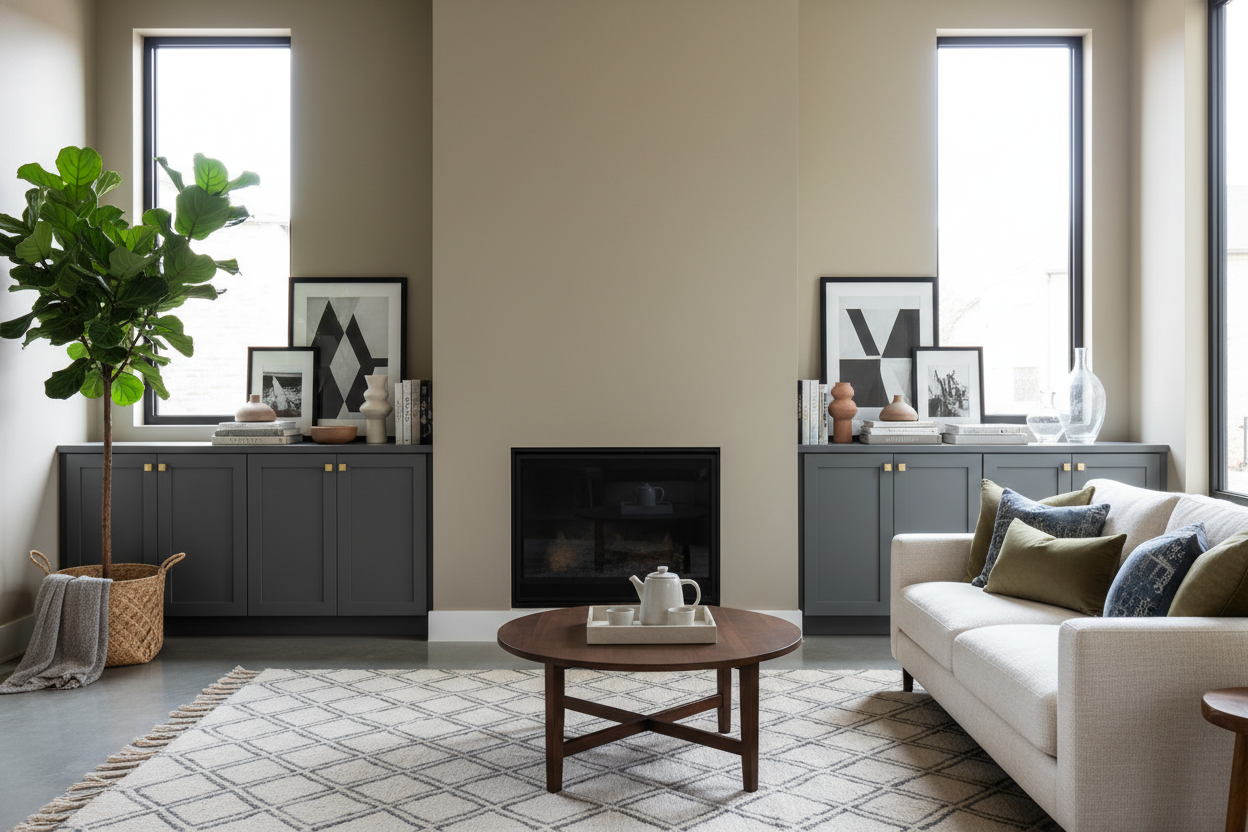
If you are worried about the top getting scratched, or if you still want to show off your favorite pieces without the dust, a black cabinet with glass doors is a fantastic alternative. It gives you that wide, horizontal footprint but keeps your 'nice' things protected behind glass. It feels a bit more like a museum display and less like a storage locker, plus it adds a bit of moodiness to the room.
FAQ
How much space should I leave on the sides of a wide cabinet?
Try to leave at least 15 to 18 inches of breathing room on either side if it is a standalone piece. If you jam a wide storage cabinet wall-to-wall, it can start to feel like a built-in, which is fine, but it can also make a small room feel boxed in.
Are wide cabinets harder to assemble than narrow ones?
Honestly, yes. Because of the span, you often need a second person to help flip the unit or attach the top piece without snapping the cam locks. I once tried to assemble a 72-inch unit by myself and nearly took out a window. Get a friend and a power drill set to low torque.
Can I use a wide cabinet as a TV stand?
Absolutely, as long as the height is right. Most wide storage cabinets with doors are about 30-34 inches tall. If your sofa is low, this might put the TV a bit high for your neck. Check your sightlines before you commit to the drill.

Dejar un comentario
Este sitio está protegido por hCaptcha y se aplican la Política de privacidad de hCaptcha y los Términos del servicio.