










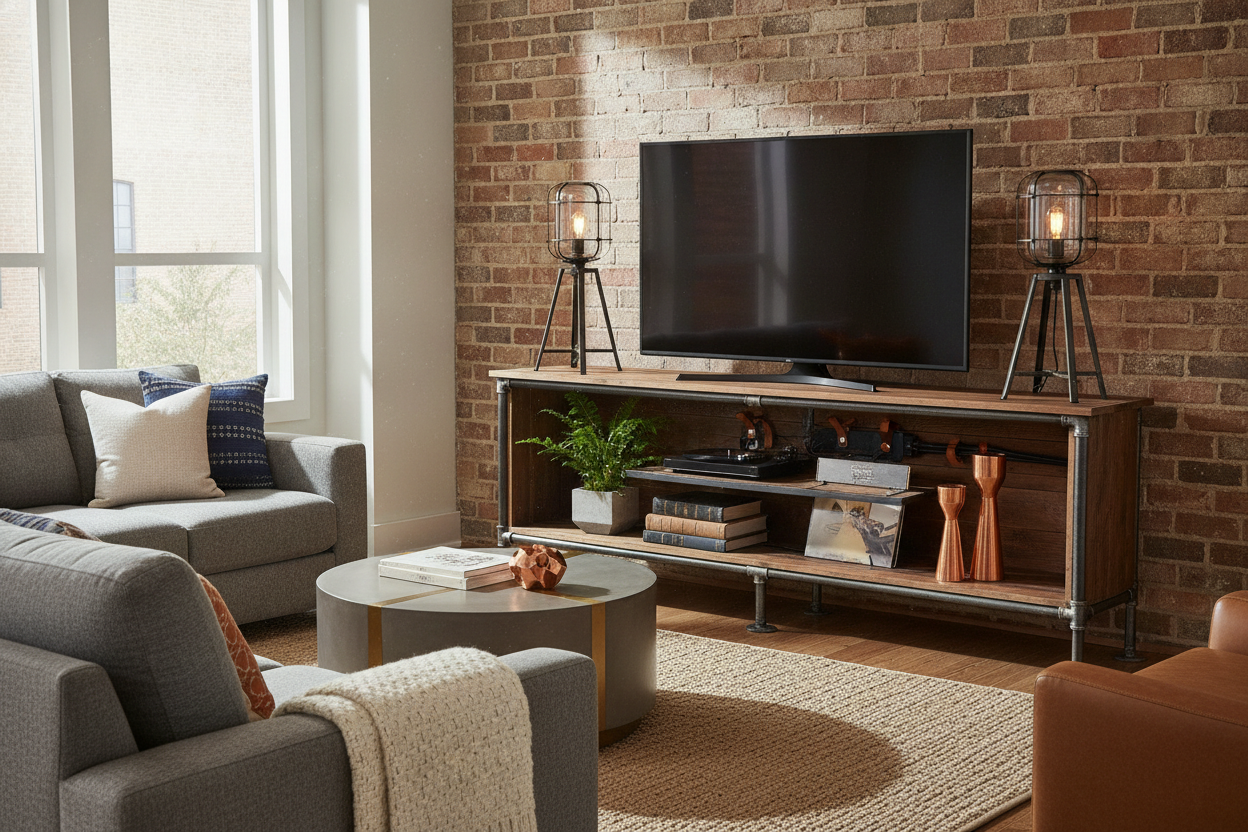
I remember the first time I tried to pull off the 'loft look' in a 600-square-foot rental. I bought what I thought was a rugged, industrial television stand online for about $120. When it arrived, it was basically four pieces of particle board wrapped in contact paper that looked like a blurry photo of a tree, held together by spray-painted PVC pipes. It didn’t look like a Tribeca artist’s studio; it looked like I was living in a dorm room that smelled like stale ramen. I lived with that wobbly eyesore for three years because I was too stubborn to admit I’d been scammed by a clever Photoshop job.
Quick Takeaways
- Look for solid wood (mango, pine, or oak) rather than MDF with a laminate sticker.
- Prioritize real steel frames with matte powder coating over shiny black plastic or thin tin.
- Avoid 'thematic' extras like oversized gears, fake water valves, or faux rivets.
- Ensure the unit has significant weight—at least 60 pounds—to ground the room.
The 'College Dorm' Curse of Faux Industrial Furniture
The industrial trend got hit hard by the mass-market machine. Suddenly, every big-box retailer was churning out 'industrial rustic tv stand' options that were anything but rustic. They use that paper-thin veneer that peels at the corners if you so much as look at it with a glass of water. It’s frustrating to browse through standard tv stands only to find 400 variations of the same flimsy pipe-and-plank design that wobbles when your cat jumps on it.
Real industrial design is about utility and permanence. It’s about materials that were meant to last 50 years in a factory, not five months in an apartment. If the 'metal' feels like it has a hollow, tinny ring to it, keep walking. You want something that feels grounded. The problem with the cheap stuff isn't just that it looks bad; it’s that it lacks the soul of actual industrialism—the sense that this piece was built to hold something heavy and important.
The 3 Rules for Spotting a Grown-Up Console
To get that industrial chic tv stand look without the cheap aftertaste, you have to be a material snob. Rule one: check the wood. If the description says 'wood grain finish' or 'paper laminate,' it’s a hard pass. You want solid wood—reclaimed is great because the dents and scratches are already there, so you don't have to panic when you drop your keys on it. Look for boards that are at least an inch thick. Anything thinner looks like a shelf for a child's bedroom.
Rule two: the metal matters. A high-end modern industrial tv console uses thick-gauge steel, usually 14-gauge or lower. Look for a matte powder-coated finish. It shouldn't be shiny; it should have that soft, charcoal-grey texture that absorbs light rather than reflecting it. Finally, rule three: check the hardware. Real bolts and recessed screws feel intentional; cam-locks and plastic caps feel like a budget compromise from a flat-pack warehouse.
Weight and Weld Matter More Than You Think
I once bought a industrial metal tv stands that looked great in photos but weighed about as much as a pizza box. Every time I plugged in a HDMI cable, the whole thing shifted six inches. A quality stand should have some heft—if you can't lift it by yourself, you're on the right track. You also want to look at the joints. In cheaper units, the welds are hidden or messy, looking like someone slapped some grey gum in the corners. In a high-end industrial media stand, the welds are either ground down perfectly smooth or left exposed as a clean, architectural detail that shows off the craftsmanship.
Ditch the Steampunk Gimmicks
We need to talk about the 'theme park' version of industrial design. If your stand has giant non-functional gears, fake water valves, or rivets that are clearly just glued-on plastic, you’ve gone too far. It’s the difference between a cool loft and a themed restaurant in a suburban mall. I always tell people to look for fireplace units without the steampunk vibe because they focus on clean lines and real textures instead of gimmicks. Good design doesn't need to scream its identity; it should whisper it through the quality of its materials.
Scale and Proportion: Don't Let It Swallow the Room
Industrial furniture is visually heavy. A 60-inch industrial tv stands made of dark oak and black steel takes up more 'visual space' than a white lacquer stand of the same size. If you’re in a small room, go for a design with open shelving to keep the sightlines clear. This prevents the furniture from feeling like a giant black hole in the corner of your living room. However, if you have a massive 20-foot wall to fill, don't be afraid of massive entertainment center setups that use verticality to their advantage.
Just make sure the scale of your TV matches the stand. A common mistake is putting a 55-inch screen on an 80-inch entertainment center industrial unit without any styling to bridge the gap. You want the stand to be about 10 to 20 percent wider than the TV itself to maintain a balanced silhouette. If the stand is too small, the whole setup looks top-heavy and precarious.
How I Softened the Hard Edges in My Living Room
My own living room features a heavy industrial entertainment stand I found at a salvage shop. For the first week, the room felt like a cold garage. The trick is contrast. I added a trailing Pothos plant on the top shelf—the green leaves against the black steel are a classic combo. I also used large woven seagrass baskets on the bottom shelf to hide my unsightly mesh of cables and gaming controllers. The natural fiber of the baskets breaks up the 'hard' look of the wood and metal.
It’s all about using organic textures to keep the room from feeling cold. Don't be afraid to stack some oversized coffee table books or add a ceramic lamp with a linen shade. These 'soft' elements act as a foil to the 'hard' industrial materials, making the space feel lived-in rather than just staged. My biggest mistake early on was thinking everything had to be metal. Once I added a wool rug and some velvet pillows nearby, the whole room finally clicked.
FAQ
Are industrial TV stands hard to assemble?
The cheap ones are a nightmare with 500 tiny screws and confusing diagrams. High-end industrial stands usually come mostly assembled or use heavy-duty bolts that take 15 minutes to tighten. If the box weighs 100 pounds, definitely get a friend to help you unbox it.
Will an industrial stand scratch my floors?
Yes, if you aren't careful. Steel feet are brutal on hardwoods and can even tear through thin carpet. Always check if the stand comes with adjustable leveling feet or felt pads. If it doesn't, buy a pack of heavy-duty felt sliders before you even bring the box inside.
Does industrial furniture go out of style?
The 'pipe-and-flange' DIY look is definitely dated, but the 'modern industrial' look—clean lines, raw materials, and functional design—is timeless. It’s basically just the 21st-century version of Shaker furniture. Stick to simple shapes and real materials, and it will look good for decades.

Dejar un comentario
Este sitio está protegido por hCaptcha y se aplican la Política de privacidad de hCaptcha y los Términos del servicio.