










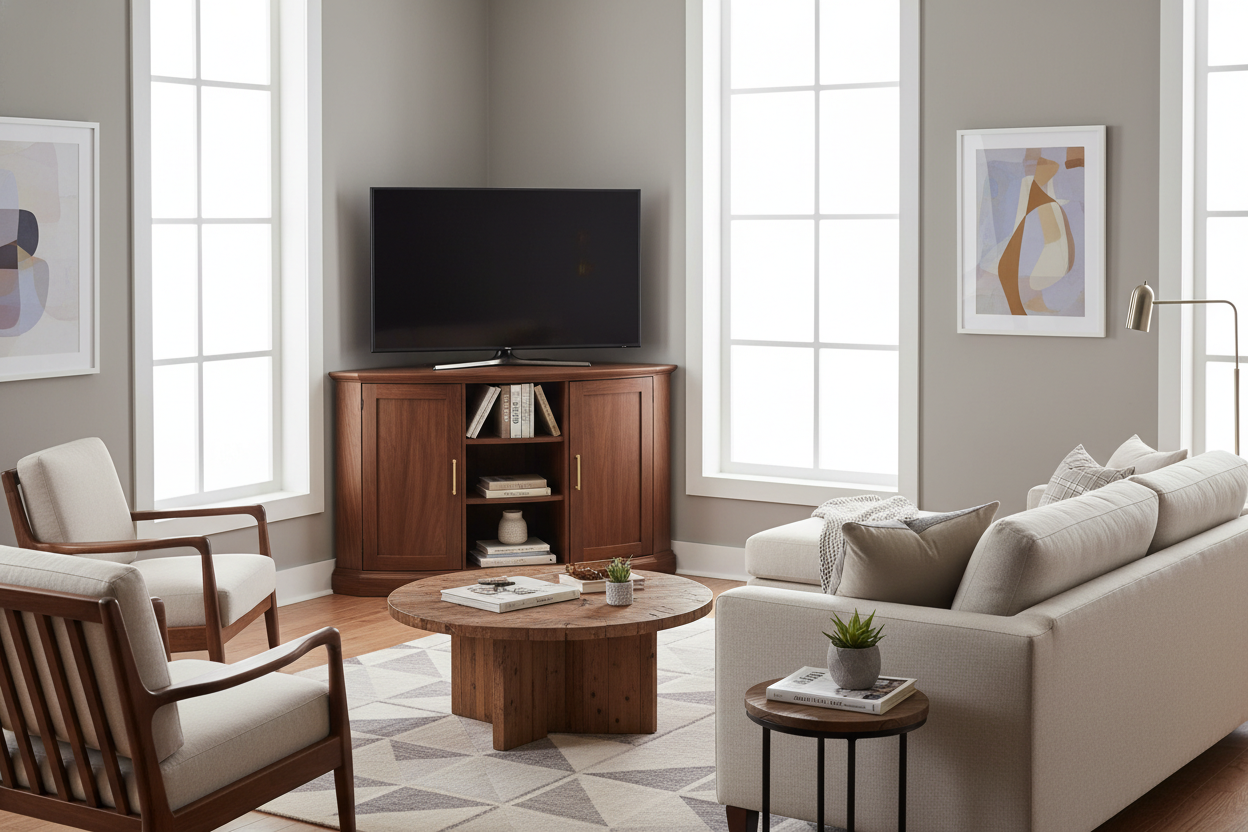
I spent three hours last night dragging my sofa across the rug because my living room has exactly zero long, blank walls. Between the floor-to-ceiling windows and the radiator, my 55-inch TV was basically homeless until I realized a solid wood corner tv stand wasn't just a 'grandma' design move—it was the only way to save my floor plan.
- Reclaims 4-6 square feet of otherwise 'dead' floor space.
- Solid timber prevents the 'sag' common in cheap particleboard units.
- Creates a natural focal point in open-concept or window-heavy rooms.
- Visual weight helps ground the room so the TV doesn't look like it's floating.
The Problem With 'Dead Corners' (And Why Flat-Wall Consoles Fail)
Modern floor plans are a trap. We love the light from big windows and the flow of open-concept kitchens, but they leave us with nowhere to put a media center. If you try to force a standard rectangular console against a short wall, it usually sticks out past the door frame or blocks a walkway. It looks like you're living in a half-unpacked apartment.
A real wood corner tv stand solves this by tucking the bulk of the furniture into the one area you aren't using: the 90-degree intersection of two walls. It turns a literal architectural dead end into the most functional part of the room. Instead of the TV being an obstacle you have to walk around, it becomes the anchor that defines the seating area.
Why I Refused to Buy Another Flimsy MDF Triangle
I have built enough flat-pack furniture to know that 'engineered wood' is just a polite term for sawdust and glue. When you put a 50-pound screen on a cheap, hollow corner unit, the center starts to dip within six months. It’s a bad look. I finally started hunting for sturdy TV stands made of kiln-dried hardwood because the physics of a corner unit require real strength.
A solid wood corner tv cabinet has a presence that laminate just can't mimic. It feels permanent. When you knock on the side, it doesn't sound hollow. That density is what stops the room from feeling cluttered; a heavy piece of furniture 'settles' into the corner, whereas a lightweight plastic-veneer stand looks like it might blow over if you open the front door too fast.
How to Make a Corner Setup Look Intentional (Not Like an Afterthought)
The biggest mistake people make with corner furniture is keeping the rest of the room squared off. If your sofa is flat against the opposite wall, you're going to be craning your neck at a 45-degree angle all night. That is the secret to fixing awkward rooms: you have to pull your furniture away from the walls. Angle your rug and your primary seating to face the corner directly.
This creates a 'conversation pit' vibe that feels cozy rather than cramped. I like to flank the stand with a tall floor lamp on one side and maybe a large basket for blankets on the other. It softens the transition from the cabinet to the wall. By treating the corner as the 'north star' of the layout, the whole room starts to make sense.
Will My Giant Flat Screen Actually Fit?
Measurement is where most people mess up. A '65-inch TV' is a diagonal measurement; the actual width is usually around 57 inches. If your TV is wider than the front face of the stand, the corners of the screen will hang off into empty space. It looks precarious and, frankly, cheap. You want at least a couple of inches of breathing room on either side of the screen.
If you have a massive screen and a tiny corner, a standard stand might not cut it. In those cases, some people opt for a corner armoire to get extra vertical storage, but for a clean, modern look, a low-profile solid wood stand is unbeatable. Just make sure to measure the depth of your 'dead corner' from the vertex to the nearest door frame to ensure the cabinet won't stick out into the path of travel.
Is a corner TV stand better for small rooms?
Absolutely. It utilizes the corner space that is usually wasted, opening up the center of the room for more foot traffic or a larger coffee table.
Can I put a 65-inch TV on a corner stand?
Yes, provided the stand is wide enough. Check the actual width of your TV (not the screen size) and compare it to the widest part of the stand's top surface.
How do I manage cables in a corner?
The beauty of a corner stand is the 'hidden' triangle of space behind it. Look for solid wood units with pre-drilled cable management holes so you can tuck all those HDMI cords into that void where nobody will see them.

Dejar un comentario
Este sitio está protegido por hCaptcha y se aplican la Política de privacidad de hCaptcha y los Términos del servicio.