










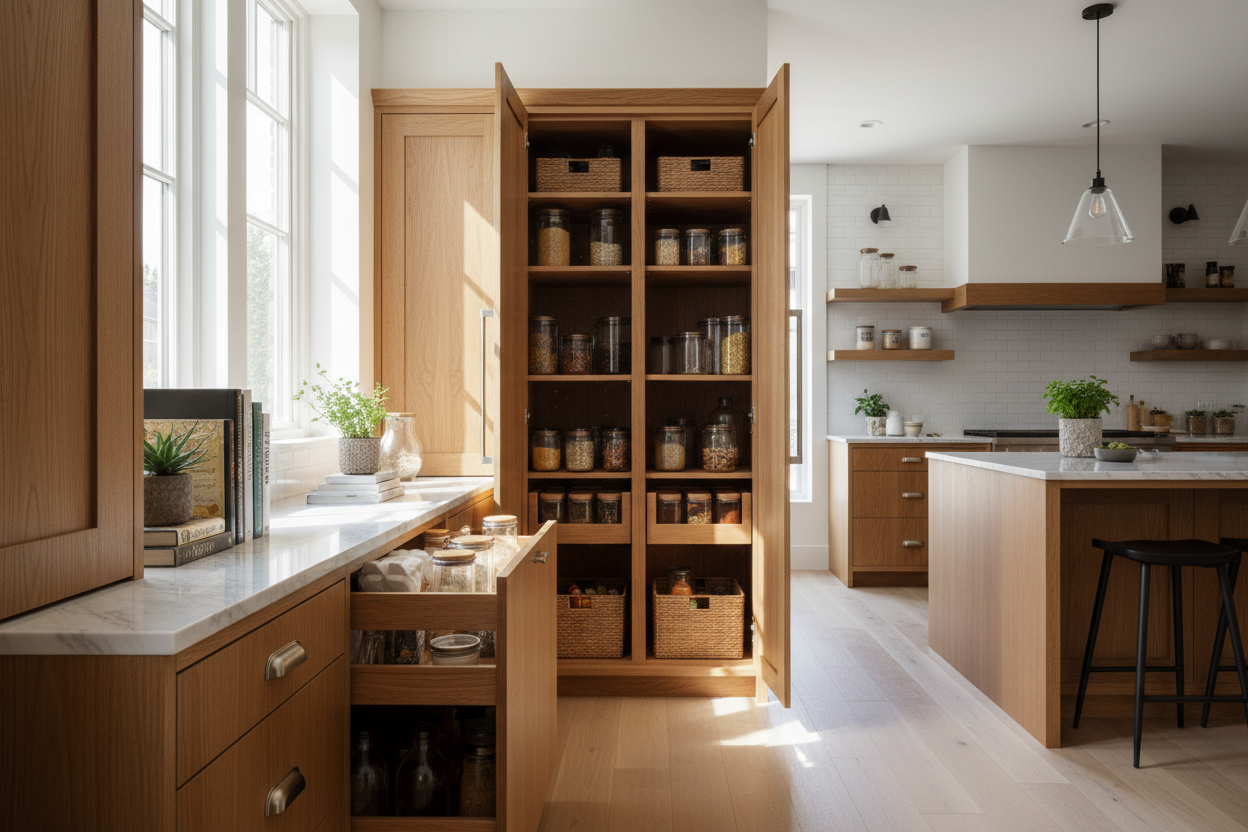
I spent twenty minutes yesterday digging for a single can of chickpeas, only to find three jars of molasses that expired during the Obama administration. It is the curse of deep pantry cabinets—they look like a storage dream in the showroom, but in reality, they are where expensive balsamic vinegar goes to die.
If you have a standard 24-inch deep setup, you know the struggle. You reach for the salt, knock over a tower of canned corn, and end up swearing at a shelf you can not even see the back of. It does not have to be this way, but you have to stop treating your pantry like a regular cupboard and start treating it like a logistics warehouse.
Quick Takeaways
- Use 24-inch long clear bins to create makeshift drawers you can actually pull out.
- Zone by frequency: put daily items in the front and bulk backstock in the abyss.
- The 'C-Shape' layout prevents items from being buried behind three layers of boxes.
- If your built-ins are a total loss, a freestanding unit with better accessibility is worth the floor space.
The 'Black Hole' Effect of Standard Kitchen Storage
Most deep pantry cabinets are essentially dark tunnels. Because they match the 24-inch depth of your base cabinets, they look sleek and flush with your appliances, but they are functionally a nightmare. I have lost more money in duplicate spices and 'lost' bags of flour than I care to admit simply because I could not see them.
The problem is visual access. Human eyes are not meant to peer two feet into a dark cave while crouching. You see the first six inches of boxes, and everything behind that might as well be in another zip code. This leads to the 'rebuying cycle'—you are at the store, you can not remember if you have panko, so you buy more, only to find three half-used boxes hiding behind a heavy slow cooker you haven't used since 2019.
What Even Qualifies as an Extra Deep Pantry Cabinet?
In terms of cabinetry, 'deep' usually means 24 inches—the same depth as your dishwasher or oven. This is often called a counter depth pantry cabinet. Older homes or DIY setups often used 12-inch shelves, which are actually superior for visibility because nothing can hide. You see one layer of food, and that is it.
Builders love the extra deep pantry cabinet because it maximizes cubic footage on a spec sheet. It sounds great to say you have '50 cubic feet of storage,' but that space is useless if you can't reach it. I have seen people get so fed up with the reach-in struggle that they end up switching to a 10 deep cabinet just to regain their sanity. If you are stuck with the 24-inch depth, you have to get aggressive with how you fill it.
The 'Fake Drawer' Trick That Changed Everything
The biggest mistake people make with a deep kitchen pantry cabinet is stacking items directly on the shelf. Do not do it. Unless you have high-end pull-out drawers—which are a $500+ retrofit that involves drilling into your cabinet walls—you need to buy long, clear acrylic bins. I am talking about the heavy-duty ones that are 16 to 20 inches long.
These act as 'fake drawers.' Instead of moving five rows of cans to find the tomato paste, you pull the entire bin out, grab what you need, and slide it back. It is the only way to utilize the full depth without losing your mind. I tried the cheap flimsy ones first, but they cracked under the weight of glass jars. Go for the thick stuff. If your current built-in shelves are fixed and impossible to organize, you might be better off buying a large food pantry kitchen cupboard that actually has built-in utility features and better accessibility.
Stop Grouping by Food Type (And Do This Instead)
We are taught to put all 'baking' together and all 'grains' together. In a counter depth pantry, that is a trap. If you put all your baking supplies in the back because you only bake once a month, you will forget what you have and buy a fourth bag of flour. Instead, organize by frequency of use.
The 'Prime Real Estate' is the front six inches of the shelf at eye level. Put your daily coffee, kids' snacks, and cereal there. The 'Backstock Zone' is the rear 12 inches. This is for the extra bag of sugar, the six-pack of tuna, or the giant jug of olive oil. If you have a corner kitchen pantry cabinet set, this zoning is even more critical because those L-shaped corners are where kitchen dreams go to die. Use the back of those corners for items you only need once a quarter, like the Thanksgiving roasting pan.
The C-Shape Method for Fixed Shelves You Can't Adjust
If you are a renter and can not install pull-outs, use the C-shape method. Instead of filling the shelf from back to front, arrange your items along the back and the two sides of the pantry cabinet deep inside. This leaves a 'void' in the front-middle section of the shelf.
It feels like a waste of space, but it is actually a strategic win. That empty gap allows you to see all the way to the back wall without moving anything. You can spot that hidden jar of pickles instantly. It turns your deep shelf into a shallow one with 'wings,' giving you the visibility of a 12-inch shelf while still utilizing that counter depth pantry footprint for bulkier items on the sides. I started doing this with my bottom shelves and stopped finding expired crackers every time I cleaned.
FAQ
How deep should a pantry cabinet be?
Standard is 24 inches to match kitchen counters, but 12 to 16 inches is actually the sweet spot for visibility. If you go 24, you absolutely need pull-out drawers or long bins to prevent losing items.
How do I stop losing items in the back of my pantry?
Stop stacking things three rows deep. Use long bins that act as drawers, or use the C-shape method to keep a clear line of sight to the back wall of the cabinet.
Are deep pantries better than shallow ones?
Only for bulk storage. For everyday cooking, shallow pantries win every time because you can see everything at a glance. Deep pantries require much more discipline and organizational hardware to stay functional.


Dejar un comentario
Este sitio está protegido por hCaptcha y se aplican la Política de privacidad de hCaptcha y los Términos del servicio.