










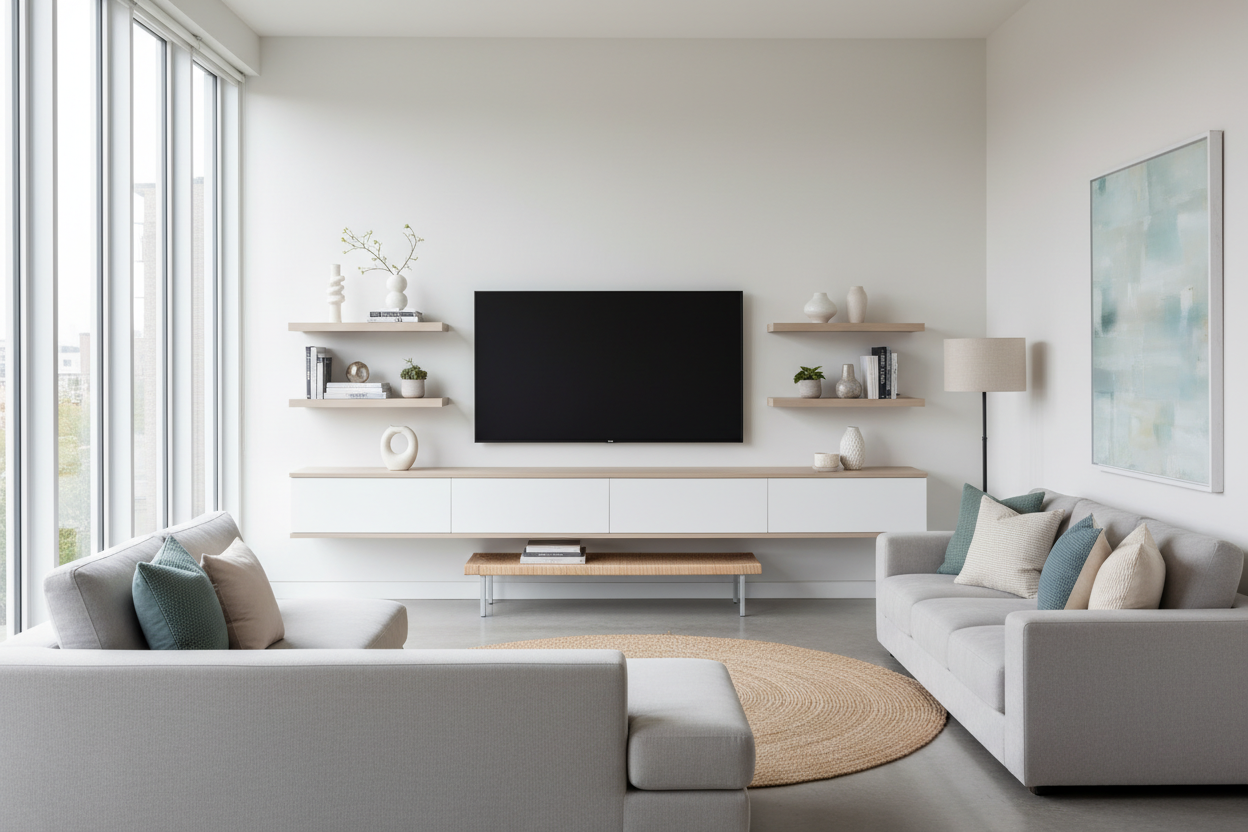
I spent three years dodging the sharp corner of a mid-century credenza that was about four inches too deep for my living room. It was a beautiful piece of solid walnut, but in a 12-by-14 space, it felt like a parked car. Every time I walked past it to get to the kitchen, I had to do a weird little side-step that eventually became muscle memory.
When I finally decided to swap that heavy block for a hanging tv stand, the entire energy of the room shifted. It wasn’t just about gaining a few inches of physical clearance. It was about the floor. For the first time since I moved in, I could see the baseboards running uninterrupted from one corner to the other. The room didn’t just feel cleaner; it felt like it had finally taken a deep breath.
Quick Takeaways
- Visual floor space is the most underrated trick for making small rooms feel expansive.
- Floating units prevent the 'cluttered floor' look that makes cleaning a nightmare.
- Structural integrity is non-negotiable; skip the cheap particleboard for solid wood or high-grade MDF.
- Cable management requires a plan—don't let a 'floating' unit be weighed down by a tail of black wires.
The Visual Floor Space Trick You Need to Know
There is a psychological phenomenon in interior design called visual weight. Your brain calculates how much space a room has based on how much of the floor is visible. When you use bulky traditional tv stands, your eye stops at the front of the cabinet. You lose those eighteen to twenty-four inches of floor depth to the furniture's footprint. The room 'ends' where the wood hits the carpet.
By switching to a wall-mounted unit, you trick your brain into perceiving the entire square footage of the room. When the floor extends all the way to the wall under the furniture, the room feels significantly larger than its actual dimensions. It creates an airy, architectural look that heavy, floor-bound furniture just can’t replicate. It’s the difference between a room that feels 'stuffed' and a room that feels 'designed.'
I’ve seen this work in tiny studio apartments and sprawling suburban basements alike. In a small space, it’s a survival tactic. In a large space, it’s a style statement. Either way, removing the 'legs' from your furniture is the fastest way to declutter the visual field without actually getting rid of your stuff.
Why I Finally Ripped Out My Floor Credenza
My old floor console was a dust magnet and a physical hazard. Living in an older building with slightly uneven floors meant the console always had a tiny, annoying wobble that I tried to fix with folded-up matchbooks. But the real breaking point was the vacuuming. Trying to get a Dyson underneath a piece of furniture with two-inch clearance is a special kind of hell that I no longer wish to participate in.
I realized that a hanging tv entertainment unit was the only way to save my traffic flow. My living room is the main artery to the rest of the apartment. By mounting the console, I cleared the 'walking zone.' I no longer have to turn my shoulders to avoid hitting the furniture. Plus, my robot vacuum can actually do its job without getting stuck in a dead-end corner. It’s a functional upgrade that solved a problem I didn’t even realize was making me irritable every single day.
Finding a Hanging TV Stand That Doesn't Look Cheap (Or Sag)
Here is the honest truth: a lot of floating furniture is junk. If you buy a $100 unit made of thin particleboard, it will sag in the middle within six months, and the mounting brackets will eventually pull away from the drywall. You are looking for a unit with a high-quality French cleat system or heavy-duty steel internal brackets. I personally vouch for the floating tv stand wall mounted media console because it uses reinforced mounting points that can actually handle the weight of a soundbar and a few heavy coffee table books.
Check the weight capacity before you buy. Most quality units are rated for 50 to 75 pounds. If the manufacturer doesn't list a weight limit, run away. Also, look at the materials. Real wood or high-density MDF with a thick veneer will hold its shape. Avoid 'hollow core' furniture that feels like it’s made of cardboard. You want something that feels substantial when you knock on it.
Installation is where most people mess up. Do not trust drywall anchors alone. You must find the studs. If your stud spacing doesn't align perfectly with the unit's pre-drilled holes, you may need to mount a backer board or use heavy-duty toggle bolts, but hitting at least two studs is the gold standard for peace of mind. I’ve seen a saggy console ruin the look of a $4,000 television—don't let that be you.
The Cord Management Reality Check
The dream of a hanging tv entertainment center is a clean, minimalist box floating on the wall. The reality is often a 'rat's nest' of HDMI cables, power strips, and router wires hanging out the bottom like an octopus. You cannot hide cords behind a floating unit the way you can with a floor console. You have to be intentional about it.
If you own your home, the best move is to install an in-wall cable routing kit. It’s a Saturday afternoon project that involves cutting two holes in the drywall and fishing wires through. If you’re a renter, paintable cable raceways are your best friend. They snap onto the wall and can be painted the exact color of your room to disappear. For more inspiration on how to execute this properly, look at some floating entertainment center ideas to see how the pros hide the 'tech spaghetti.'
Don't forget the power strip. I recommend mounting a slim power strip inside the console itself using heavy-duty Velcro. That way, you only have one main power cord coming out of the unit instead of five different plugs reaching for the outlet. It’s these small details that make the difference between a DIY project and a high-end custom look.
How to Style a Hovering Console So It Looks Intentional
Once the unit is up, the temptation is to cover the top with every remote, candle, and coaster you own. Resist that. Because the unit is floating, any clutter on top feels 'heavier' and works against the airy aesthetic you just worked so hard to create. You want to style it with an asymmetrical approach to keep it from looking too stiff.
I like to put a tall, sculptural vase on one end and a stack of two or three books on the other. A trailing plant, like a Pothos or Philodendron, is a secret weapon here—letting the vines hang off the edge of the unit helps soften the hard lines of the wall mounted tv center and draws the eye downward, emphasizing the floating effect. If you're stuck on what to put where, check out this guide on what actually belongs on an entertainment center for a breakdown of scale and balance.
One final tip: don't mount it too high. The biggest mistake people make is treating a floating console like a shelf. It should still sit at a height that feels connected to the rest of the room’s 'seated' furniture—usually about 20 to 24 inches off the floor. If you mount it at chest height, it starts to look like a kitchen cabinet that lost its way. Keep it low, keep it clean, and enjoy the fact that you can finally see your floor again.
FAQ
Can a floating TV stand hold a 75-inch TV?
Technically, the stand doesn't 'hold' the TV; your wall does. Most people mount the TV to the studs separately and use the hanging console for the media boxes and decor. Just ensure the console is wider than the TV so the proportions don't look top-heavy.
What if my walls are plaster instead of drywall?
Plaster is trickier because it can crumble. You'll need to use specialized masonry bits and likely a combination of studs and heavy-duty toggle bolts. If you aren't confident, this is the one time I'd suggest hiring a pro for an hour of labor.
Do I need to move my electrical outlets?
Not necessarily. Most floating consoles have an open back or pre-drilled 'portals' for wires. If your outlet is directly behind where the unit will sit, you're in luck—everything can stay hidden inside the cabinet.

Dejar un comentario
Este sitio está protegido por hCaptcha y se aplican la Política de privacidad de hCaptcha y los Términos del servicio.