










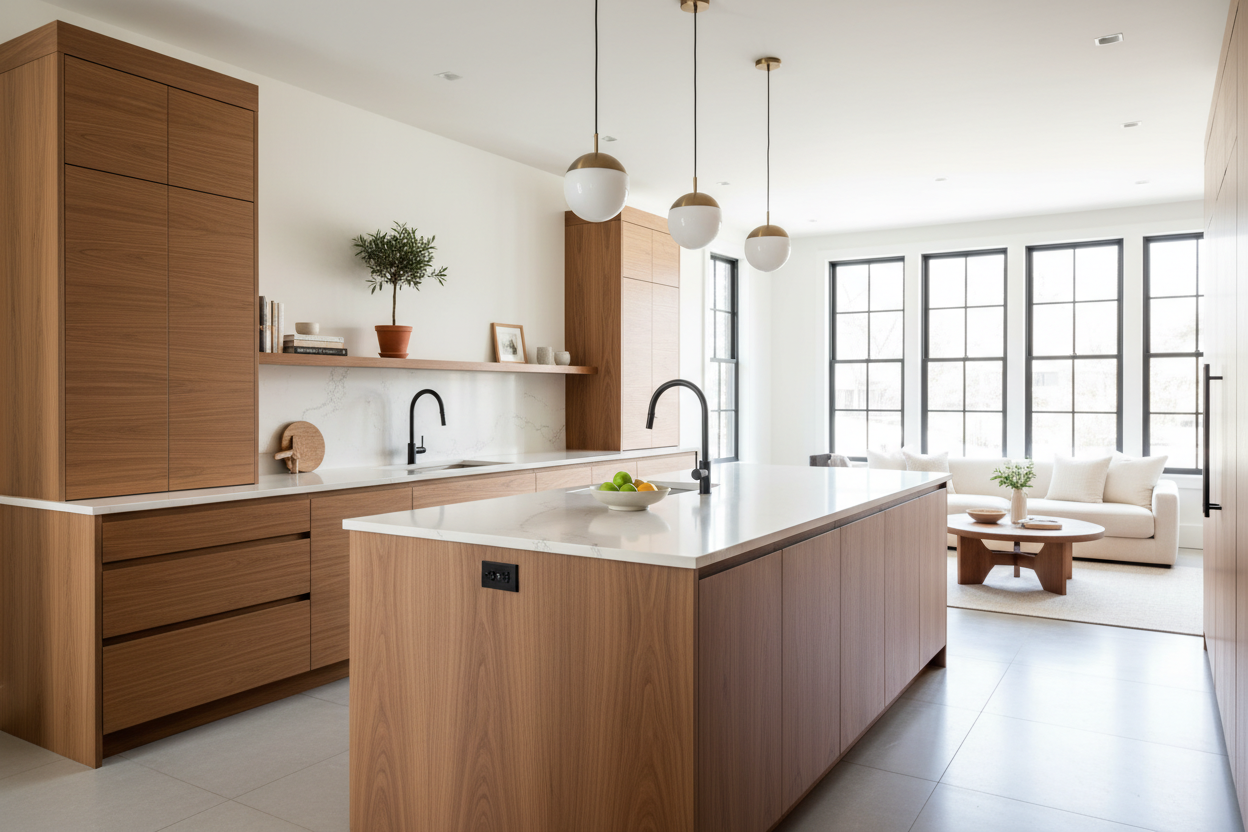
I once spent three months waiting for a 'bespoke' walnut credenza that arrived with a visible 1/8-inch gap in the miter joint. The maker tried to tell me it added 'character' and proved it was authentic. I call BS. Character is a knot in the wood or a unique grain pattern; a gap in a joint is just bad math. When you invest in hand made cabinets, you aren't paying for rustic wonkiness—you are paying for the kind of obsessive precision a robot in a factory simply cannot achieve.
- Precision is the point: If you can see the 'hand' in the work through errors, it is a hobby project, not a professional build.
- Grain matching: True artisans align the wood grain across multiple drawer fronts for a seamless look.
- Humidity awareness: Humans adjust for wood movement; machines just cut the line they are told to cut.
- Strategic spending: You do not need custom work in every corner of your house.
The 'Rustic' Myth (And Why We Need to Let It Go)
There is this persistent idea, fueled by the early days of Etsy, that 'hand made' should look a little rough around the edges. We have been conditioned to think that visible tool marks or slightly uneven doors are the hallmarks of quality. That is a lie. In the world of high-end woodworking, the goal is actually the opposite.
True craftsmanship is invisible. When I look at hand built kitchen cabinets, I do not want to see where the chisel slipped. I want to see joints so tight they look like the wood grew that way. If a cabinet maker tells you a door doesn't sit flush because it is 'artisanal,' they are just hoping you do not know any better. Real skill shows up in the silence of a drawer slide and the perfection of a 90-degree angle.
What Flawless Hand Built Kitchen Cabinets Actually Give You
The biggest giveaway of a master cabinet maker is grain matching. In a factory, they grab whatever slab is next on the pile. In a custom shop, a builder will spend hours 'bookmatching' or sequencing the wood. This means the grain flows across your entire bank of drawers like a single piece of art. It is especially striking on tall, vertical pieces like freestanding pantry cabinets, where the wood grain can travel five or six feet without a jarring break.
Then there is the box construction. Most big-box cabinets are held together by staples and hot glue. A hand-built box uses dovetails or mortise-and-tenon joints. These are not just for show; they are engineered to handle the weight of heavy stoneware and the constant slamming of a busy kitchen for thirty years. I have seen 2.0 lb/ft³ density plywood boxes outlast entire houses, while the cheap 1.5 stuff sags within five years.
The Factory Tolerance Gap (Why Machines Miss the Mark)
Factories run on 'tolerances.' If a machine is off by half a millimeter, the factory line keeps moving because stopping it costs thousands. But wood is a living material. It breathes, expands, and contracts based on the weather. A machine doesn't know that it is a humid Tuesday in July and the white oak is slightly swollen.
A human woodworker does. They adjust their cuts to account for the environment. They 'read' the grain to ensure a board won't warp six months after installation. That human touch isn't about making it look 'crafty'—it is about using a brain to ensure the engineering stays perfect long after the installers leave.
You Don't Need Artisan Work in Every Room
I am a recovering perfectionist, but I am also a realist. You do not need a master woodworker to build your laundry room storage. I always tell my clients to put the money where they touch the wood every single day. Spend the big bucks on the kitchen island and the primary bathroom vanity. For the rest? Mix and match.
I have seen stunning homes where the owner used high-end hand built kitchen cabinets for the main run but filled in the gaps with kitchen accent cabinets that they bought ready-made. It creates a 'collected' look that feels less like a showroom and more like a home. Similarly, do not waste a custom budget on a mudroom. You can get perfectly functional slim shoe cabinets for a fraction of the price and save that $5,000 for the rift-sawn oak you really want in the kitchen.
Three Questions to Ask Before Hiring a Local Woodworker
Before you hand over a deposit, you need to vet their technical standards. First, ask: 'How do you account for wood movement in your door panels?' If they don't mention floating panels or seasonal expansion, walk away. Second, ask to see a photo of their grain matching on a large-scale project. If the drawers look like a random jigsaw puzzle, they are cutting corners.
Third, ask about their finishing process. A great cabinet can be ruined by a bad spray job. You want to hear about conversion varnishes or high-quality oils, not just 'some hardware store paint.' You are looking for a technician who happens to work with wood, not a hobbyist with a circular saw.
My Biggest Custom Cabinet Mistake
Years ago, I commissioned a custom vanity for a bathroom remodel. I was so focused on the 'look' of the reclaimed wood that I didn't check the internal clearances for the plumbing stack. The woodworker built beautiful, deep drawers that hit the pipes the second we tried to slide them in. We had to hack apart his masterwork just to make it functional. The lesson? A pretty cabinet that doesn't work is just an expensive box. Always give your maker the exact specs of your appliances and plumbing before they even buy the wood.
Is grain matching really worth the extra cost?
Yes, if you are using a wood with a prominent pattern like walnut or oak. It is the difference between a kitchen that looks 'custom' and one that looks truly high-end. If you are painting the cabinets, however, grain matching is a waste of money.
How long should hand made cabinets actually last?
If they are built with solid hardwood frames and high-grade plywood boxes, they should easily last 30 to 50 years. The hardware (hinges and slides) might need a swap after 20, but the 'bones' should be a lifetime investment.
Why are custom cabinets so much more expensive than IKEA?
You aren't just paying for wood. You are paying for the 40+ hours of labor, the specialized machinery, and the fact that every single piece is cut to fit your specific (and likely crooked) walls. IKEA is great for a budget, but it is built to a standard size; custom is built to your home's unique reality.


Dejar un comentario
Este sitio está protegido por hCaptcha y se aplican la Política de privacidad de hCaptcha y los Términos del servicio.