










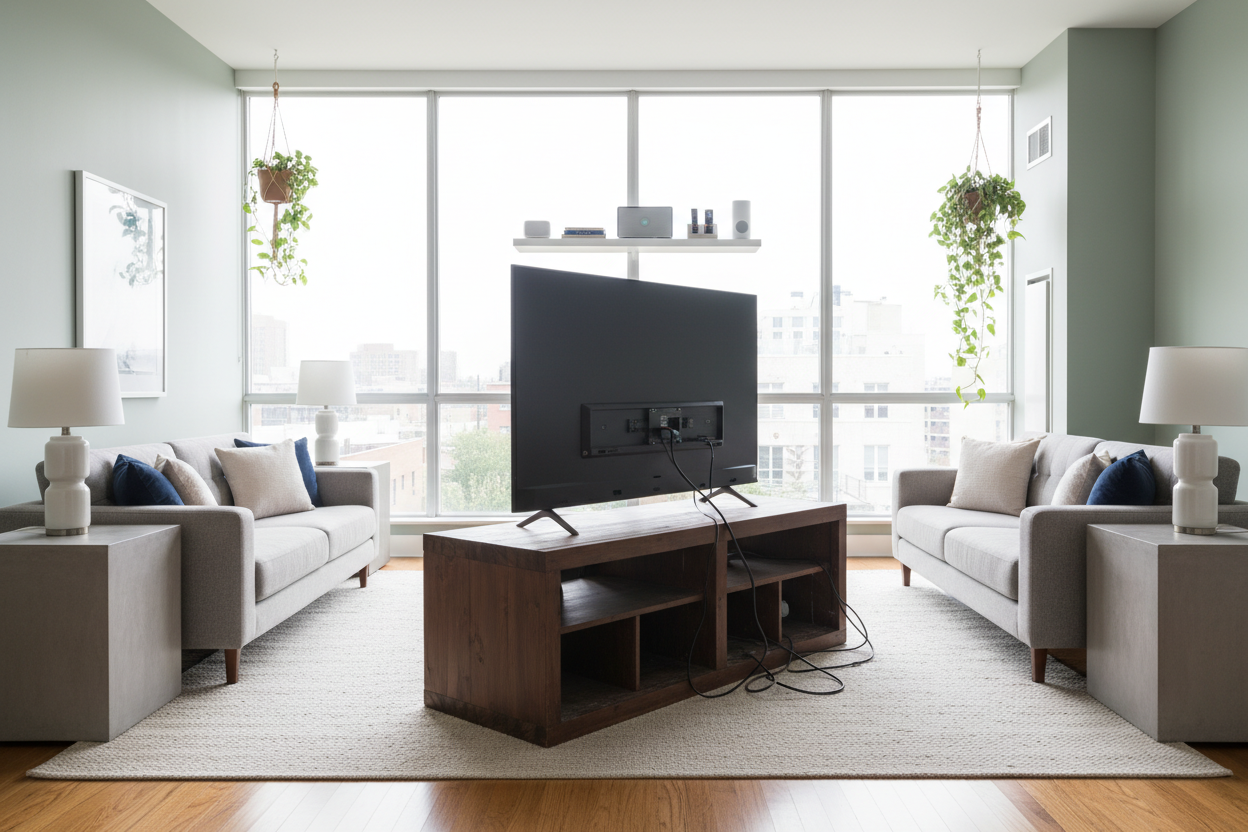
I spent three weeks obsessing over refresh rates and nit brightness before finally pulling the trigger on a new 65-inch OLED. It is a marvel of engineering—thinner than a stack of three credit cards. But when I finally got it home and set it down, I realized I’d made a classic rookie mistake. I was trying to balance this futuristic sliver of glass on a chunky, espresso-stained beast of a console I’ve hauled around since my first apartment. It looked like a high-tech wafer sitting on a Hippo.
Finding a stand for smart tv setups shouldn't be an afterthought, yet we treat it like one. We spend thousands on the glass and then pennies on the thing holding it up. If your living room feels 'off' after a tech upgrade, it’s probably because your furniture is still living in 2012 while your screen is living in 2024. Let’s fix the proportions before your guests start asking why your TV looks like it’s being swallowed by a Victorian sideboard.
- Depth is the Enemy: Modern screens are thin; your furniture should be too.
- Cable Chaos: Smart TVs have fewer wires, but they still need smart routing.
- Stability Over Style: Never trust the 'chicken feet' legs that come in the box.
- Material Matters: Aim for solid wood or high-grade MDF over cheap, hollow particle board.
The Clashing Eras of Living Room Tech
There is a specific kind of visual sadness that comes from seeing a paper-thin, bezel-less monitor perched atop one of those deep, cavernous lcd tv stands designed for the heavy, boxy units of yesteryear. Back then, we needed depth. We had DVD players, VCRs, and receivers that were 18 inches deep. Today? You probably have a slim soundbar and maybe a gaming console. That’s it.
When you put a modern screen on a deep console, you end up with a massive 'dead zone' of dust-collecting wood in front of the screen. It breaks the immersion. A proper screen tv stand should feel like an extension of the tech—minimalist, sleek, and purposeful. If your stand sticks out more than 16 inches from the wall, you’re likely wasting floor space and ruining the silhouette of your room.
Why Depth Matters More Than Width Now
I learned this the hard way when I tried to cram a 22-inch deep 'media center' into my 12x14 living room. It felt like a boulder was blocking the flow of traffic. Since modern TVs are essentially flat, the footprint of your furniture can—and should—shrink. A shallower profile makes the whole room feel larger and less cluttered.
If you have a weirdly shaped room or a corner setup, look for an adjustable TV stand for living room. These pieces allow you to customize the width to match your screen exactly, ensuring you don't have a foot of empty shelf hanging off the sides. It’s about creating a unified horizontal line that doesn't overwhelm the space. I’ve found that a depth of 14 to 15 inches is the sweet spot for most modern setups.
My 'Aha' Moment with Modern Cable Management
Even though our TVs are 'smarter,' they aren't wireless. You still have power cables, HDMI leads for the PS5, and that chunky power brick for the soundbar. My 'aha' moment came when I realized that a tv accessory stand isn't just a shelf—it’s a camouflage system. I once bought a cheap open-frame stand and spent three hours trying to zip-tie cables to the legs. It looked like a robot was exploding behind my TV.
I eventually swapped it for something with integrated routing. I actually found that a dark walnut TV stand fixed my 'black hole' screen problem by providing enough visual warmth to balance out the giant black rectangle of the TV when it's off. The dark wood also does a fantastic job of hiding those pesky black cables that always seem to peek through. If your stand doesn't have a dedicated hole for cords, it’s not a media stand; it’s just a bench.
The Danger of the Flimsy Factory Legs
Let’s talk about the 'chicken feet.' You know, those two flimsy plastic V-shaped legs that come in the box? They are the bane of my existence. They require a massive surface area, meaning you need a wider stand just to keep the TV from overhanging. Worse, they offer zero stability. I once saw a cat knock over a 55-inch screen because it was balanced on a single stand tv base that had the structural integrity of a toothpick.
If you have kids, pets, or just a sense of self-preservation, get a real piece of furniture. A modern TV stand with cabinets and drawers provides a heavy, grounded base that anchors the screen. It lowers the center of gravity and gives you a place to tuck away the controllers and remotes that usually end up lost in the sofa cushions. Plus, a solid piece of furniture won't wobble every time someone walks heavily past it.
Finding a Base That Actually Matches Your Decor
Shopping for television display stands shouldn't feel like you're browsing a Best Buy clearance aisle. Your furniture should reflect your personal style, not just your tech specs. Whether you’re looking for a specific stand para tv for a bilingual household or a mid-century modern tv screen stands for a retro vibe, the goal is intentionality.
Don't be afraid to mix textures. A metal frame with wooden slats can bridge the gap between your cold, glass tech and your warm, cozy rugs. I always tell people to browse various TV stands with a tape measure in hand. Measure your TV's actual width (not the diagonal screen size!) and make sure the stand is at least 2-4 inches wider on each side. This 'breathing room' prevents the setup from looking cramped. A well-chosen base makes the TV look like a piece of art rather than a temporary installation.
FAQ
How high should my TV stand be?
The middle of your screen should be at eye level when you’re seated. For most sofas, that means a stand height of 18 to 22 inches. If you’re straining your neck, it’s too high.
Can I put a 75-inch TV on a 60-inch stand?
Technically, if the legs fit, you can, but it will look terrible. The 'overhang' makes the room feel top-heavy and unstable. Always aim for a stand wider than the TV.
What material is best for a TV stand?
Solid wood is the gold standard for longevity, but high-quality MDF with a real wood veneer is great for budget-conscious buyers. Avoid thin, hollow-core boards that bow under the weight of the screen over time.


Dejar un comentario
Este sitio está protegido por hCaptcha y se aplican la Política de privacidad de hCaptcha y los Términos del servicio.